
## The Problem
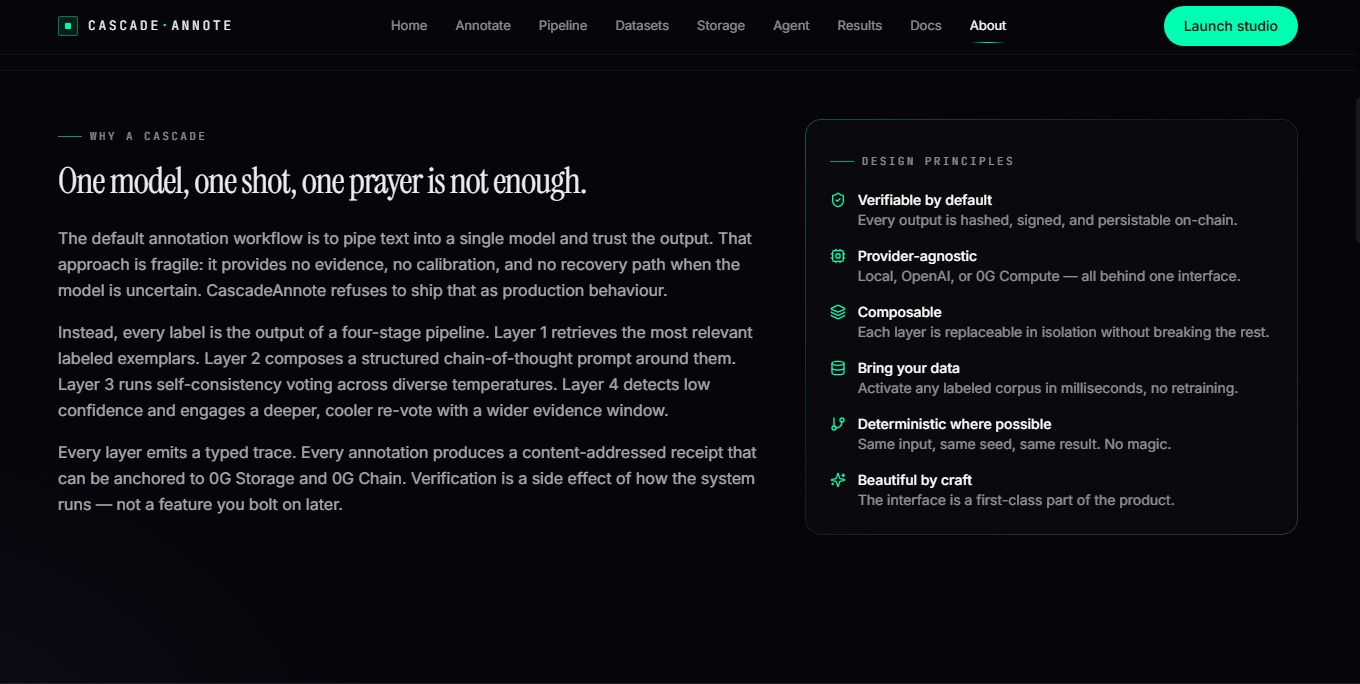
Standard AI annotation pipelines pipe text into a single model and
trust the output blindly. This approach is fragile — it provides no
evidence, no calibration, and no recovery path when the model is
uncertain. Labels produced this way are unverifiable and untraceable.
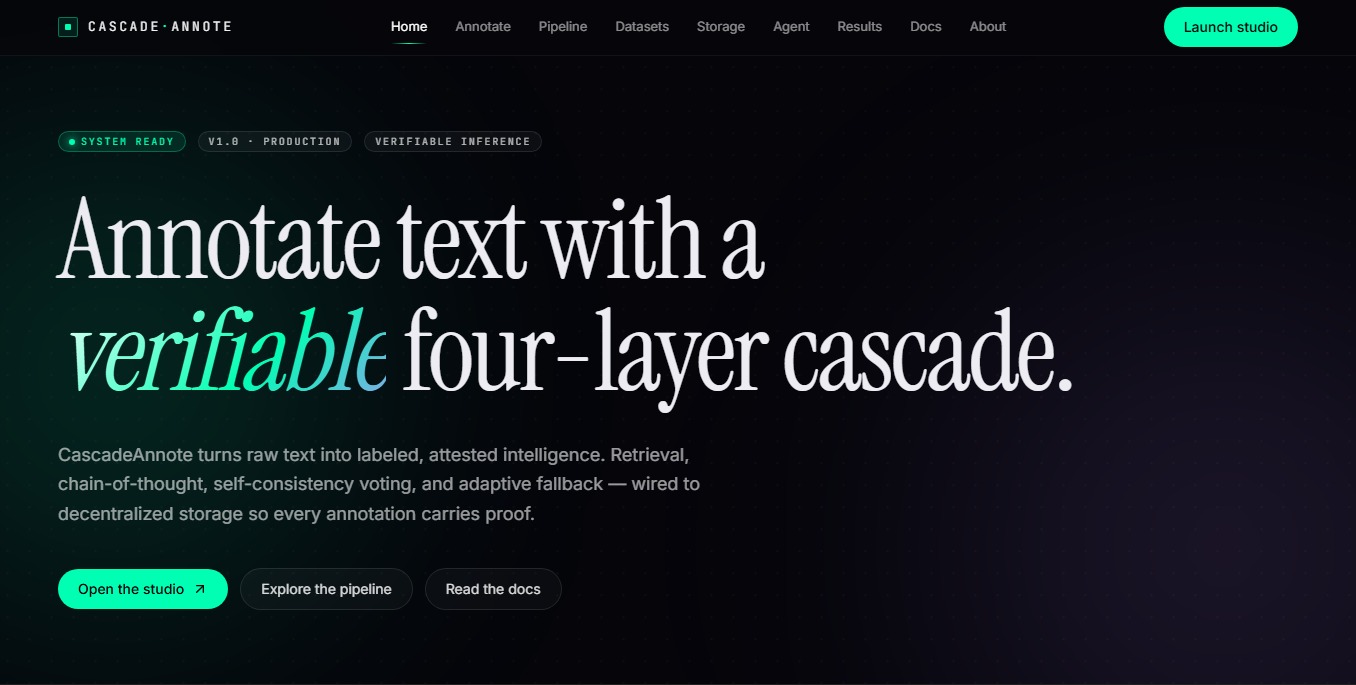
## The Solution — CascadeAnnote
CascadeAnnote treats every label as a falsifiable claim backed by
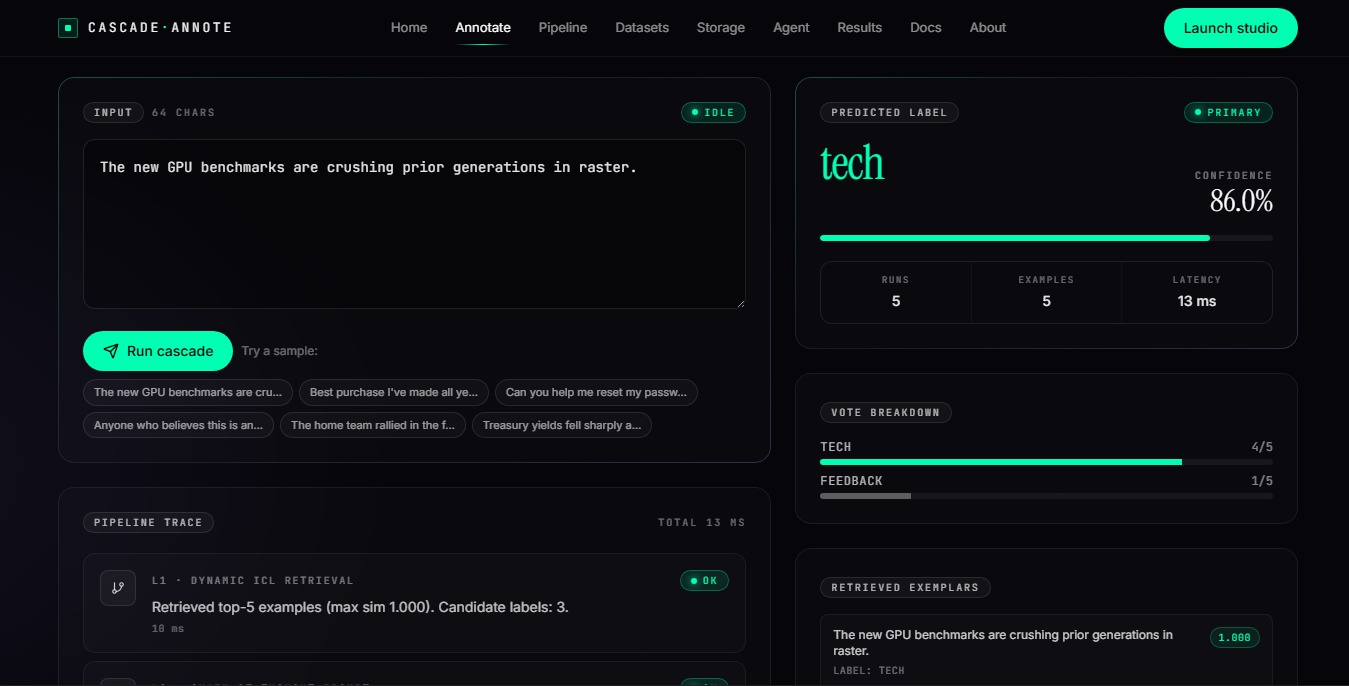
evidence. It runs every annotation through a 4-layer cascade:
L1 — Dynamic ICL Retrieval
TF-IDF + cosine similarity retrieves the most relevant labeled
exemplars from the corpus in real time.
L2 — Chain-of-Thought Reasoning
A structured 5-step CoT prompt builds an evidence-backed reasoning
trace before committing to a label.
L3 — Self-Consistency Vote
5 independent inference runs at varied temperatures produce a
majority-voted label with a calibrated confidence score.
L4 — Adaptive Fallback
If confidence falls below threshold, the system automatically widens
the evidence window and re-votes at cooler temperatures.
## 0G Infrastructure Integration
CascadeAnnote is natively built on 0G's modular stack:
- 0G Storage — every annotation is SHA-256 hashed and uploaded
to the 0G indexer, producing a verifiable rootHash + txHash receipt
- 0G Compute — Layer 3 inference can be routed through 0G Compute
for fully on-network verifiable inference
- 0G Chain — a stable did:0g agent identity is derived per
deployment; receipts are anchored under this DID
## Tech Stack
- Next.js 15 + TypeScript + Tailwind CSS
- Pure TypeScript engine — no GPU, no heavy ML dependencies
- Provider-agnostic: Local / OpenAI / 0G Compute
- Single Vercel deployment — fully serverless
## Links
- Live Demo: https://cascade-annote.vercel.app
## What We Built During the Hackathon
Week 1 — Architecture & Core Engine
Designed the 4-layer cascade pipeline architecture. Implemented L1
retrieval engine using TF-IDF with unigram + bigram indexing and
cosine similarity scoring. Built the seed corpus with 60 labeled
examples across 4 label families (sentiment, topic, intent, toxicity).
Week 2 — Inference & Voting
Built the chain-of-thought prompt builder (L2) with a 7-strategy
label extractor. Implemented the self-consistency voter (L3) with 5
inference runs at temperatures [0.3, 0.7]. Integrated local ICL
classifier, OpenAI, and 0G Compute as provider-agnostic backends.
Week 3 — 0G Integration & Verifiability
Integrated 0G Storage adapter — every annotation is SHA-256 hashed
and uploaded with a verifiable rootHash + txHash receipt. Implemented
0G Chain agent identity (did:0g DID) and 0G Compute inference routing.
Built the adaptive fallback layer (L4) with confidence thresholding.
Week 4 — Frontend & Deployment
Built 9 frontend pages (annotate studio, pipeline explorer, dataset
uploader, storage receipt explorer, agent identity, results dashboard).
Deployed as a single Next.js 15 serverless app on Vercel.
## Current Status
✅ Fully deployed and live at https://cascade-annote.vercel.app
✅ All 4 pipeline layers operational
✅ 0G Storage receipts working
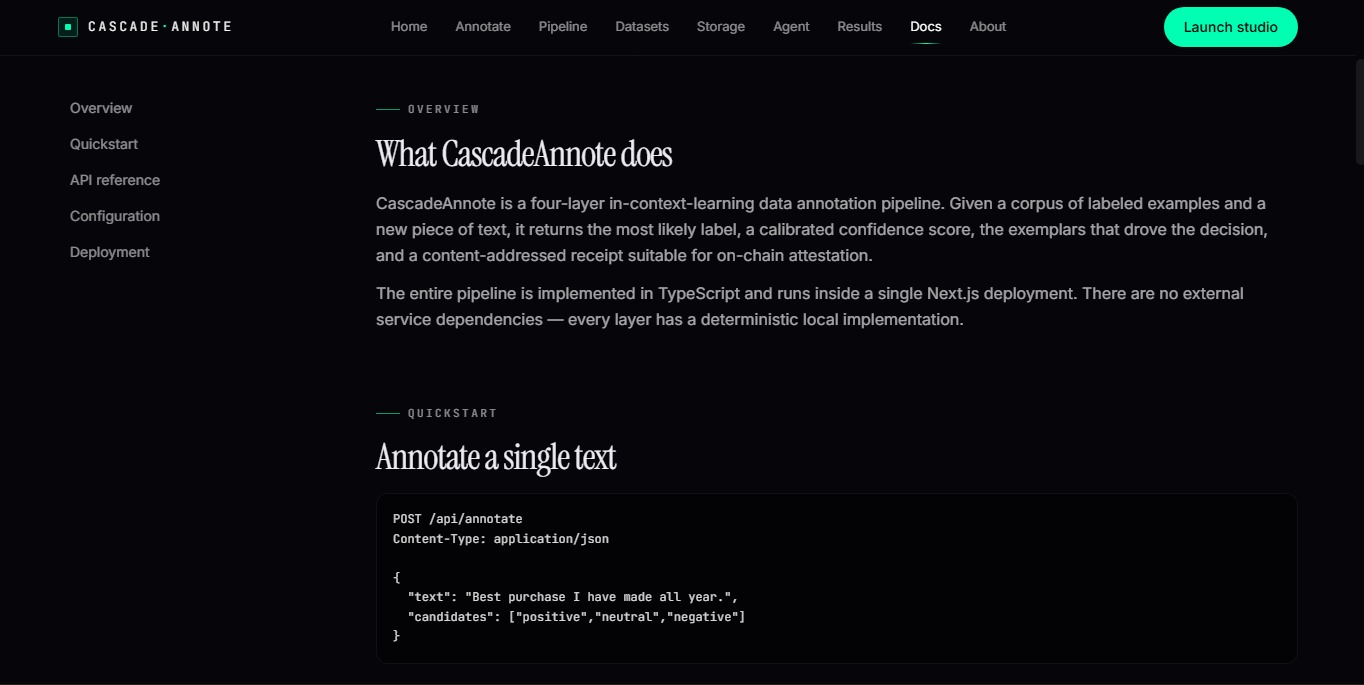
✅ Batch annotation API (up to 50 texts per call)
✅ CSV corpus upload and activation
Not yet fundraised. CascadeAnnote is currently bootstrapped and
self-funded as an independent open-source project. We are open to
grants, ecosystem funding, and strategic partnerships — particularly
within the 0G ecosystem — to accelerate development of the active
learning loop, multi-agent voting, and sealed inference features on
the roadmap.