
iWallet
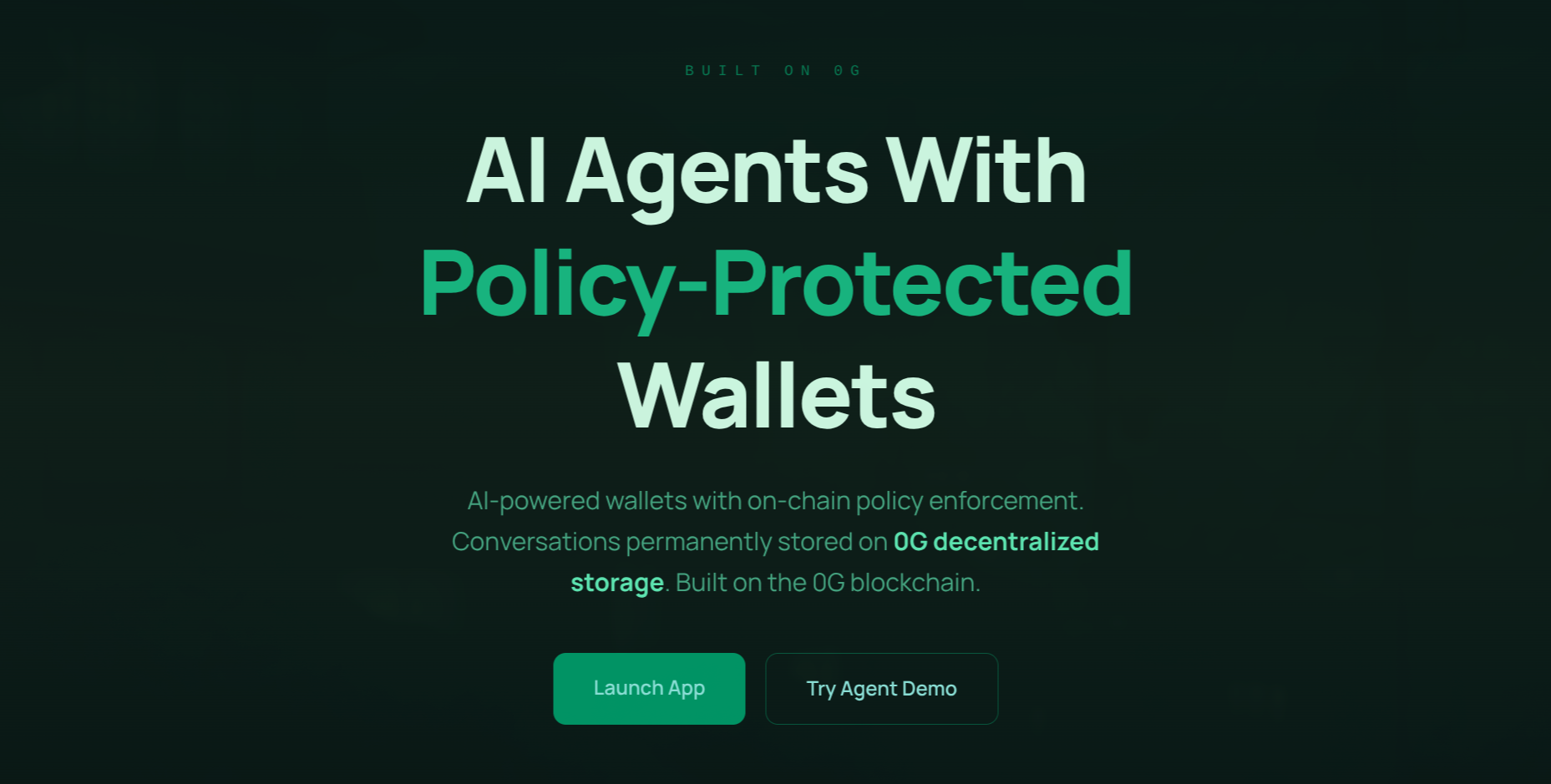
AI-Native Smart Wallet with On-Chain Policy Rules — built on the 0G Blockchain.
Video

Công nghệ sử dụng
Sự miêu tả
iWallet
AI-Native Smart Wallet with On-Chain Policy Rules — built on the 0G Blockchain.
iWallet creates deterministic sub-wallets derived from your master wallet, each controlled by an AI agent. On-chain policy rules (daily spend limits, contract whitelists, cooldowns) act as guardrails — even a misbehaving agent cannot exceed its boundaries. Agent conversations are permanently stored on 0G decentralized storage.
Live Demo
Frontend: [https://wallet.goon4.site](https://wallet.goon4.site)
Backend/MCP: [https://be-wallet.goon4.site](https://be-wallet.goon4.site)
Contract (Mainnet): [0x08a7Ea416AF2b8DD4614aa6A314ee7c96F8aA68d](https://chainscan.0g.ai/address/0x08a7Ea416AF2b8DD4614aa6A314ee7c96F8aA68d)
Contract (Testnet): [0xCF1f2860BA28aD3c7BCfCc29ab34c2f70D64F4ca](https://chainscan-galileo.0g.ai/address/0xCF1f2860BA28aD3c7BCfCc29ab34c2f70D64F4ca)
Key Features
On-Chain Policy Enforcement — daily limits, allowed contracts, cooldowns enforced by smart contracts
0G Storage Integration — agent conversations permanently archived on decentralized storage
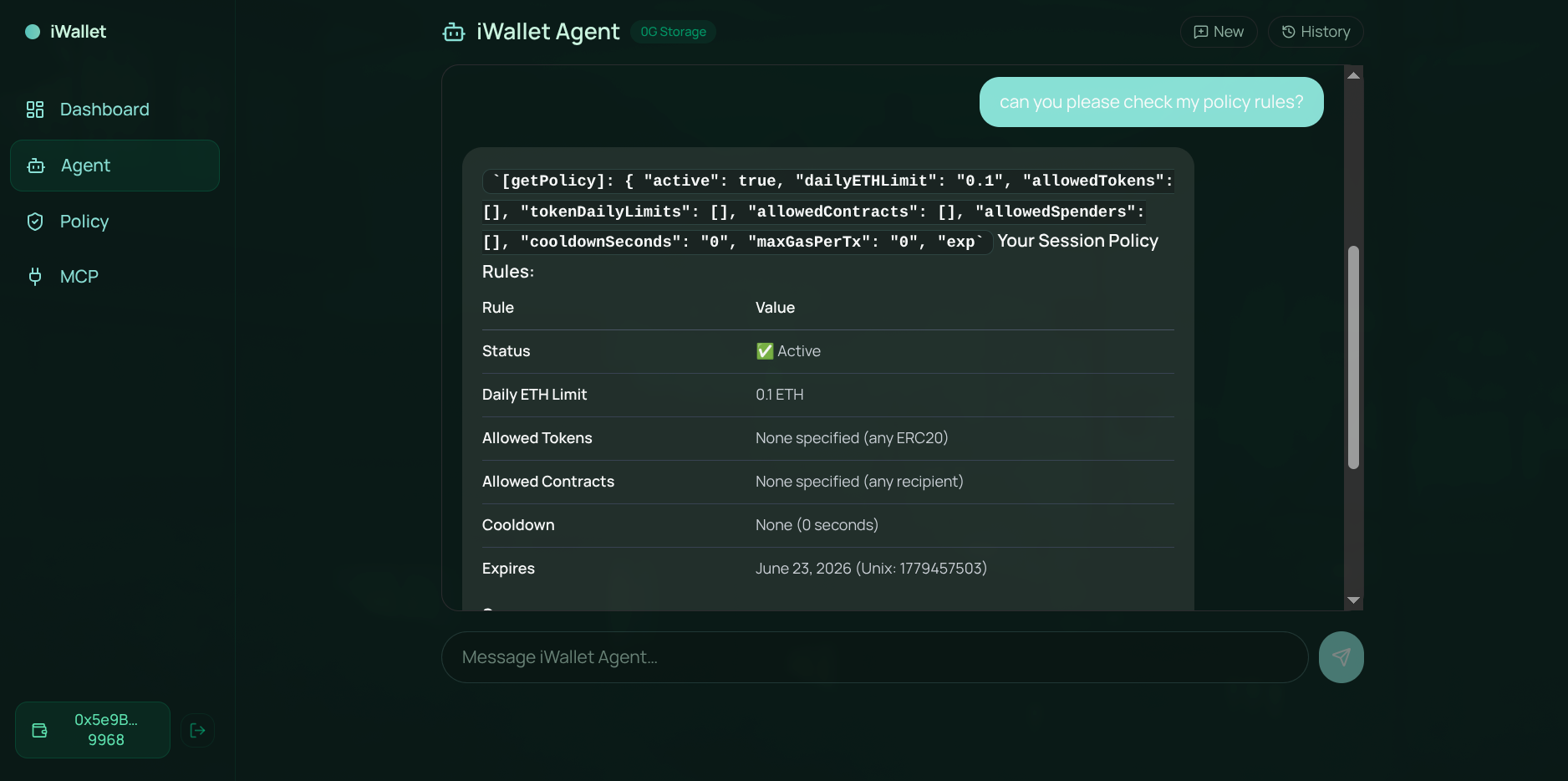
AI Agent with Tool Calling — check balances, send ETH, read policy via LLM
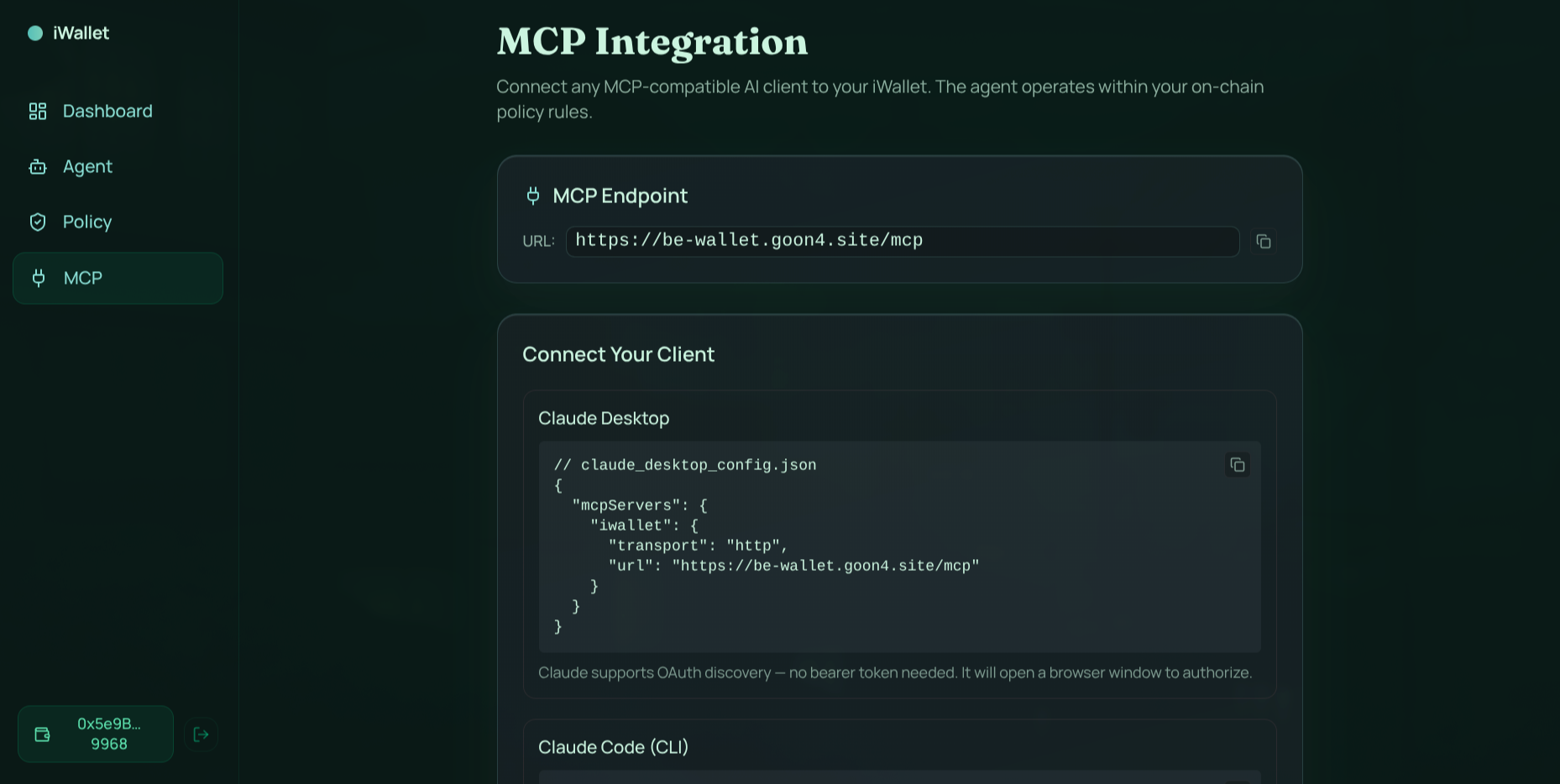
MCP Protocol — any MCP-compatible client (Claude, Cursor, VS Code) can control the wallet
Deterministic Sub-Wallets — derived from master wallet signature, no new seed phrases
The Problem
AI agents that control crypto wallets are powerful — but dangerous. Most existing setups give the agent a full private key with no restrictions. If the agent is compromised by prompt injection, hallucination, or a malicious plugin, there is nothing stopping it from draining all funds.
Off-chain guardrails (server-side rate limiters, software checks) are not enough. They can be bypassed. A compromised backend or a single prompt injection attack is all it takes.
Real incidents:
Freysa AI (Nov 2024) — agent tricked into releasing $47K via prompt injection disguised as an admin override
Grok + Bankrbot (May 2025) — Morse code tweet bypassed text filters, drained $200K
ElizaOS (2025) — Princeton researchers demonstrated memory poisoning attacks exposing $140M+ in TVL
The Solution
iWallet introduces session keys — derived sub-wallets that the AI agent uses to sign transactions. Each session key is bound to an on-chain policy set by the master wallet owner:
Daily ETH spend limit — agent cannot send more than X ETH per day, no matter what
Contract whitelist — if set, agent can only interact with approved addresses
Cooldown period — minimum seconds between transactions
Session expiry — session key automatically becomes invalid after a set time
Token allowances — per-ERC20 daily transfer limits
These rules live inside the iWallet smart contract on 0G Chain. Every execute() call checks all policy constraints atomically before forwarding. Violations revert on-chain. The AI agent has no way around it.
Key Features
On-Chain Policy Enforcement — daily limits, allowed contracts, cooldowns enforced by smart contracts
0G Storage Integration — agent conversations permanently archived on decentralized storage
AI Agent with Tool Calling — check balances, send ETH, read policy via LLM
MCP Protocol — any MCP-compatible client (Claude, Cursor, VS Code) can control the wallet
Deterministic Sub-Wallets — derived from master wallet signature, no new seed phrases
0G Component Usage
0G Chain
Smart contracts deployed on 0G Mainnet and Testnet enforce policy rules on every agent transaction. The iWalletFactory deploys per-user wallets using the Beacon Proxy pattern, allowing protocol-wide upgrades in a single transaction.
Problem solved: Cryptographically guaranteed spending limits — no backend, no server, no trust required.
0G Storage (Log Layer)
After each agent session, the full conversation history is uploaded to 0G Storage via @0gfoundation/0g-ts-sdk. On the next session, the backend fetches the history and injects it into the agent's system prompt as persistent memory.
Problem solved: AI agents are stateless by default. 0G Storage gives them permanent, decentralized memory across sessions without any centralized database.
How It Works
1. Connect — User connects their master EOA wallet
2. Deploy — iWalletFactory creates a deterministic iWallet contract for the user on 0G Chain
3. Set Policy — User configures rules (daily limit, whitelist, cooldown, expiry) stored on-chain
4. Fund — Send 0G to the iWallet address + session key for gas
5. Chat — AI agent uses session key to sign transactions; contract enforces policy on every call
6. Memory — Conversation archived to 0G Storage; next session loads history automatically
Tech Stack
Contracts: Solidity 0.8.28, Hardhat v3, OpenZeppelin (UUPS + Beacon upgradeable)
Backend: Bun, Elysia.js, OpenAI-compatible LLM (MiniMax M2), viem,
@0gfoundation/0g-ts-sdk
Frontend: React 19, TanStack Start, Tailwind v4, wagmi v3, Reown AppKit, Three.js
Protocol: MCP (Model Context Protocol) for AI agent interoperability
Storage: 0G Storage Log layer for immutable conversation archival
Tiến độ hackathon
iWallet — Hackathon Progress
Day 1 — Apr 20: Project Kickoff
Initialized the monorepo (Bun workspace, packages structure)
Set up initial documentation and project setup guide
Day 2 — Apr 21: Smart Contract Foundation
Wrote
iWallet.sol— the core agent-bounded smart wallet with per-session policy enforcement (daily ETH limits, contract whitelists, cooldowns, expiry)Wrote
iWalletFactory.sol— factory contract for deploying per-user walletsSet up Hardhat v3 with OpenZeppelin upgradeable contracts
Configured shared
packages/chainsandpackages/tokens
Day 3 — Apr 27–28: Frontend & 3D Landing Page
Built the interactive 3D landing page using React Three Fiber (R3F) with a robot model
Implemented scroll-driven animation stages with GSAP — atmosphere lighting, narrative text overlays, scene transitions
Optimized 3D model with PBR textures and GLB processing script
Added responsive mobile layout and camera adjustments
Deployed CI/CD pipeline via GitHub Actions to
wallet.goon4.siteSet up
be-wallet.goon4.sitesubdomain for backend
Day 4 — Apr 29: Landing Page Polish & Merge
Merged
landing-pagebranch — copywriting, color refinements, footer polishFixed peer dependency issues in lockfile
Day 5 — May 4: MCP Protocol Integration
Refactored backend from private-key-based to MCP (Model Context Protocol) based architecture
Any MCP-compatible client (Claude Desktop, Cursor, VS Code) can now control the wallet
Fixed CI:
bun xcompatibility, lockfile drift handling, SSR bundle assertions
Day 6 — May 9: Mainnet Deployment & Dashboard
Deployed upgradeable iWallet stack to 0G Aristotle Mainnet
0x08a7Ea416AF2b8DD4614aa6A314ee7c96F8aA68d)Upgraded contracts to Beacon + UUPS proxy pattern — factory owner can upgrade all wallets in one tx
Fixed bug: session counters now clear correctly on
addSessionafter revokeAdded multichain support — backend routes by session
chainId, no more localhost switchAuto-verifies newly deployed iWallets on
factory.DeployedeventBuilt full dashboard UI: wallet balance grid, Withdraw All, session cap progress bars, status pills, reissue-bearer dialog
Day 7 — May 15: AI Agent + 0G Storage Integration
Integrated 0G Storage for persistent agent memory — conversations are archived to the 0G Log layer and loaded back as context on new sessions
Built the AI agent chat UI with streaming SSE responses — users see tool calls (balance check, send ETH) in real time
Implemented agent tools:
get_balance,send_eth,get_policy,get_session_infoAdded landing page, sidebar layout, and
/agentchat pageRefactored routing:
/connect→/policy, added dedicated/mcppage with connection instructionsFixed 0G Storage to save full conversation history and inject it into the system prompt as persistent memory
Added robust health check retry logic in deploy script
Updated all READMEs and added
.env.examplefiles for both packages