Bumblebee_3
2
Bài viết
3332
Xem
1
Người theo dõi
Arbitrum Deep Dive: The Layer 2 That's Quietly Eating Ethereum's Gas Fees

If you've ever sent a transaction on Ethereum mainnet and watched $40 disappear in gas fees for a simple token swap, you already understand why Layer 2 solutions exist.
Arbitrum is the answer to that problem — and right now, it's the biggest, most battle-tested answer the Ethereum ecosystem has.
With over $15B+ in Total Value Locked (TVL), hundreds of protocols deployed, and a thriving developer ecosystem, Arbitrum isn't just a scaling solution anymore. It's an ecosystem in its own right — one that every serious Web3 developer needs to understand deeply.
In this blog, we'll go from zero to expert. We'll cover how Arbitrum works under the hood, what makes it different from other L2s, how to deploy on it, and what the future of the Arbitrum ecosystem looks like.
Why Ethereum Alone Isn't Enough: The Problem Arbitrum Solves
Ethereum is the world's programmable blockchain. It's decentralized, battle-tested, and home to the largest developer community in crypto. But it has one critical limitation: throughput.
Ethereum mainnet handles roughly 15–30 transactions per second (TPS). During peak demand — NFT drops, DeFi yield farming frenzies, token launches — gas fees spike to absurd levels. We're talking $200+ for a single swap during the 2021 bull run.
The root cause is Ethereum's security model: every validator must re-execute every transaction to verify it. This ensures trustlessness but kills scalability.
The blockchain trilemma says you can only have two of three: Decentralization, Security, Scalability. Ethereum chose the first two. Layer 2s like Arbitrum exist to add the third — without giving up the first two.
The Layer 2 Landscape
Before we zoom into Arbitrum, here's the L2 landscape at a glance:
Solution | Approach | EVM Compatible | Security Source |
|---|---|---|---|
Arbitrum One | Optimistic Rollup | ✅ Full | Ethereum L1 |
Optimism | Optimistic Rollup | ✅ Full | Ethereum L1 |
zkSync Era | ZK Rollup | ✅ (zkEVM) | Ethereum L1 |
Starknet | ZK Rollup | ❌ (Cairo VM) | Ethereum L1 |
Polygon PoS | Sidechain | ✅ Full | Own validators |
Base | Optimistic Rollup (OP Stack) | ✅ Full | Ethereum L1 |
Arbitrum and Optimism pioneered the Optimistic Rollup category. Today, Arbitrum holds the dominant position with the highest TVL of any L2 by a significant margin.
How Arbitrum Actually Works
Optimistic Rollups: The Core Idea
The name "optimistic rollup" tells you everything about the philosophy:
Be optimistic. Assume all transactions are valid by default. Only run computation when someone challenges a transaction.
Here's the flow:
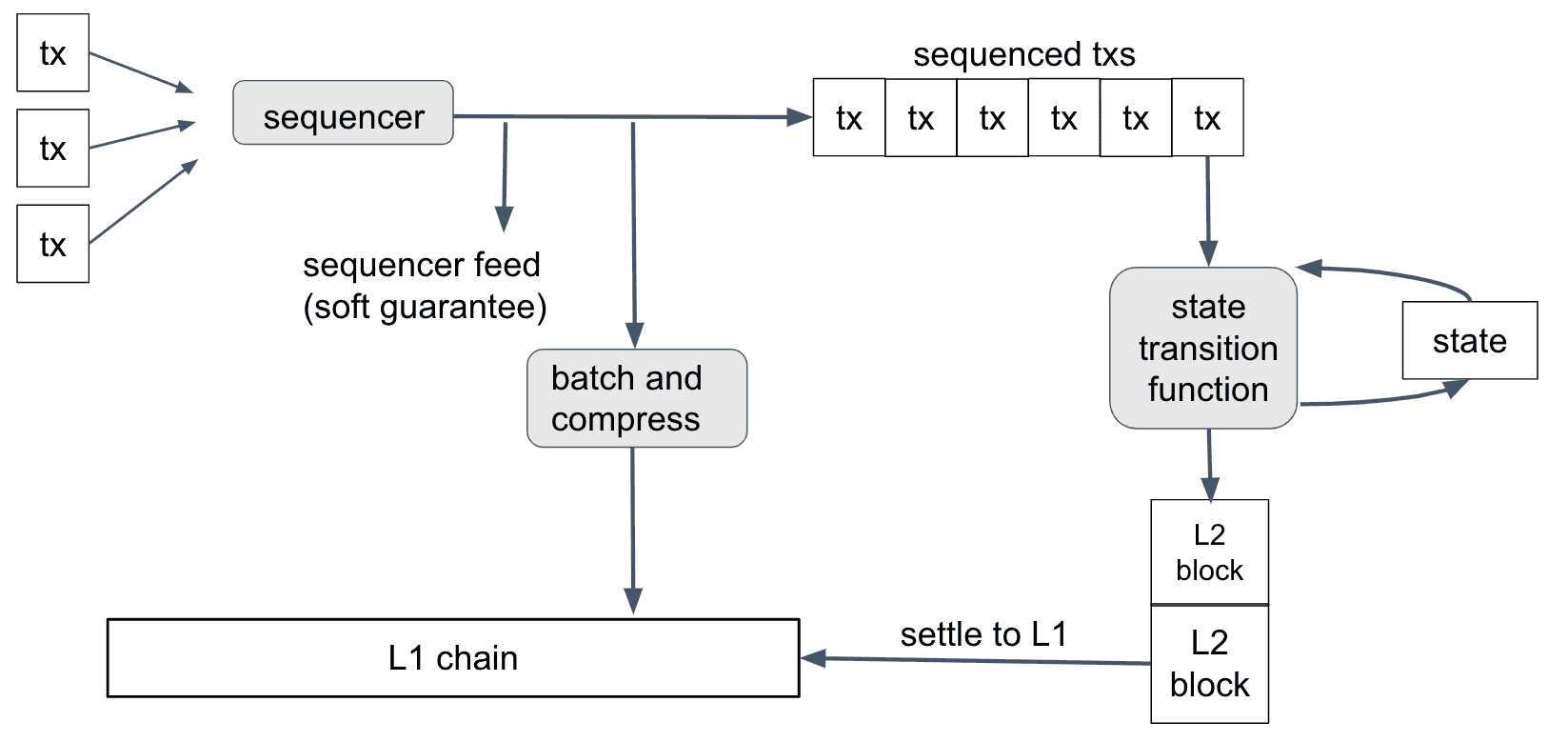
Users submit transactions
        ↓
Sequencer orders & batches them (off-chain)
        ↓
Batch posted to Ethereum L1 as calldata
        ↓
7-day challenge window opens
        ↓
If challenged → fraud proof runs on L1If not challenged → batch finalized ✅
This approach means:
99%+ of transactions are processed cheaply off-chain
Ethereum L1 remains the ultimate security backstop
Fraud proofs ensure no one can cheat without being caught
The tradeoff? A 7-day withdrawal delay when moving assets from Arbitrum back to Ethereum mainnet (bridging from L2 → L1). Fast bridges from third parties like Hop Protocol and Across can get around this.
Arbitrum Nitro: The Technical Breakthrough
The original Arbitrum used a custom VM. Arbitrum Nitro (launched 2022) was a complete rewrite that changed everything:
What Nitro introduced:
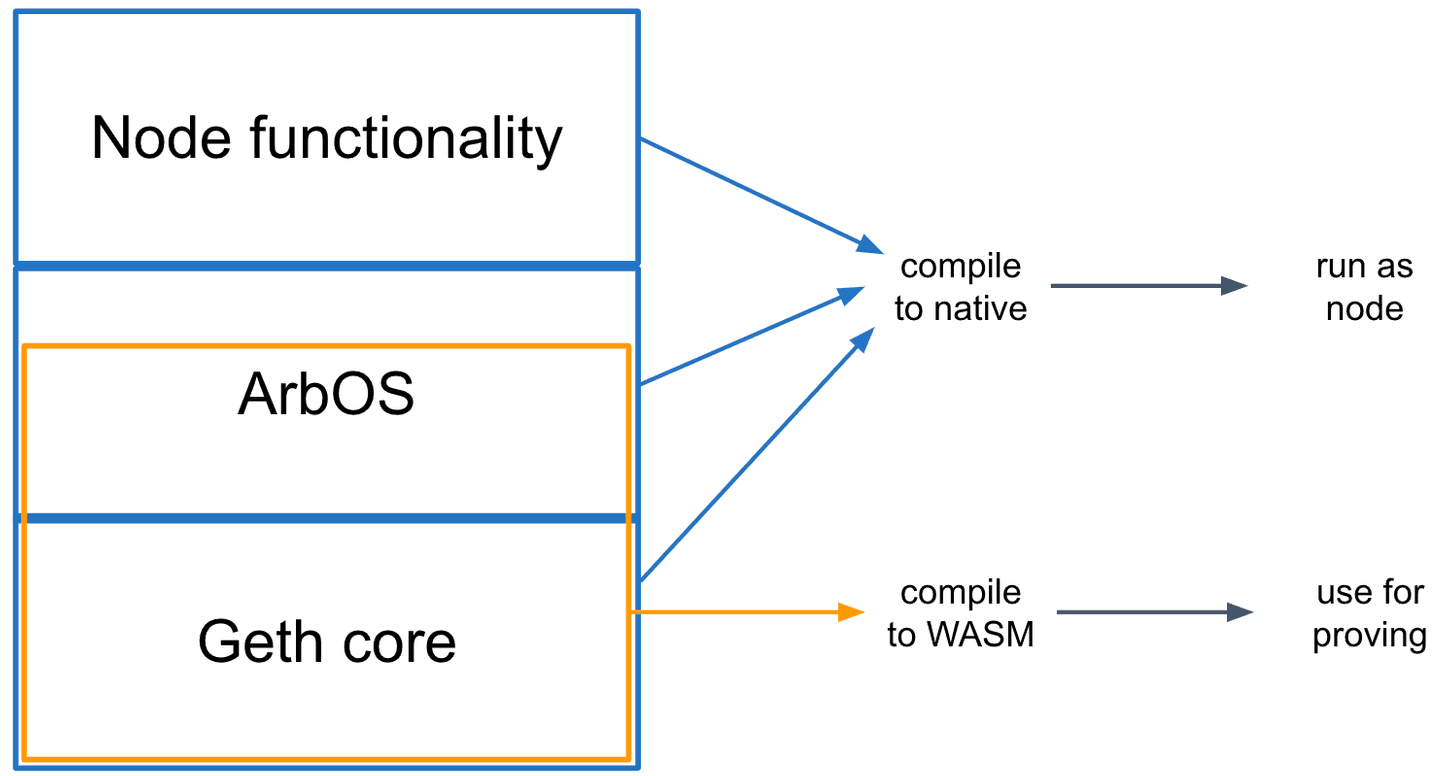
WASM-based fraud proofs — Arbitrum compiles its fraud proof logic to WebAssembly, making dispute resolution dramatically more efficient
Geth at the core — Nitro runs an actual Go-Ethereum (Geth) node under the hood, making it natively EVM-compatible at the execution layer
AnyTrust for data availability — An optional mode where a Data Availability Committee (DAC) stores transaction data off-chain, reducing costs further for high-throughput use cases
Arbitrum Nitro Stack:

┌─────────────────────────────┐
│     User Transactions       │
├─────────────────────────────┤
│    Sequencer (ordering)     │
├─────────────────────────────┤
│   Geth (EVM Execution)      │  ← Standard Ethereum client
├─────────────────────────────┤
│  ArbOS (L2 State Manager)   │  ← Arbitrum's custom OS layer
├─────────────────────────────┤
│ WASM Fraud Proof (if needed)│
├─────────────────────────────┤
│   Ethereum L1 (Settlement)  │  ← Ultimate security anchor
└─────────────────────────────┘
The result: Arbitrum Nitro is 7–10x cheaper than the original Arbitrum — and the EVM compatibility is near-perfect, meaning Solidity code deploys without modification.
Interactive Fraud Proofs: Arbitrum's Secret Weapon
Most optimistic rollups use single-round fraud proofs — the entire disputed transaction is re-executed on L1. This is expensive.
Arbitrum uses multi-round interactive fraud proofs — a bisection protocol where the dispute is narrowed down step-by-step until only a single computational step needs to be verified on L1.
Dispute starts → Full execution disagreement
        ↓
Bisect the execution trace in half
        ↓
Both parties agree on first half? Bisect second half
        ↓
Repeat until disagreement is at ONE instruction
        ↓
Only that single step runs on L1 → verdict reached
This makes fraud proofs dramatically cheaper to run on Ethereum — and makes it economically irrational to submit false proofs, since you'll always get caught and lose your stake.
Part 3: The Arbitrum Ecosystem
Two Chains, One Ecosystem
Arbitrum runs two production chains with different tradeoffs:
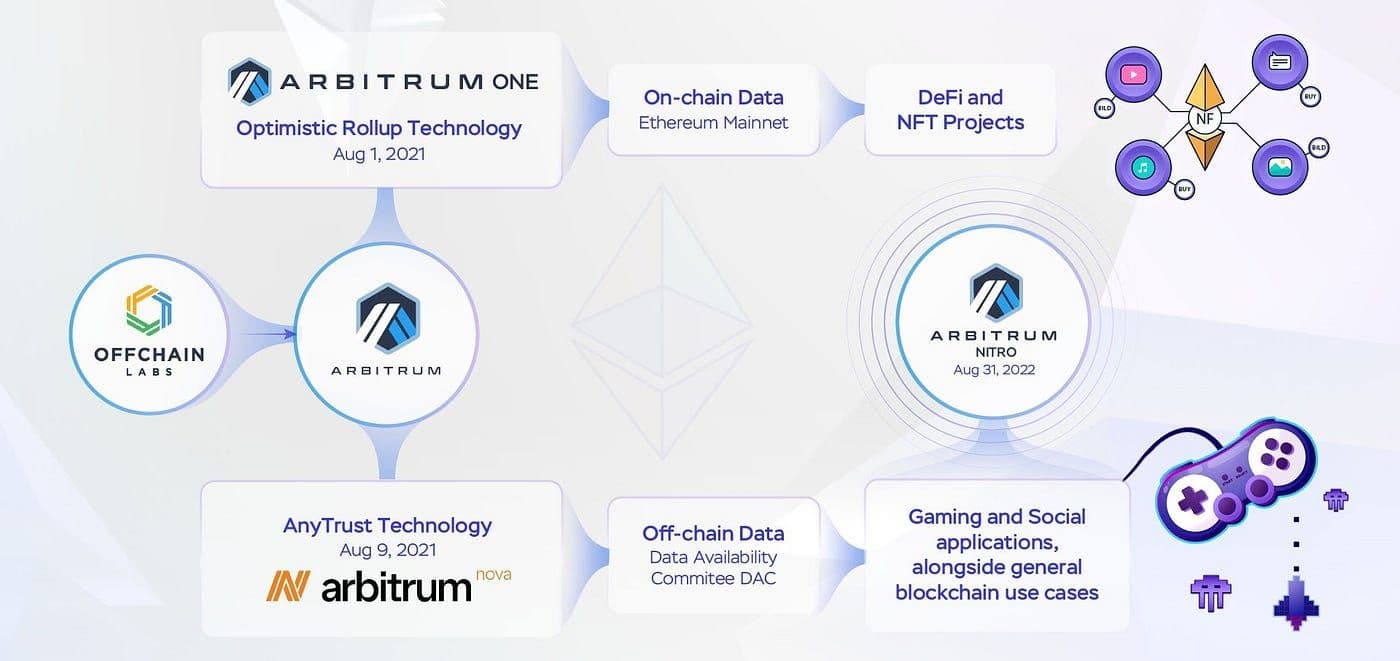
Arbitrum One
The flagship chain
Full Ethereum security via calldata posted to L1
Higher cost than Nova, lower cost than mainnet
Where most DeFi and serious protocols live
Arbitrum Nova
Powered by AnyTrust technology
Data stored with a trusted Data Availability Committee
Ultra-low fees — perfect for gaming and social apps
Slightly lower security assumptions than One
Feature | Arbitrum One | Arbitrum Nova |
|---|---|---|
Data Availability | Ethereum L1 | AnyTrust DAC |
Security Level | Maximum (L1-equivalent) | High (DAC-dependent) |
Transaction Cost | ~$0.01–0.10 | ~$0.001–0.01 |
Best For | DeFi, NFTs, serious protocols | Gaming, social, high-frequency |
Notable Apps | GMX, Uniswap, Aave | Reddit, Treasure DAO |
The DeFi Powerhouse: Key Protocols
Arbitrum's DeFi ecosystem is massive. Here are the flagship protocols:
GMX — Decentralized Perpetuals The crown jewel of Arbitrum DeFi. GMX lets users trade perpetual futures with up to 50x leverage, using a unique GLP liquidity pool model where liquidity providers earn fees from traders. It consistently generates some of the highest real yield in all of DeFi.
Uniswap V3 The most widely used DEX on Arbitrum. Uniswap's concentrated liquidity model works especially well on L2, where lower gas costs make active position management viable for more users.
Aave V3 The leading lending protocol, with Arbitrum-specific features like efficiency mode (eMode) for correlated asset pairs, enabling much higher capital efficiency.
Camelot DEX Arbitrum-native DEX with a focus on ecosystem launches and a unique dual AMM model supporting both volatile and stable pairs.
Radiant Capital Omnichain lending protocol that lets you deposit collateral on one chain and borrow on another — built natively on Arbitrum with LayerZero integration.
Protocol | Category | TVL (approx) |
|---|---|---|
GMX | Perpetuals / Derivatives | ~$500M+ |
Uniswap V3 | DEX | ~$300M+ |
Aave V3 | Lending | ~$200M+ |
Camelot | Native DEX | ~$100M+ |
Radiant | Omnichain Lending | ~$150M+ |
Setting Up Your Environment
The beauty of Arbitrum for developers: if you know Ethereum, you already know Arbitrum.
Network Details:
Arbitrum One (Mainnet)
  Chain ID:    42161RPC URL:     https://arb1.arbitrum.io/rpcExplorer:    https://arbiscan.io

Arbitrum Sepolia (Testnet)
  Chain ID:    421614RPC URL:     https://sepolia-rollup.arbitrum.io/rpcExplorer:    https://sepolia.arbiscan.io

Arbitrum Nova (Mainnet)
  Chain ID:    42170RPC URL:     https://nova.arbitrum.io/rpcExplorer:    https://nova.arbiscan.io
Add Arbitrum Sepolia to MetaMask and get free testnet ETH from the Arbitrum faucet.
Your First Arbitrum Smart Contract
Here's a complete example — a simple on-chain message board:
// SPDX-License-Identifier: MIT
pragma solidity ^0.8.19;

contract ArbitrumMessageBoard {
    struct Message {
        address author;
        string content;
        uint256 timestamp;
    }

    Message[] public messages;
    mapping(address => uint256) public messageCount;

    event MessagePosted(
        address indexed author,
        string content,
        uint256 timestamp
    );

    // Post a message — costs almost nothing on Arbitrum!
    function postMessage(string calldata _content) external {
        require(bytes(_content).length > 0, "Empty message");
        require(bytes(_content).length <= 280, "Message too long");

        messages.push(Message({
            author: msg.sender,
            content: _content,
            timestamp: block.timestamp
        }));

        messageCount[msg.sender]++;

        emit MessagePosted(msg.sender, _content, block.timestamp);
    }

    function getMessageCount() external view returns (uint256) {
        return messages.length;
    }

    function getLatestMessages(uint256 _count)
        external
        view
        returns (Message[] memory)
    {
        uint256 total = messages.length;
        uint256 count = _count > total ? total : _count;
        Message[] memory latest = new Message[](count);

        for (uint256 i = 0; i < count; i++) {
            latest[i] = messages[total - count + i];
        }
        return latest;
    }
Deploying with Hardhat
javascript
// hardhat.config.jsrequire("@nomicfoundation/hardhat-toolbox");require("dotenv").config();

module.exports = {
  solidity: "0.8.19",
  networks: {
    arbitrumSepolia: {
      url: "https://sepolia-rollup.arbitrum.io/rpc",
      accounts: [process.env.PRIVATE_KEY],
      chainId: 421614,
    },
    arbitrumOne: {
      url: "https://arb1.arbitrum.io/rpc",
      accounts: [process.env.PRIVATE_KEY],
      chainId: 42161,
    },
  },
  etherscan: {
    apiKey: {
      arbitrumOne: process.env.ARBISCAN_API_KEY,
      arbitrumSepolia: process.env.ARBISCAN_API_KEY,
    },
  },
};
javascript
// scripts/deploy.jsconst { ethers } = require("hardhat");

async function main() {
  const [deployer] = await ethers.getSigners();
  console.log("Deploying with account:", deployer.address);

  const balance = await deployer.provider.getBalance(deployer.address);
  console.log("Balance:", ethers.formatEther(balance), "ETH");

  const MessageBoard = await ethers.getContractFactory("ArbitrumMessageBoard");
  const board = await MessageBoard.deploy();
  await board.waitForDeployment();

  console.log("✅ MessageBoard deployed to:", await board.getAddress());
}

main().catch(console.error);
Deploy commands:
bash
# Deploy to testnet
npx hardhat run scripts/deploy.js --network arbitrumSepolia

# Verify on Arbiscan
npx hardhat verify --network arbitrumSepolia <CONTRACT_ADDRESS>

# Deploy to mainnet
npx hardhat run scripts/deploy.js --network arbitrumOne
Interacting via Frontend (ethers.js)
javascript
import { ethers } from "ethers";

const ARB_ONE_RPC = "https://arb1.arbitrum.io/rpc";
const CONTRACT_ADDRESS = "0xYourContractAddress";
const ABI = [ /* your ABI here */ ];

async function connectAndPost(message) {
  // Connect to MetaMaskconst provider = new ethers.BrowserProvider(window.ethereum);await provider.send("eth_requestAccounts", []);

  // Switch to Arbitrum Oneawait window.ethereum.request({
    method: "wallet_switchEthereumChain",
    params: [{ chainId: "0xA4B1" }], // 42161 in hex
  });

  const signer = await provider.getSigner();
  const contract = new ethers.Contract(CONTRACT_ADDRESS, ABI, signer);

  // Post message — gas fees on Arbitrum are negligibleconst tx = await contract.postMessage(message);console.log("Tx hash:", tx.hash);

  const receipt = await tx.wait();
  console.log("✅ Confirmed in block:", receipt.blockNumber);
}
Gas Cost Comparison: Mainnet vs Arbitrum
This is where Arbitrum shines most visibly for end users:
Operation | Ethereum Mainnet | Arbitrum One | Savings |
|---|---|---|---|
ETH Transfer | ~$2–5 | ~$0.01 | 99% |
ERC-20 Transfer | ~$5–15 | ~$0.05 | 99% |
Uniswap Swap | ~$20–80 | ~$0.10–0.50 | 98% |
NFT Mint | ~$30–150 | ~$0.20–1.00 | 99% |
Contract Deploy | ~$50–500 | ~$0.50–5 | 99% |
Prices vary with network conditions but the ratio remains roughly consistent.
The ARB Token & Governance
What Is ARB?
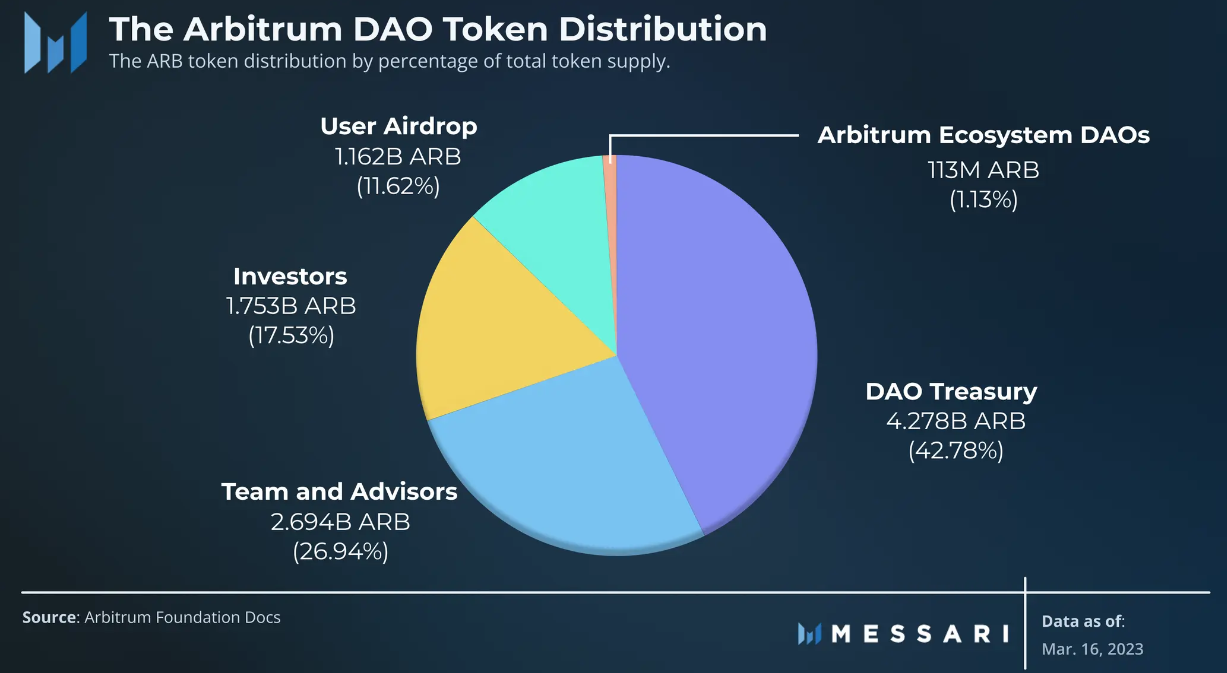
ARB is Arbitrum's native governance token, launched via airdrop in March 2023 — one of the largest airdrops in crypto history (~$1B+ distributed to early users).
ARB is not a gas token — ETH is still used for gas on Arbitrum. ARB is purely for governance of the Arbitrum DAO.
Property | Detail |
|---|---|
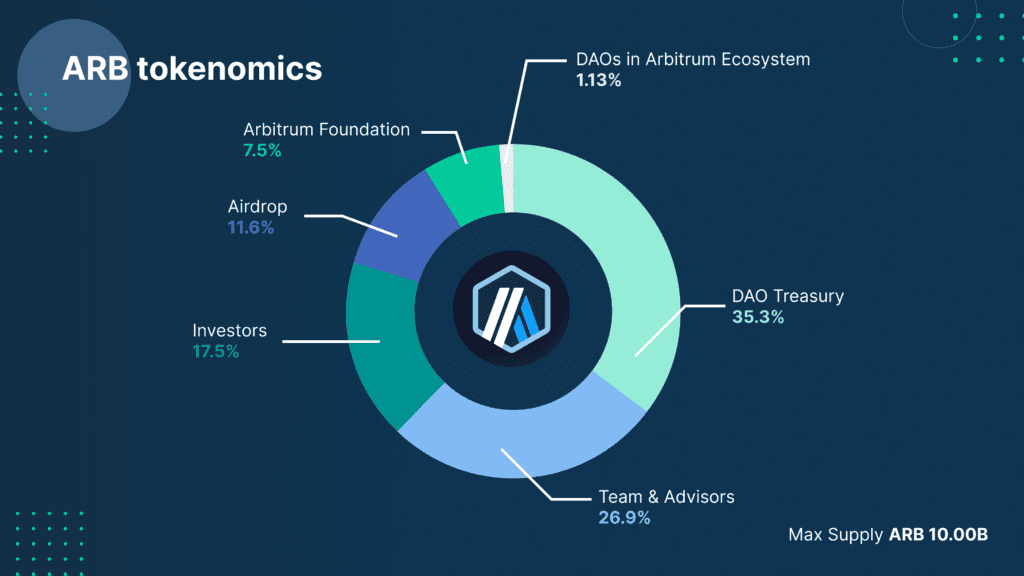
Total Supply | 10,000,000,000 ARB |
Initial Circulating Supply | ~1.275B ARB (12.75%) |
Airdrop Allocation | 11.62% to users & DAOs |
Team & Investors | 26.94% (4-year vesting) |
DAO Treasury | 42.78% (community controlled) |
Governance | 1 ARB = 1 vote |
Arbitrum DAO: How It Works
The Arbitrum DAO controls the Arbitrum protocol through on-chain governance:
Constitutional AIPs (Arbitrum Improvement Proposals)
Changes to the core protocol or Constitution
Requires higher thresholds to pass
Examples: changing fraud proof parameters, upgrading core contracts
Non-Constitutional AIPs
Funding proposals, ecosystem grants, parameter changes
Simpler approval process
Examples: LTIPP (Long-Term Incentive Pilot Program) distributing ARB to protocols
Proposal Submitted
        ↓
3-day temperature check (off-chain on Snapshot)
        ↓
7-day on-chain voting period
        ↓
If passed → 3-day timelock delay
        ↓
Execution on-chain ✅
The DAO has already voted on multi-million dollar grant programs to grow the Arbitrum ecosystem — making ARB governance genuinely consequential, not just performative.
Arbitrum Orbit — Build Your Own L3
One of the most exciting developments in the Arbitrum ecosystem is Arbitrum Orbit — a framework that lets anyone deploy their own custom chain that settles to Arbitrum One or Nova (making it an L3).
What Is an L3?
Ethereum (L1) ← Security anchor
      ↑
Arbitrum One/Nova (L2) ← Settles to L1
      ↑
Your Orbit Chain (L3) ← Settles to L2
An L3 inherits Ethereum's security through the Arbitrum L2. It can be:
Public or permissioned (private validator set)
EVM-compatible or custom VM
Any token for gas (not just ETH)
Custom precompiles for specialized functionality
Why Build an Orbit Chain?
Benefit | Detail |
|---|---|
Custom gas token | Use your own token for fees instead of ETH |
Privacy options | Restrict who can transact or validate |
High throughput | Dedicated blockspace, no congestion |
Custom parameters | Your own block time, gas limits, precompiles |
Full sovereignty | You control upgrades and governance |
Real Orbit chains already live:
Xai — Gaming-focused L3 with its own XAI token for gas
Degen Chain — Built for the Farcaster /degen community
Rari Chain — NFT-focused L3 for the RARI ecosystem
Treasure Chain — Gaming infrastructure for Treasure DAO
bash
# Getting started with Orbit (Arbitrum docs)
git clone https://github.com/OffchainLabs/orbit-setup-script
cd orbit-setup-script
npm install

# Configure your chain parameters in chainConfig.json# Then deploy your L3 with:
npm run deploy
Arbitrum vs zkSync Era
Factor | Arbitrum One | zkSync Era |
|---|---|---|
Rollup Type | Optimistic | ZK |
Finality | 7-day withdrawal | ~few hours |
EVM Compatibility | Full (Geth-based) | zkEVM (some limitations) |
Proof System | Fraud proofs | ZK-SNARKs |
Maturity | More battle-tested | Newer, evolving fast |
TVL | ~$15B+ | ~$3B+ |
The big question: ZK rollups are theoretically superior (instant finality, cryptographic proofs vs economic incentives). But ZK-EVMs are still maturing, and Arbitrum's head start in ecosystem and TVL is significant. The race is far from over.
Where Arbitrum Leads
✅ Highest TVL of any L2 (~$15B+)
✅ Most battle-tested optimistic rollup in production
✅ Best-in-class fraud proof system (multi-round interactive)
✅ Strongest DeFi ecosystem (GMX, Uniswap, Aave, Camelot)
✅ Most active developer ecosystem
✅ Arbitrum Orbit for custom L3 deployment
✅ Active DAO with real governance power
The Road Ahead
Arbitrum's Key Upcoming Developments
BoLD (Bounded Liquidity Delay) Arbitrum's next-generation dispute protocol that enables permissionless validation — meaning anyone can challenge invalid state transitions without needing to be a known validator. This removes the current semi-centralized aspect of fraud proof participation.
Stylus Perhaps the most exciting development: Arbitrum Stylus lets developers write smart contracts in Rust, C, and C++ — compiled to WASM — that run alongside Solidity on the same chain.
rust
// Yes, this is real — Solidity meets Rust on Arbitrum Stylususe stylus_sdk::prelude::*;

#[entrypoint]pub fn user_main(input: Vec<u8>) -> Result<Vec<u8>, Vec<u8>> {
    // High-performance computation in Rust
    // Runs on Arbitrum as a smart contract
    let result = compute_heavy_math(&input);
    Ok(result)
}
Stylus programs can be 10–70x more gas efficient than equivalent Solidity code for computation-heavy operations — opening the door to on-chain ML inference, complex cryptography, and more.
🔗 Cross-Chain Interoperability Arbitrum is deepening integrations with LayerZero, Chainlink CCIP, and Wormhole — enabling seamless asset and message passing between Arbitrum and other chains without trusted bridges.
Key Takeaways
"Arbitrum took the hard path — building the most technically sophisticated fraud proof system in the space — and it paid off. The ecosystem rewards are now undeniable."
What makes Arbitrum special:
It inherits Ethereum's full security without asking users to trust anything new
The developer experience is the best in L2 — pure EVM, same tools
The ecosystem density (GMX, Uniswap, Aave all in one place) creates compounding network effects
Orbit and Stylus give it a clear path to capturing not just DeFi, but gaming, enterprise, and high-performance compute use cases
Where to be cautious:
The 7-day withdrawal window is a real UX friction (fast bridges help, but add trust assumptions)
The sequencer is still centralized — a single point of failure for liveness (not security)
ZK rollups are maturing fast and may close the gap within 2–3 years
Getting Started: Your Action Plan
If you're a developer:
bash
# 1. Add Arbitrum Sepolia to MetaMask#    Chain ID: 421614 | RPC: https://sepolia-rollup.arbitrum.io/rpc

# 2. Get testnet ETH#    https://www.alchemy.com/faucets/arbitrum-sepolia

# 3. Deploy your first contract
npx hardhat run scripts/deploy.js --network arbitrumSepolia

# 4. Explore Stylus (Rust contracts)
cargo install --git https://github.com/OffchainLabs/cargo-stylus
cargo stylus new my-first-stylus-contract
📚 If you're learning:
Start with docs.arbitrum.io — the official docs are excellent
Use Arbitrum Sepolia Explorer to inspect transactions
Try GMX or Camelot on mainnet with small amounts to feel the UX difference
Join the Arbitrum Discord and follow the DAO forum for governance discussions
Complete the Arbitrum learning tracks on HackQuest — hands-on missions that make the concepts click
Final Thoughts
Arbitrum isn't just a gas fee fix. It's a bet that Ethereum's security model is worth preserving — that the right answer to blockchain scalability isn't to compromise on decentralization or trust assumptions, but to build smarter infrastructure on top of what already works.
So far, that bet is paying off. The TVL numbers, the developer activity, the protocol deployments — they all tell the same story. Arbitrum has built something real.
If you're serious about Ethereum development, Arbitrum isn't optional knowledge anymore. It's the baseline.
So what's your experience with Arbitrum ?