
ArbiSecure
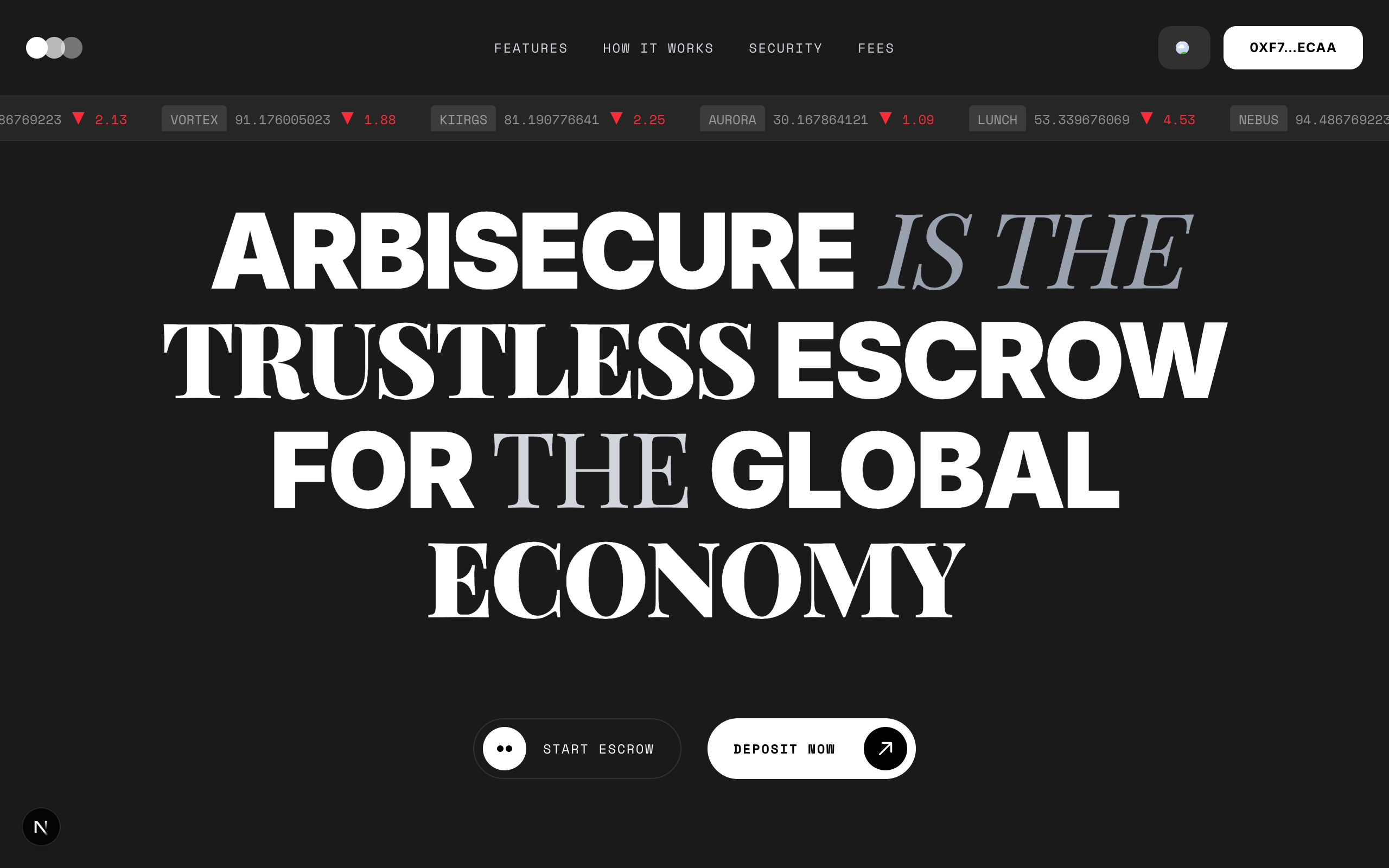
ArbiSecure: Trustless service escrows on Arbitrum Stylus. Secure, low-gas payment links for the global gig economy that ensure instant settlement and eliminate platform fees.
Video
Công nghệ sử dụng
Sự miêu tả
ArbiSecure Protocol Documentation
ArbiSecure is the first self-enforcing escrow protocol built on Arbitrum Stylus. It utilizes programmable milestone releases to prevent disputes before they happen, backed by a decentralized network of staked arbiters for edge cases.
📖 Overview
In the global freelance economy, high-value work faces a "Trust Gap." Clients fear non-delivery, and freelancers fear non-payment. Traditional escrow is slow, expensive, and relies on manual client approval, which often leads to delays and "ghosting."
ArbiSecure solves this by automating trust.
Instead of waiting for a client to manually click "Approve," ArbiSecure deals use pre-approved release conditions. When verifiable on-chain or off-chain events occur (e.g., a GitHub PR merge, an API health check, or a specific date), funds are released automatically.
Key Differentiators
Preventative Escrow: 90% of payments release automatically based on code/data, not human opinion.
Arbitrum Stylus (Rust): Achieving 80%+ gas savings compared to Solidity, making micro-milestones economically viable.
Staked Arbiter Network: A marketplace of reputation-backed arbiters for subjective disputes.
Gasless Onboarding: First deal is always free via Biconomy Paymaster.
⚡ Core Features
1. Programmable Milestone Releases
The heart of ArbiSecure is the ability to attach logic to money. At deal creation, both parties agree to specific conditions.
Time-based: Auto-release after X hours/days.
Oracle-verified: Uses Chainlink Functions to verify external data (GitHub commits, API status).
Hybrid: "Release when PR #42 is merged OR 48 hours have passed."
2. Staked Arbiter Marketplace
For subjective work (e.g., "Is this logo design good?"), human arbitration is still needed.
Staking: Arbiters must stake 500 USDC to participate.
Slashing: Arbiters who collude or fail to respond lose their stake.
Reputation: On-chain tracking of dispute resolution speed and fairness.
3. Evidence Submission System
Disputes are not just chat logs. ArbiSecure uses a structured evidence flow:
Users upload proof (screenshots, logs) to IPFS.
Content-addressed hashes are stored on-chain.
Arbiters review immutable evidence to make rulings.
🏗 Technical Architecture
ArbiSecure leverages the performance of Arbitrum Stylus to handle complex logic efficiently.
Tech Stack
Component | Technology | Purpose |
Smart Contracts | Rust (Stylus SDK) | High-performance state management & condition checking. |
Network | Arbitrum Sepolia | Low-cost L2 execution. |
Oracles | Chainlink Functions | Verifying off-chain events (GitHub/API). |
Frontend | Next.js + RainbowKit | User interface & wallet connection. |
Storage | IPFS (Pinata) | Decentralized storage for dispute evidence. |
UX | Biconomy Paymaster | Gasless transactions for new users. |
Contract Logic (Rust Snippet)
How we handle conditional releases efficiently in Rust:
enum ConditionType {
    TimeElapsed,           // Block timestamp check
    OracleConfirmation,    // External data feed (Chainlink)
    ManualApproval,        // Client signature
    HybridAll,             // All conditions met
}

#[external]
fn check_and_release_milestone(deal_id: U256, milestone_index: u8) {
    let mut milestone = self.get_milestone(deal_id, milestone_index);

    // Check all pre-approved conditions
    let all_met = milestone.conditions.iter().all(|c| c.met);

    if all_met && !milestone.released {
        self.release_milestone_funds(deal_id, milestone_index);
    }
}
ArbiSecure © 2026. Built for the Arbitrum Open House NYC Buildathon.