
SubTerra AI
Well Log Intelligence on Bittensor.
Video


Công nghệ sử dụng
Sự miêu tả
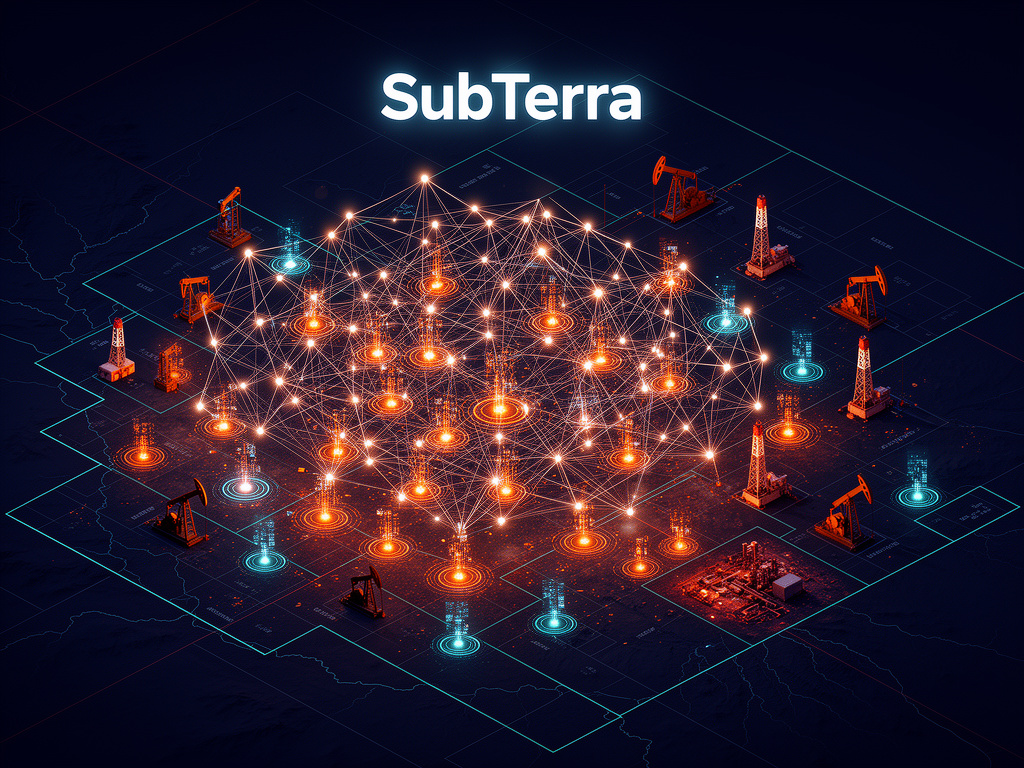
SubTerra AI Well-Log Intelligence Subnet
Bittensor Subnet Ideathon Submission
Tagline: Well Log Intelligence, On-Chain
Description: SubTerra AI Well-Log Intelligence Subnet transforms well log interpretation for shale operators, targeting the $2.4B annual US spend where decentralized AI can cut interpretation costs by 80% while improving completion accuracy. Unlike traditional petrophysical analysis that takes 2-3 days and costs $5,000 per well, SubTerra delivers reservoir quality predictions in 5 minutes for $50-200.
Core Value Proposition
Miners compete to deliver "digital petrophysicists" that process standard LAS files (gamma ray, resistivity, density, neutron, sonic curves) into actionable insights: porosity profiles, permeability estimates, pay zone flags, and optimal completion intervals.
Validators score outputs against ground-truth production data, reducing completion uncertainty and improving EUR (estimated ultimate recovery) predictions by 20-30%.
This creates a decentralized alternative to Schlumberger Techlog and Halliburton Geographix with 10x better economics via miner rivalry.
Miner Tasks & Specialization
Miners respond to validator queries with structured outputs:
Well-Log Porosity Prediction
Predict effective porosity from log curves, calibrated to core samples. Methods: Machine learning regression, rock physics transforms, neural network ensembles.
Permeability Estimation
Estimate permeability from porosity-permeability transforms, accounting for lithology and fluid type. Methods: Coates-Dumanoir equations, ML on core-calibrated data, permeability-height products.
Pay Zone Identification
Flag intervals meeting cutoff criteria (porosity >6%, water saturation <50%, shale volume <35%). Methods: Multi-cutoff analysis, fuzzy logic, probabilistic classification.
Completion Quality Scoring
Rank zones by expected production using integrated petrophysical analysis. Methods: EUR prediction models, sweet spot mapping, fracture stimulation optimization.
Specialization paths let teams shine:
Statistical ML: Gradient boosting, random forests on log features
Deep Learning: LSTM/Transformers on sequential log data
Physics-Informed: Rock physics constraints, fluid substitution models
Multi-Well Analysis: Spatial interpolation between offset wells
Real-Time Processing: LWD (logging while drilling) interpretation
Validators run standardized benchmarks:
Historical Replay: Feed Permian Basin wells with known production; score vs actual 90-day IP rates
Synthetic Challenges: Generate realistic noise-corrupted logs; measure recovery accuracy
Blind Tests: Partner-provided recent completions; compare predictions to actual results
Economic Ground Truth: Weight scores by ex-post EUR and finding costs
Yuma Consensus allocates emissions based on composite score:
40% technical accuracy (RMSE vs core/measured data)
30% production prediction accuracy (vs actual EUR)
20% compute efficiency (inference speed, cost per prediction)
10% model diversity (non-correlated predictions improve ensemble)
Technical Architecture
Data Formats: LAS 2.0/3.0 (well logs), DLIS (digital log), ASCII, CSV
Input Size: 100KB-5MB per well (thousands of rows, 10-50 log curves)
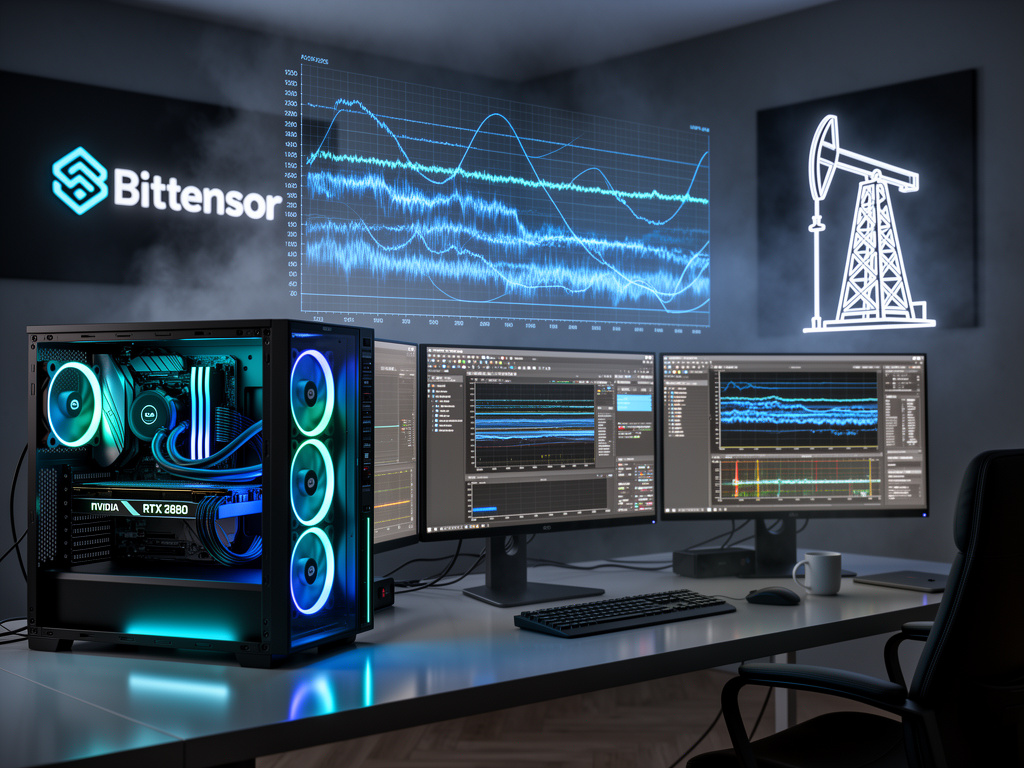
Compute Profile: Standard gaming/consumer GPUs; 8GB VRAM minimum, 12GB optimal. CPU inference acceptable for batch processing. Result: 256 miners can participate vs 5-10 for seismic.
Axon Protocol: gRPC endpoints for well queries:
/predict_porosity - Return porosity curve
/estimate_permeability - Return permeability profile
/identify_pay_zones - Return flagged intervals
/score_completion - Return quality ranking
Subnet dTAO Economics: Launch with 200 TAO liquidity pool; miners stake 250 dTAO minimum for priority queuing on high-value jobs.
Revenue Model (Enterprise-Facing dApp)
API Subscriptions:
$500/mo for 25 wells (shale independents)
$2,000/mo for 150 wells (mid-size operators)
$10,000/mo unlimited (large independents, E&Ps)
Per-Well Pricing:
Quick Look: $50/well (5-min turnaround, single miner)
Standard: $200/well (ensemble of 10 miners, confidence intervals)
Premium: $500/well (expert review + uncertainty quantification)
Data Marketplace: Miners/validators contribute proprietary training datasets for curation bounties (paid in dTAO).
Target Clients:
Primary: Shale independents (Pioneer, Diamondback, Continental, EOG, Devon)
Secondary: PE-backed operators (Laredo, Matador, Centennial)
Pilot: Minnows with 5-20 rig programs first
Go-to-Market Path
MVP Launch (Q2 2026): Bittensor testnet with 50,000 public domain wells from FracFocus and state regulators
Pilot Program (Q3 2026): Partner with 3 shale operators for blind tests on recent completions
Mainnet Launch (Q4 2026): Register NetUID with 256 active miners, $10k/day GMV target
Subnet Registration: 300-500 TAO
dTAO Flywheel: Early wins → validator stakes → emissions → token price → miner capex → better predictions
Subnet Partnerships & Ecosystem
SubTerra plans to leverage 7+ existing Bittensor subnets for infrastructure, data, security, and distribution:
Data Layer
SN13 (Data Universe): Stores and curates well log datasets, provides training data infrastructure
SN22 (Desearch): Scrapes and aggregates data from public sources (FracFocus, USGS, state databases)
Infrastructure
SN64 (Chutes): GPU marketplace for elastic compute — miners rent GPUs on-demand
SN75 (Hippius): Storage and VPS hosting for validators and miner nodes
SN44 (Score): Computer vision for operations monitoring — safety compliance, equipment inspection
Security
SN60 (Bitsec.ai): AI security and model validation — protects against adversarial attacks
Sales & Distribution
SN71 (Leadpoet): Lead generation — identifies shale operator decision-makers, qualified lead bounties
Complete Stack: Data (Universe + Desearch) → Compute (Chutes) → Storage (Hippius) → Security (Bitsec) → Vision (Score) → Customers (Leadpoet)
Competitive Moats
Data Flywheel: User-submitted well logs → better training → superior models → more customers → more data.
Miner Diversity: Basin-specific specialists (Permian shales vs Marcellus gas vs Bakken oil).
Cost Edge: Decentralized GPUs 70% cheaper than on-prem HPC; 8GB gaming GPUs vs $50k workstations.
Auditability: All interpretations logged immutably on Bittensor chain for regulatory/compliance.
Speed Advantage: 5 minutes vs 2-3 days for traditional analysis.
Risks & Mitigation
Data Quality: Use only wells with verified production data; flag uncertain predictions
Compute Scaling: Cloud burst capacity for demand spikes
Market Education: Free tier to prove value before paid conversion
Competition: Scale fast; data flywheel creates winner-take-most dynamic
Upside: First subnet to crack shale log interpretation unlocks $100M+ ARR potential
Why This Wins
Real problem: $2.4B spent annually, pain is acute
Bittensor-native: Perfect fit for distributed inference on small tasks
Defensible: Domain expertise + data flywinner
Profitable path: Clear customer willingness to pay, fast sales cycle
Achievable: 6-month MVP vs 18-month for seismic
This is a business disguised as research, not research disguised as a business.
Tiến độ hackathon
Data pipeline: LAS → PyTorch dataloaderBaseline model: LSTM on 1,000 wells
Validation framework: Compare predictions to production data
Web interface: Upload well, get prediction
Miner client: Python inference script
Team: Petrophysicist + ML Engineer + BD Lead
Trạng thái huy động vốn
Bootstrap SubTerra with Bitstarter crowdfunding platform via TAO community pledges.