
The Decentralized Memory Operating System for AI Agents
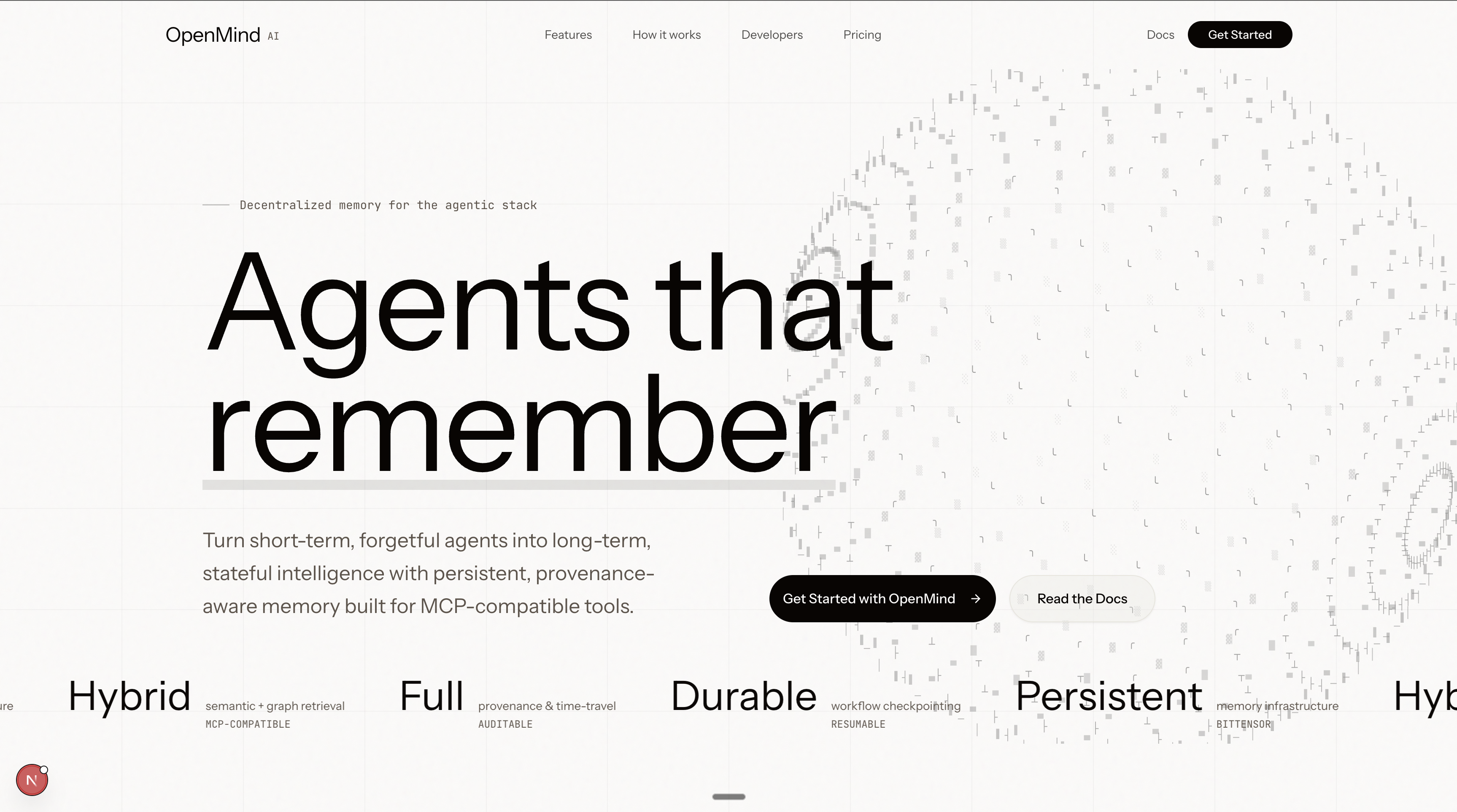
OpenMind is a decentralized Memory Operating System for AI agents and assistants.
It acts as a persistent, private, always-available external memory layer that any MCP-compatible AI tool can plug into (like Cursor, Claude Desktop, LangGraph-based agents, and similar systems).
Instead of forcing an AI to rely on fragile, compressed summaries of past conversations, OpenMind stores the full uncompressed history of what the AI has seen and done over time—messages, documents, tool outputs, transcripts, interactions, and learned relationships.
When memory is needed, the AI can retrieve the exact, relevant evidence from the past with high precision, rather than guessing from partial context.
Today’s AI systems still have structural memory failure:
They forget key details after sessions end or tools restart.
They repeatedly ask users to restate information.
They produce inconsistent responses and break long-running workflows.
They hallucinate when missing historical context.
They become expensive to run because developers keep stuffing large context summaries into prompts.
AI lack self learninig
Even with large context windows, this problem remains: token windows are temporary and lossy, not true long-term memory.
OpenMind fixes this by moving memory out of the model context window and into a durable external layer that is queryable, versioned, and continuously available.
OpenMind combines:
Lossless encrypted storage with Reed-Solomon durability
Hybrid semantic + graph retrieval
Versioning and time-travel memory queries
Durable workflow checkpointing
Shared memory spaces for multi-agent collaboration
Multimodal memory support (e.g., images, PDFs, screenshots)
So an agent can recall not just “something similar,” but the exact prior facts, messages, and relationships that matter.
Many memory products improve app-level convenience.
OpenMind introduces a network-level advantage: a decentralized self-learning memory competition.
Multiple miners compete to return best retrieval evidence.
Better quality + lower latency retrieval earns better rewards.
High-quality retrieval traces become reproducible learning signals.
Network performance compounds over time as usage grows.
This means OpenMind is designed not only to store memory, but to make the memory network itself smarter and more reliable as it is used.
OpenMind’s goal is to become the default memory layer for agentic AI—the foundational infrastructure that allows agents to:
remember continuously,
act coherently over long time horizons,
reduce hallucinations caused by memory gaps,
lower token costs by avoiding bloated prompts,
and build real trust and long-term relationships with users.
In short: OpenMind exists to make AI feel truly continuous, reliable, and human-like over time—by ending forgetting at the infrastructure level.