
Knock-out leverage on NVDA in USDG, live on Robinhood Chain mainnet. Its vault is never short: every position is bought as real NVDA and held, and the most you can lose is your margin.
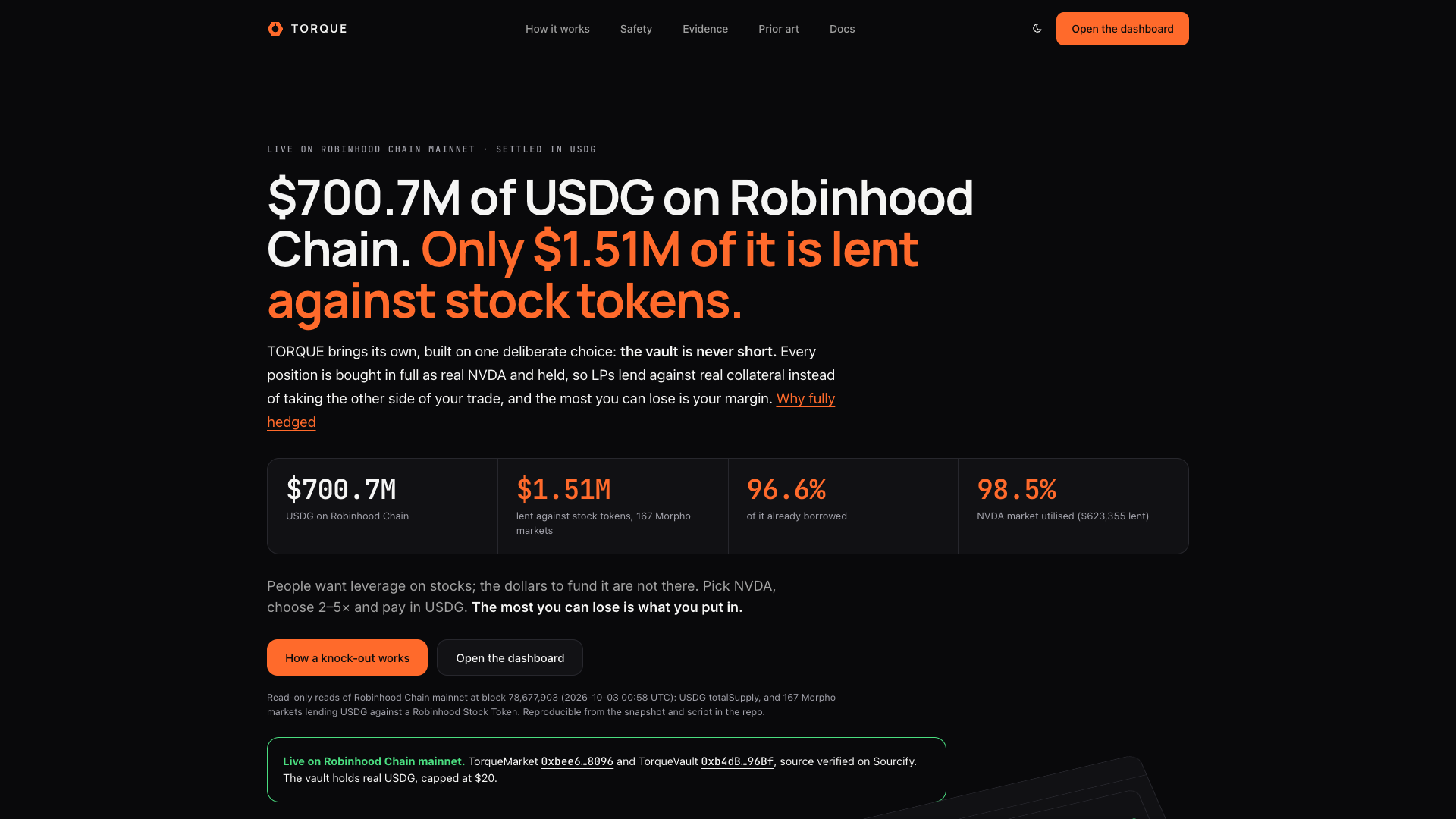
TORQUE is knock-out leverage on NVDA built on one deliberate choice: the lending vault is never short. Every position is bought in full as real NVDA and held by the contract, so LPs lend against real collateral instead of taking the other side of the trade, as they do in pool-as-counterparty designs where LPs pay when traders win.
The trader's loss stops at the margin by construction, with no liquidation bonus taken, and it is live on Robinhood Chain mainnet: five positions opened and closed, every loan repaid in full, zero bad debt, both contracts an exact bytecode match on Sourcify with no owner, no pause switch and no upgrade path (block 79,360,631).
Paxos USDG is the whole product: traders post USDG margin, LPs deposit USDG, the vault lends USDG and every payout is USDG, with knock-out residuals credited for the trader to claim so a frozen USDG address can never block a knock-out.
WHAT WE TRADED FOR IT
Full hedging caps capacity at what the on-chain NVDA/USDG pool can fill, rules out shorts in v1, and gives LPs interest and fees rather than traders' losses. We think that is the right trade for tokenized stocks, whose price feed freezes for about 52 hours every weekend. The reasoning is at torque.0xo.in/docs/why-fully-hedged.
HOW IT WORKS
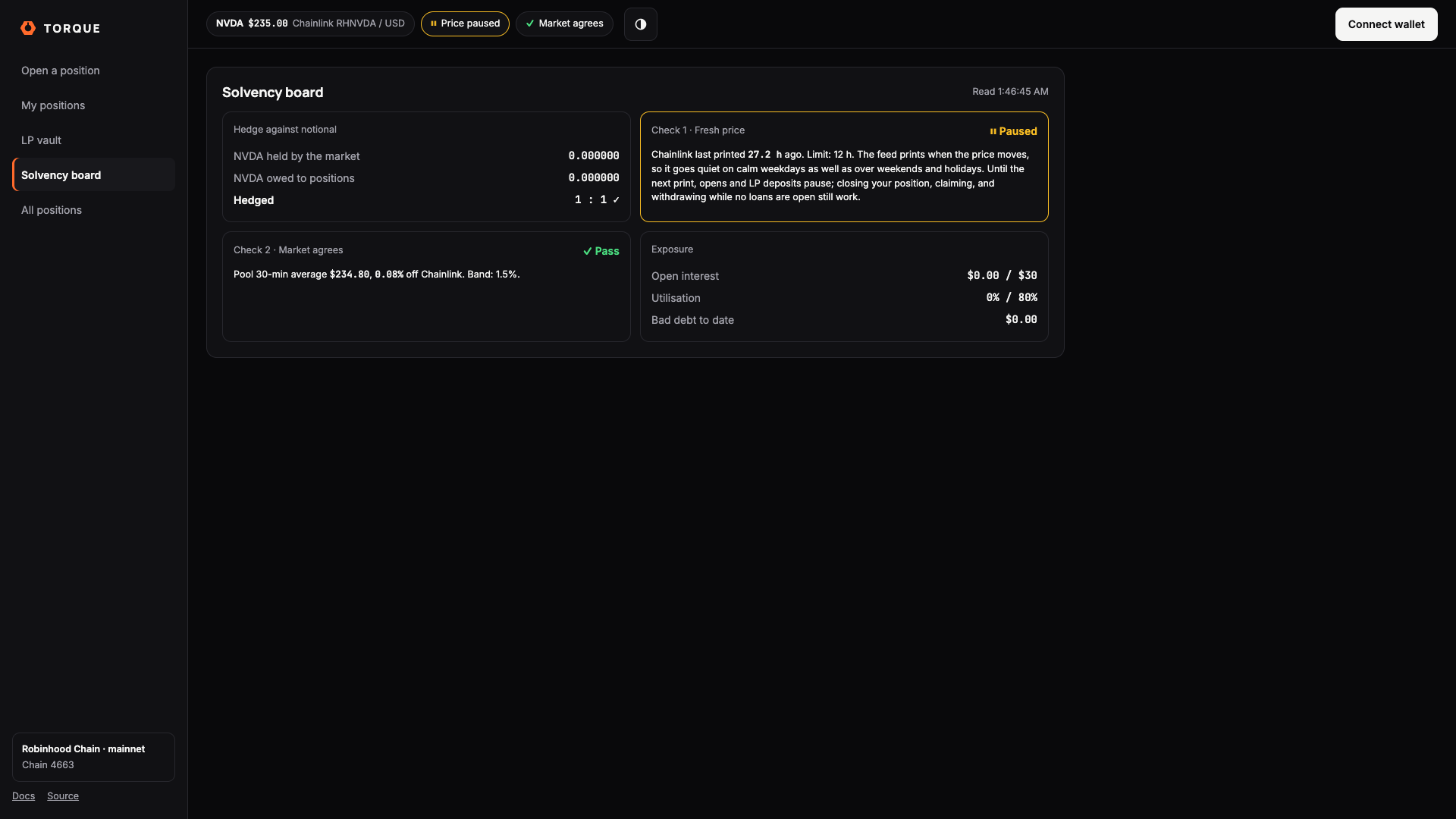
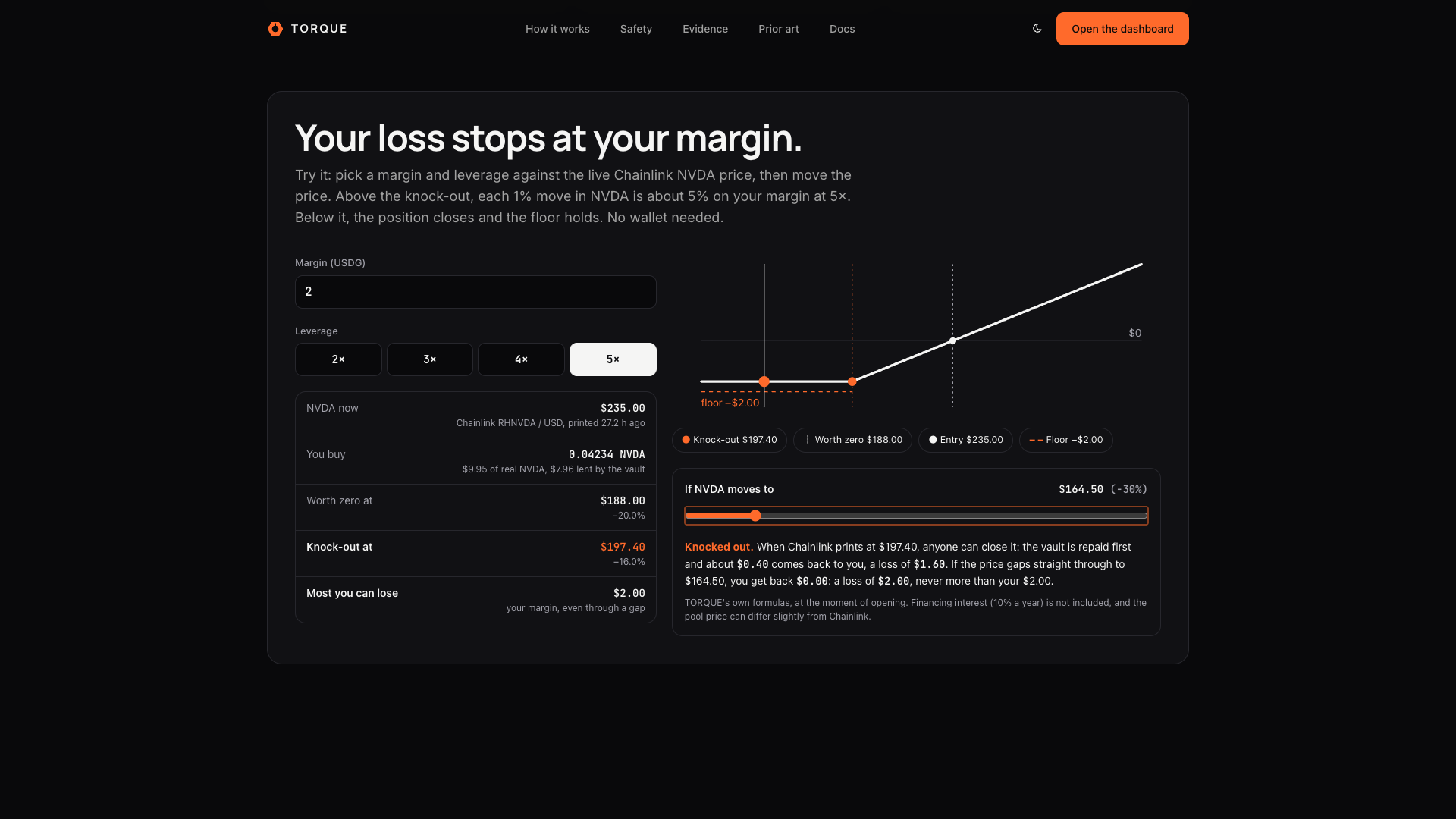
Pick NVDA, choose 2–5× and post USDG. The vault lends the rest, and the whole position is bought as real NVDA in the on-chain Uniswap pool. Each position has a knock-out level 5% above the price at which it would be worth zero. When Chainlink prints at that level, anyone can knock it out: the vault is repaid first and the trader claims what is left. Two safety checks gate every open and every LP deposit: Chainlink's NVDA price must be under 12 hours old, and the pool's 30-minute average must agree with it within 1.5%.
WHO IT IS FOR
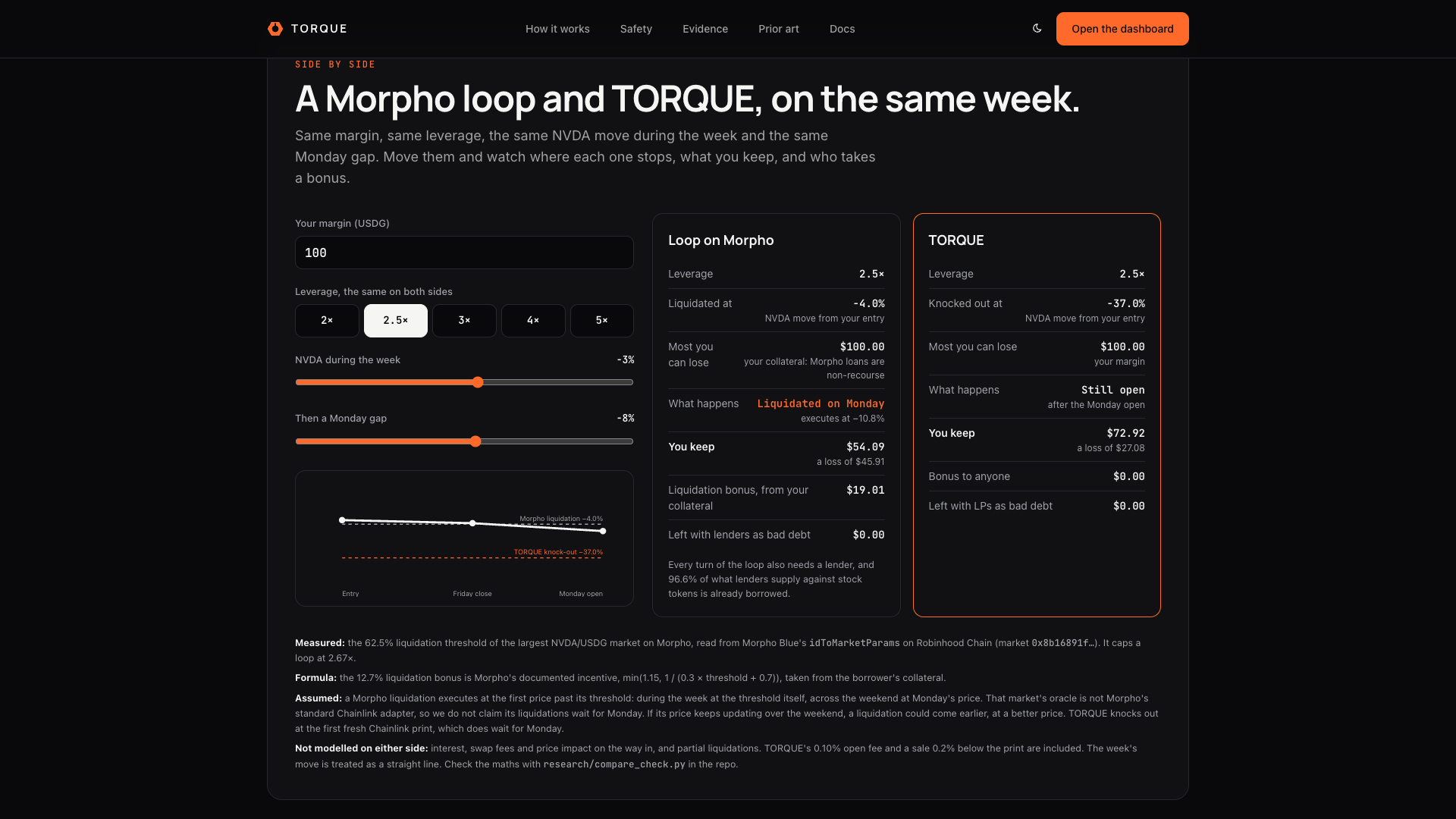
Someone holding NVDA on Robinhood Chain who wants 3× of it, with a floor. Today their on-chain route is to loop on Morpho: post NVDA as collateral, borrow USDG, buy more, repeat. In the largest NVDA/USDG market the liquidation threshold is 62.5%, so looping tops out at 2.67× before any safety margin, and a 2.5× loop is liquidated after a 4% fall; every turn needs a lender; and a liquidation pays the liquidator a 12.7% bonus out of the borrower's collateral (Morpho's documented formula). With TORQUE it is one transaction, up to 5×; a 2.5× position is knocked out only after a 37% fall; the USDG comes from TORQUE's own vault; and a knock-out pays no bonus. On both, the most the trader can lose is what they posted. Try the two on the same week, with every Morpho figure labelled measured, formula or assumed: torque.0xo.in/#compare.
THE EVIDENCE, AND WHAT IS INFERENCE
• Measured: at block 78,677,903 there is $700.7M of USDG on the chain, but only $1.51M is lent against stock tokens, across 167 Morpho markets, and borrowers have taken 96.6% of it (98.5% in the largest NVDA market). Borrowing against stocks has taken nearly all of the USDG supplied for it. It is concentrated: NVDA, SPCX, GOOGL and AAPL markets hold almost all of it, and 10 of the 63 funded markets are 90% or more borrowed (every market, read at block 79,510,989: torque.0xo.in/docs/demand).
• Our inference, not a measurement: part of that borrowing is demand for leverage on stocks, and some of it would choose a hard floor over a liquidation.
• Size: serving the borrowing we measured would take a vault of about $1.82M at TORQUE's 80% utilisation limit, or about $767k for the NVDA market alone (research/capacity.py). The $20 cap is a buildathon limit, not the design.
• Not yet: no outside user has opened a position or deposited; all five mainnet positions and the $20 vault are ours. Opens pause whenever the feed is more than 12 hours old, which was 26.6% of the last 89 days, mostly weekends. Our LP backtest over 90 days of Chainlink prints returned +3.25% (14.1% a year) at 5× and 80% utilisation, with demand assumed; that window never tested the floor, so the report shows the gap sizes at which LPs would lose money. Every other weakness, including the missing keeper incentive, is on the limits page.
CHECK IT YOURSELF
Every claim has a one-line command at torque.0xo.in/docs/verify, or run ./script/verify-claims.sh from the repo.
Dashboard: app.torque.0xo.in · Docs: torque.0xo.in/docs · Code: github.com/Torque-Protocol/torque
SMART CONTRACTS, WITH EVIDENCE (all in the public repo, all re-runnable)
• 9 solvency invariants, written before the product code: full NVDA backing, cash conservation, the $20 cap, open-interest and utilisation caps, NAV never overstated, bad debt only after a real gap, nothing unsafe succeeds when a safety check fails, exact payouts. 9/9 pass at 1,024 runs × 128 calls deep (131,072 calls per invariant); the handler simulates weekends where the pool drifts away from a frozen feed.
• An adversarial pass before mainnet: 23 attacks, including reentrancy through a hook-calling token, first-depositor inflation, rounding farms, donations, knock-outs at a manipulated tick, sandwiching the hedge, same-block ordering and a dead feed. 23/23 pass. It found one real hole, fixed before deployment: a dead price feed could have locked LP funds. Now, after 7 days without a usable print, anyone can unwind positions at the pool's 30-minute average, vault repaid first.
• A planted-bug harness: 25 deliberate bugs planted one at a time; the suite caught 24. The 25th removes one of two duplicate cap checks and changes no behaviour.
• 32/32 unit tests, and 6/6 fork tests against the real mainnet USDG, NVDA, pool and Chainlink feed, including a sandwich on the real pool: $1k / $10k / $100k front-runs cost the attacker about $1 / $10 / $100.
• Deployed to Robinhood Chain mainnet at block 78,466,999 (2026-10-02 19:04 UTC). Creation and runtime bytecode are an exact match on Sourcify. No owner, no proxy, no pause; the vault's one-shot link to the market is spent.
ON MAINNET
• Five positions ($2 at 5×, real NVDA bought in the pool) opened and closed. Every close repaid the vault at least its 7.96 USDG loan; bad debt is 0; the vault holds 20.05 USDG at its $20 cap (block 79,360,631).
PRODUCT AND TOOLS
• Dashboard (app.torque.0xo.in): open, close, LP vault, solvency board and all positions, each on its own page; a wallet modal with WalletConnect; reads through Alchemy.
• Landing page with a live payoff simulator and a Morpho-loop-vs-TORQUE calculator (its maths checked against an independent Python implementation), and 14 docs pages, including "Why fully hedged", "Demand, measured" (every Morpho stock-token market at one block), every published limit (including the missing keeper incentive), and a page that verifies every claim with one command each.
• An LP backtest over 90 days of Chainlink prints, a knock-out watcher anyone can run (tested end to end on a mainnet fork; no keeper is running), verify-claims.sh, capacity.py (the vault size the measured demand implies), and the research scripts behind the market-gap figures.
• Demo and pitch videos.
Everything was written between 2026-10-02 and 2026-10-04: 40 commits in the public repo.
No outside funding raised. Open to ecosystem grants and support to take TORQUE past its buildathon cap.