
Alok
4
文章
3990
查看
1
关注者
Arbitrum: Scaling Ethereum Without Compromising Security
Introduction: The Scalability Dilemma
Ethereum is the foundation of decentralized applications.
From DeFi protocols to NFTs, DAOs to on-chain gaming — Ethereum provides a trustless execution environment secured by global consensus.
But Ethereum was never optimized for mass-scale throughput.
It prioritizes:
Decentralization
Security
Permissionless verification
The result?
Limited block space, rising gas fees during congestion, and throughput of roughly 15–30 TPS on Layer 1.
Scaling Ethereum directly by increasing block size or hardware requirements would weaken decentralization.
So the ecosystem evolved differently.
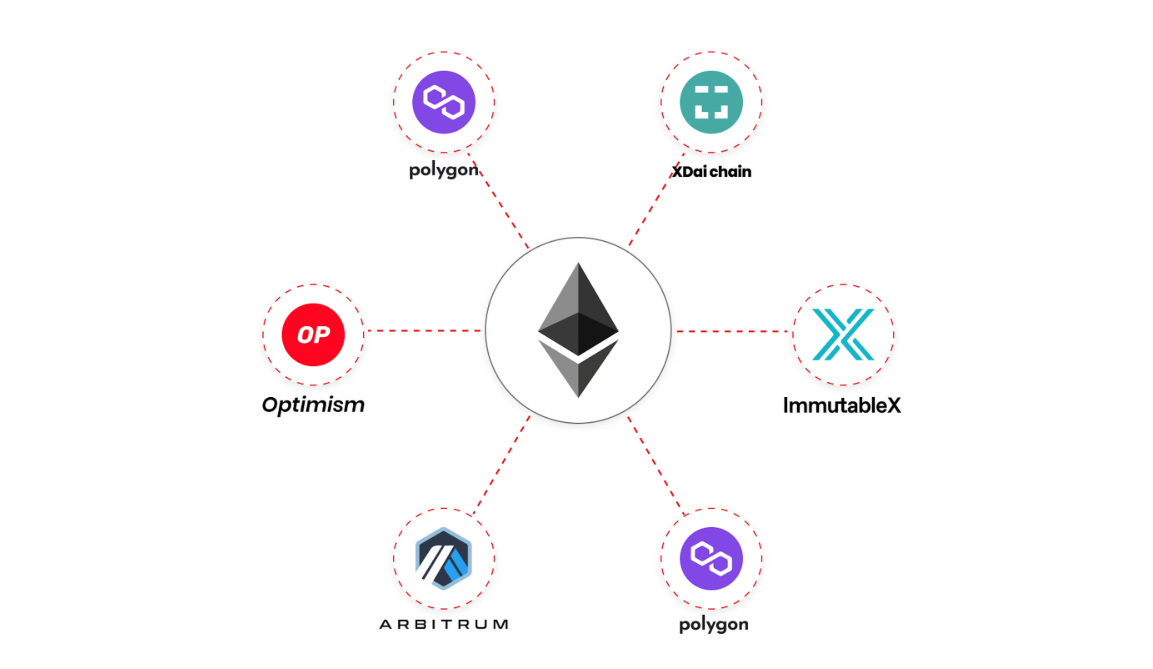
Instead of scaling vertically, Ethereum scales modularly.
Arbitrum is one of the most successful implementations of this vision.
Ethereum’s Core Constraint: Why L1 Cannot Simply “Scale Up”
Ethereum’s architecture requires every full node to:
Validate every transaction
Store state
Participate in global consensus
This design ensures security and censorship resistance — but also limits throughput.
When demand spikes (e.g., NFT mints or DeFi liquidations):
Users compete for block inclusion
Gas prices rise dramatically
UX deteriorates
Scaling must reduce computational burden on L1 without sacrificing trust guarantees.
This is where rollups enter.
What is Arbitrum?
Arbitrum is a Layer 2 rollup protocol built on Ethereum.
It moves transaction execution off-chain while keeping:
Data availability on Ethereum
Settlement finality on Ethereum
Security anchored to Ethereum
In simple terms:
Execution happens on L2.
Verification and settlement remain on L1.
This separation is the foundation of modular blockchain design.
Feature | Ethereum (L1) | Arbitrum (L2) |
|---|---|---|
Execution Location | On-chain | Off-chain |
Settlement | On Ethereum | On Ethereum |
Security Model | Native Ethereum consensus | Inherits Ethereum security |
Throughput | ~15–30 TPS | Significantly higher (batched execution) |
Gas Fees | High during congestion | Much lower |
Data Posting | Full execution on L1 | Compressed calldata posted to L1 |
Withdrawal Speed | Immediate finality | ~7 day fraud-proof window |
EVM Compatibility | Native | Near-complete EVM equivalence |
Core Mechanism: Optimistic Rollups
Arbitrum uses Optimistic Rollups.
Why “Optimistic”?
Because transactions are assumed valid by default.
Instead of verifying every computation on L1 (expensive), Arbitrum:
Batches thousands of transactions
Compresses the state updates
Posts calldata to Ethereum
Opens a challenge window for fraud detection
If no one challenges the batch during the dispute window, it is finalized.
This dramatically reduces Ethereum’s computational load.
Multi-Round Interactive Fraud Proofs (Advanced Insight)
The most innovative component of Arbitrum’s design is its interactive fraud proof system.
If a dispute occurs:
The protocol does not replay the entire batch on L1.
Instead, it narrows the dispute step-by-step.
Each round reduces the disagreement to a smaller computational segment.
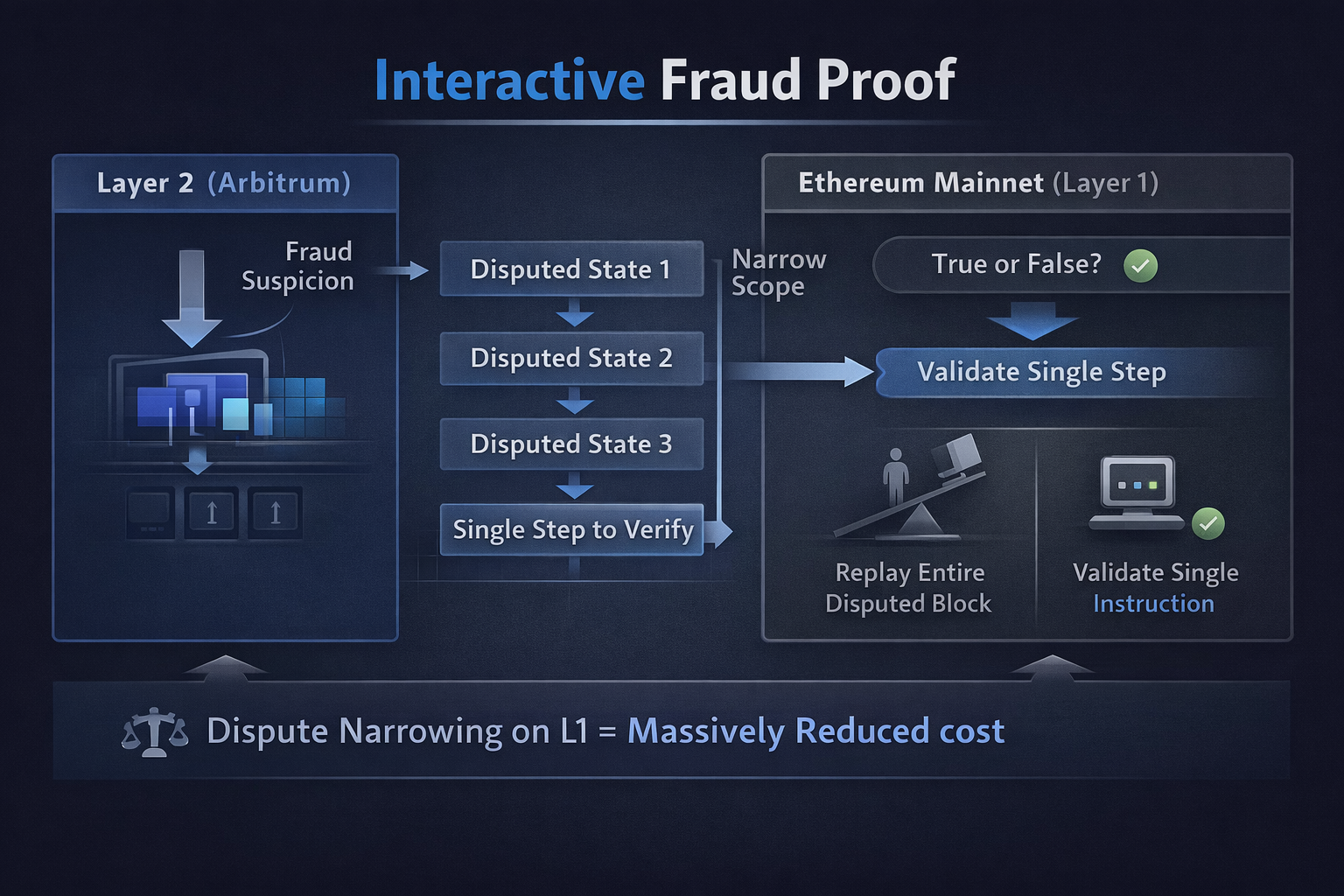
Eventually, a single instruction is executed on Ethereum to determine correctness.
This “binary search style” verification drastically reduces gas costs compared to naive replay mechanisms.
It is a key reason Arbitrum remains efficient even during disputes.
Arbitrum Nitro: Major Architectural Upgrade
Arbitrum’s Nitro upgrade significantly enhanced performance.
Nitro introduced:
A Geth-based execution engine
Improved calldata compression
Faster node synchronization
Near-complete EVM equivalence
This means developers can deploy existing Ethereum contracts without rewriting logic.
Nitro improved both throughput and developer experience — strengthening ecosystem growth.
Developer Experience & EVM Compatibility
Arbitrum achieves near-complete EVM equivalence.
Developers can use:
Solidity
Vyper
Yul
Any EVM-compatible tooling
Existing Ethereum tools like Hardhat, Foundry, and MetaMask work seamlessly.
This compatibility eliminates migration friction — a critical adoption factor.
Arbitrum Nova & AnyTrust Model
Arbitrum also introduced Nova, optimized for high-throughput, low-cost applications.
Nova uses the AnyTrust model.
Instead of posting full calldata on Ethereum, it relies on a Data Availability Committee (DAC).
Benefits:
Extremely low fees
High throughput
Ideal for gaming and social applications
Trade-off:
Slightly weaker data availability guarantees compared to full rollups
This represents a spectrum of security-performance trade-offs within Layer 2 design.
Version | Year | Core Architecture | Key Improvements | Impact |
|---|---|---|---|---|
Arbitrum One (Classic) | 2021 | Optimistic Rollup | Initial rollup implementation | Enabled Ethereum L2 scaling at production level |
Arbitrum Nitro | 2022 | Geth-based execution + improved rollup | Better calldata compression, faster nodes, near-complete EVM equivalence | Major performance & UX upgrade |
Arbitrum Nova | 2022 | AnyTrust model | Data Availability Committee, ultra-low fees | Optimized for gaming & social apps |
ARB DAO Governance | 2023 | On-chain governance | Community-led protocol decisions | Decentralized ecosystem control |
Real-World Impact: What Arbitrum Enables
Arbitrum makes economically infeasible applications viable:
High-frequency DeFi strategies
On-chain perpetual trading platforms
Fully on-chain game mechanics
Social tipping and microtransactions
Low-cost DAO governance
By lowering execution costs, Arbitrum expands design space for builders.
Trade-Offs and Considerations
No Layer 2 is perfect.
Important factors:
Withdrawal delay due to fraud-proof window (~7 days typical)
Sequencer centralization (improving over time)
L2 competition landscape
Evolving decentralization roadmap
However, Arbitrum strikes a pragmatic balance between:
Scalability
Security
Developer adoption
Arbitrum in the Modular Ethereum Future
Ethereum is transitioning into a layered system:
Layer 1 → Security + Settlement
Layer 2 → Execution
Rather than replacing Ethereum, Arbitrum extends it.
This architecture preserves decentralization while unlocking scalability.
The future of Ethereum is not a single monolithic chain.
It is an ecosystem of rollups anchored to a secure settlement layer.
Conclusion
Arbitrum demonstrates that scalability does not require sacrificing security.
By separating execution from settlement, it enables:
Lower fees
Faster confirmations
Greater application design freedom
Understanding Arbitrum is not just about one Layer 2.
It is about understanding how Ethereum scales.
For Web3 builders, this knowledge is foundational.