
Bumblebee_3
2
文章
5082
查看
1
关注者
You Can Screenshot It. You Still Don't Own it. --NFT
If you've spent any time near the internet in the last few years, you've probably heard "NFT" thrown around — usually accompanied by someone either calling it the future of everything or an elaborate scam for fools. The truth, as it usually is, sits somewhere more nuanced and frankly more interesting than either camp suggests.
This guide won't try to sell you on NFTs. It also won't tell you they're worthless. What it will do is walk you through how they actually work — and by the end, you'll be able to form your own opinion from a position of understanding rather than vibes.
The Problem That NFTs Actually Solve
Before we get into what NFTs are, let's talk about the problem they're responding to.
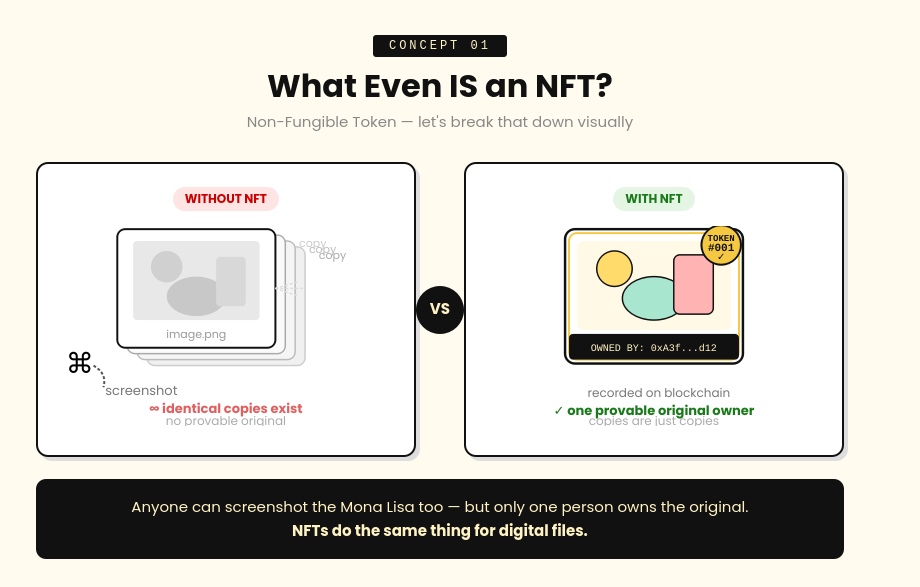
Digital files have always had one fundamental property: they're infinitely copy-able at zero cost. You take a photo, I can save it. You make a song, someone rips it. You draw a piece of art, it's screenshot a thousand times before lunch. This is actually one of the great gifts of the internet — information spreads freely and cheaply.
But it creates a real headache for creators.
If I paint a physical painting and sell it to you, you own it. When you sell it to someone else for 10x the price twenty years later, that transfer is unambiguous — one person hands over a canvas, another hands over money. There's a clear record of who owns the original.
In the digital world, there's been no equivalent. Any file that can be opened can be copied. The "original" and the copy are byte-for-byte identical. There was no way to say "this specific file is the one you actually own" — because ownership of data isn't really a concept that the internet was built with.
That's the gap NFTs fill. Not perfectly, and not without flaws — but they fill it.
So What Actually Is an NFT?
NFT stands for Non-Fungible Token
Let's unpack that.
Token means it's a unit on a blockchain — like a coin, but it carries data.
Non-Fungible is the interesting part. "Fungible" means interchangeable. A dollar is fungible — trade your dollar for my dollar and nothing changes. A Bitcoin is fungible — one BTC equals one BTC, wherever it is, whoever owns it.
Non-fungible means the opposite: each one is unique and can't be directly swapped for another of the same type.
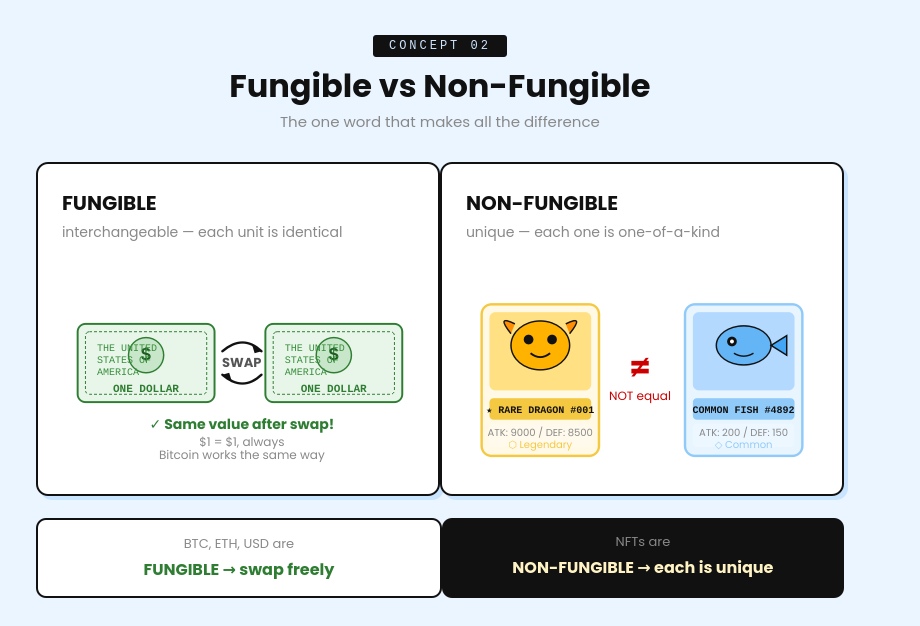
Think of a physical trading card. A common card from a booster pack is worth maybe 50 cents. A holographic first-edition rare of the same character could be worth thousands. Even though they're both "the same card," they're not interchangeable — one is uniquely valuable. That's non-fungibility.
An NFT is a token on the blockchain that represents ownership of something unique. The "something" can be:
A digital artwork
A piece of music
A video clip
An in-game item
A real estate deed
A concert ticket
Your university degree
The NFT doesn't necessarily contain the file itself. Think of it less like the object and more like the certificate of authenticity and the title deed rolled into one — permanently stored on a blockchain that no single entity controls.
Breaking Down the Anatomy
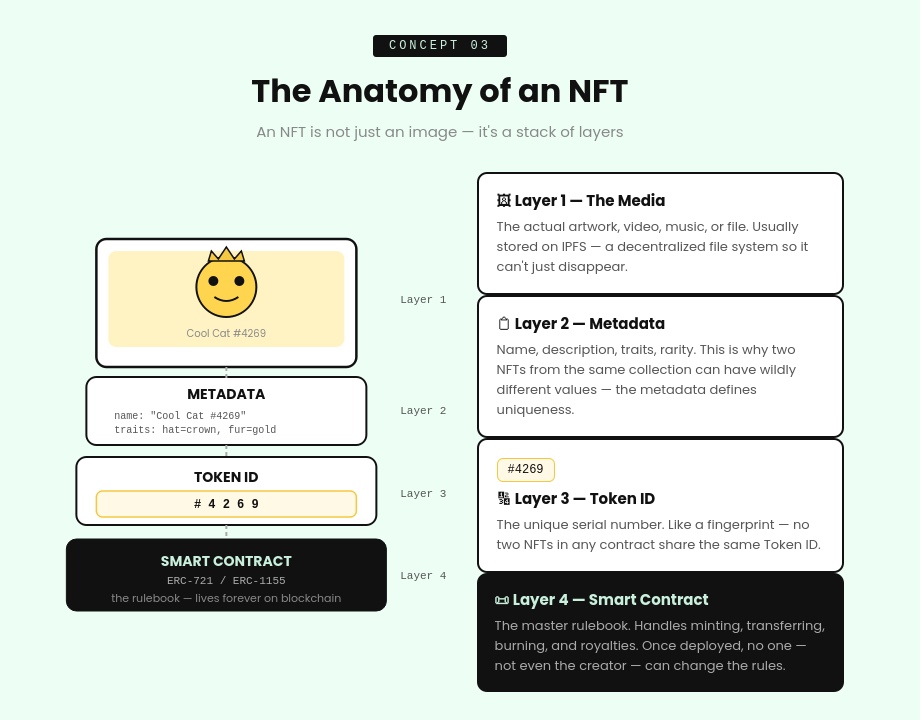
When you "own" an NFT, what you're actually holding is a few interlocking pieces:
Layer 1 — The Media File
The actual image, video, or audio. This usually lives on IPFS (InterPlanetary File System) — a decentralised storage network where files are identified by their content rather than a location. This matters because if it were stored on a normal server, the company running it could delete it. IPFS makes that much harder.
Layer 2 — The Metadata
A structured data file (usually JSON) that contains the name, description, and traits of the NFT. This is where "rarity" comes from in collections — if only 1% of tokens have the "gold background" trait, those tokens command a premium.
Layer 3 — The Token ID
The unique serial number. Within any smart contract, no two NFTs share the same Token ID. This is the actual fingerprint of uniqueness.
Layer 4 — The Smart Contract
The rulebook that governs everything: minting, transfers, royalties, burning. It lives on the blockchain and once deployed, not even the creator can arbitrarily change the rules. ERC-721 and ERC-1155 are the two main standards on Ethereum.
How Minting Actually Works
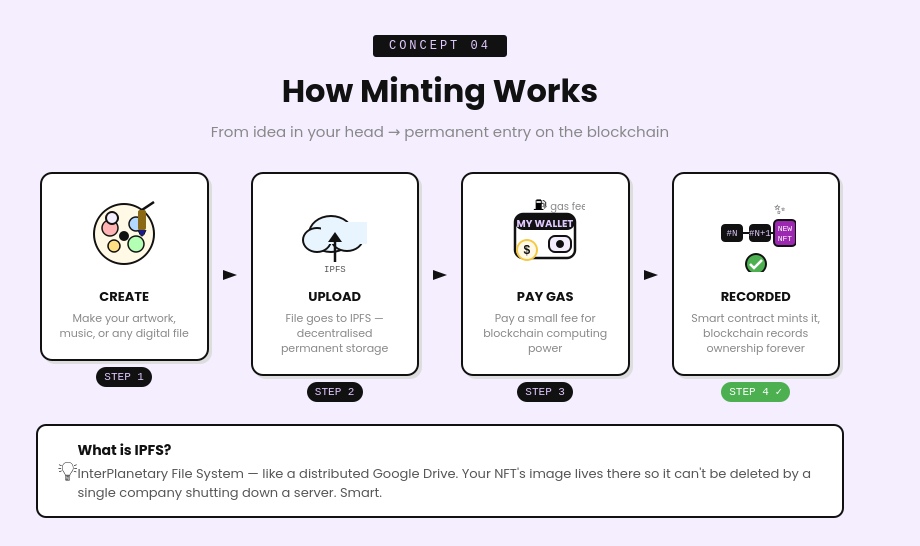
"Minting" is the act of creating an NFT — it's the moment the token gets recorded on the blockchain for the first time.
Here's how it actually happens:
Step 1 — Create your file. Make whatever digital thing you want to tokenise.
Step 2 — Upload to IPFS. Your file gets pushed to decentralised storage and comes back with a unique content-based address (a CID — Content Identifier). The metadata file gets uploaded the same way.
Step 3 — Pay gas. Interacting with the blockchain costs a small fee paid in the chain's native token (ETH for Ethereum). This fee compensates the validators who process the transaction.
Step 4 — The smart contract does its thing. It assigns a new Token ID, records your wallet address as the owner, stores the pointer to your metadata, and writes all of this permanently into the blockchain. No take-backs.
From this point on, that NFT exists. The record is public, tamper-proof, and doesn't depend on any company staying in business.
The Part Creators Should Actually Care About: Royalties
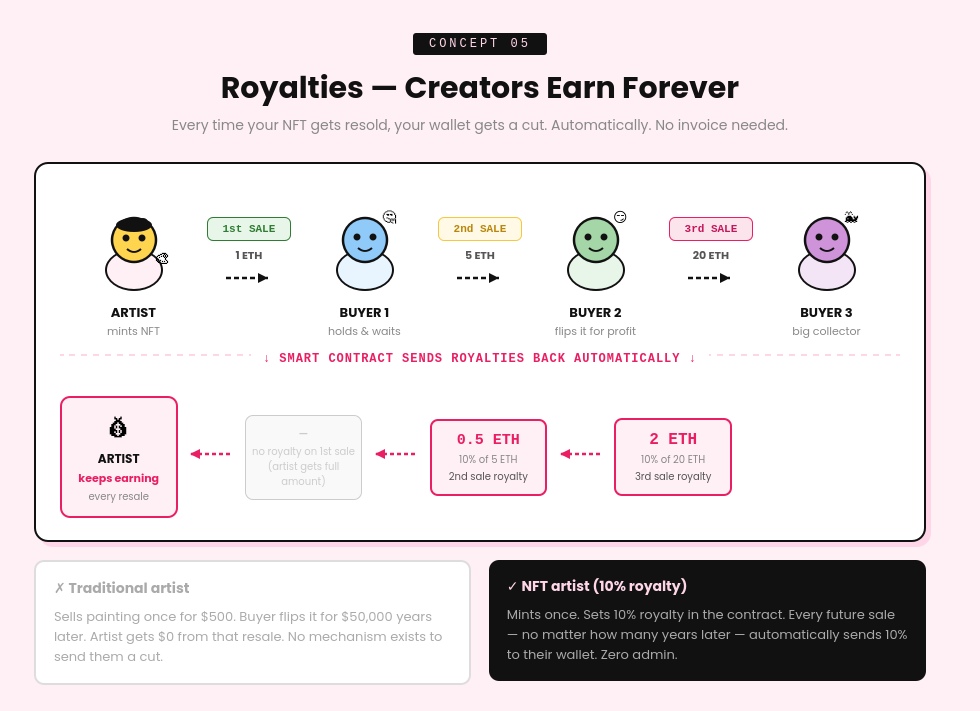
This is, genuinely, one of the most interesting things NFTs introduced — and it's been underappreciated amid all the JPEG discourse.
When you mint an NFT, you can encode a royalty percentage into the smart contract. Let's say 10%. Every time that NFT gets resold on a secondary marketplace, 10% of the sale price automatically gets sent to your wallet. No invoice, no chasing payment, no middleman taking a cut.
Think about what this means for artists. A musician sells an album as NFTs to early fans. Those fans sell the NFTs later when the artist blows up. The artist gets 10% of every resale — automatically, forever, because the smart contract enforces it. This is structurally different from anything the traditional art or music world offered.
Is there a catch? Yes — royalty enforcement is still evolving. Some marketplaces have made royalties optional, which created controversy. But on-chain royalty enforcement (via newer standards) is being developed to make this more reliable. The principle is sound; the implementation is still being worked out.
NFTs Are Bigger Than Digital Art
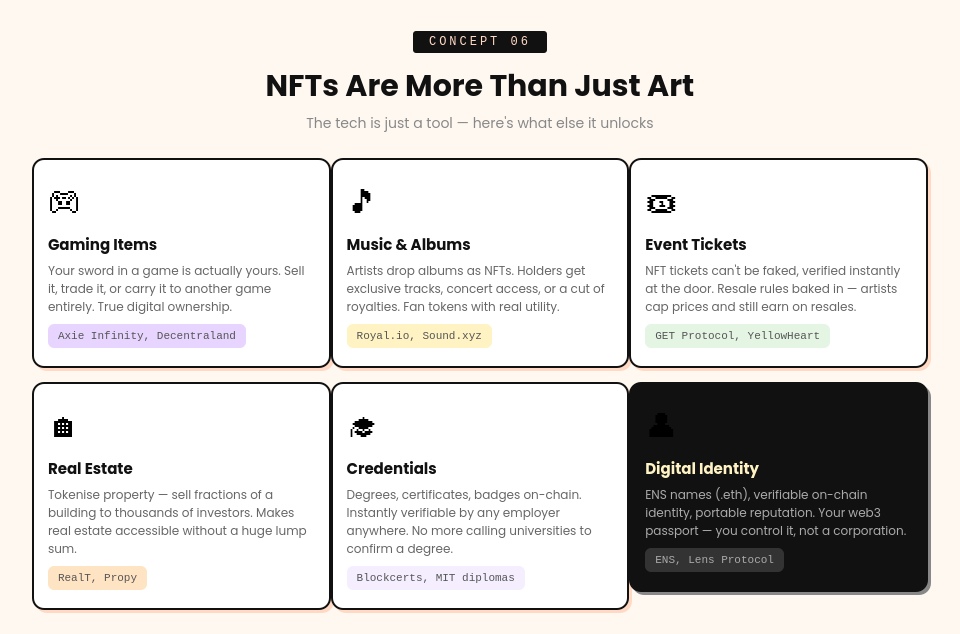
The public conversation about NFTs got fixated on expensive JPEGs. That's a bit like judging databases by whether you like spreadsheets. The technology has real applications across industries:
Gaming — Your sword, your skin, your virtual land. NFTs let players actually own their in-game items and sell them if they stop playing. This has always felt broken in traditional gaming — you spend years on an account and if the servers go down, it's gone.
Event Tickets — NFT tickets can't be forged. Ownership is verifiable in seconds. Artists can program maximum resale prices directly into the contract, solving the scalper problem that has plagued live music for decades.
Real Estate — Property can be fractionalized — split into hundreds or thousands of tokens, each representing a share. This makes real estate investment accessible to people who can't afford a full property deposit.
Credentials — Universities like MIT have already experimented with blockchain diplomas. An employer can verify a degree in seconds without calling anyone. In regions with poor record-keeping infrastructure, this is genuinely impactful.
Digital Identity — ENS names (.eth domains) function as readable wallet addresses and on-chain identities. As more of life moves on-chain, having a portable, self-owned identity you control becomes more valuable.
The Honest Reality Check
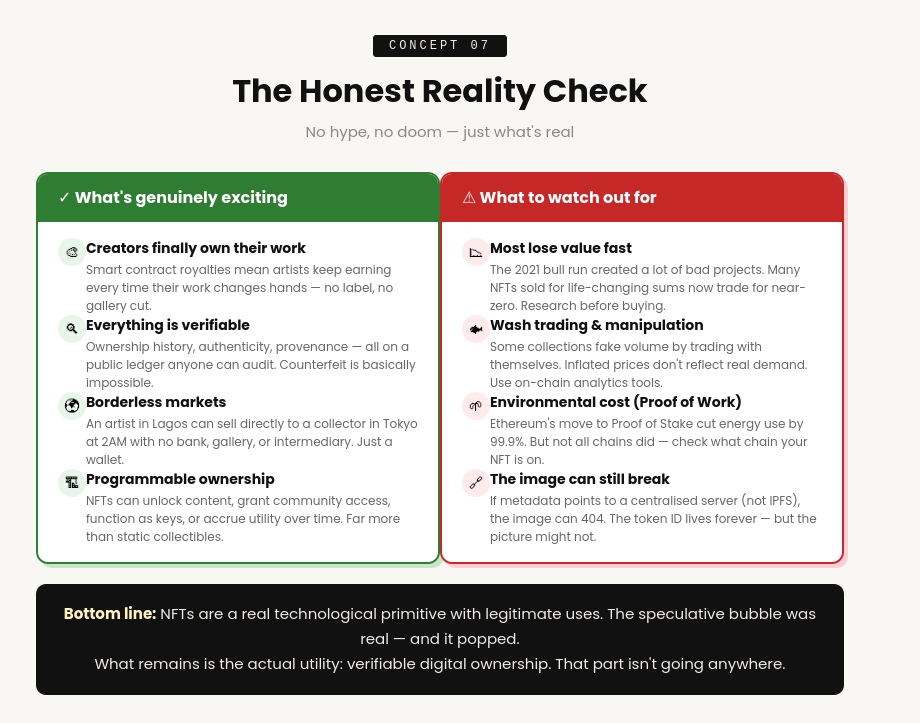
Let's not pretend the space is perfect.
The good:
The technology solves a real problem. Verifiable digital ownership, programmable royalties, borderless markets, and self-custodied assets are all genuinely useful primitives. The tooling has improved enormously and legitimate use cases are being built.
The messy:
The 2021 bull market attracted enormous amounts of speculation and some outright fraud. Wash trading (where people trade with themselves to fake volume), rug pulls (teams that abandon projects after collecting funds), and zero-utility collections were very real problems. Many people lost money.
The nuanced:
Ethereum's move to Proof of Stake in 2022 reduced its energy use by roughly 99.9%, addressing the environmental criticism that was legitimate for Proof of Work chains. The "you can just screenshot it" argument misunderstands what ownership means — you can also photograph the Mona Lisa, but the museum still owns it.
The actual risk you should know:
If an NFT's metadata points to a centralised server rather than IPFS, the image can disappear when that server goes offline. The token ID lives on the blockchain forever; the picture it points to might not. This is a real, ongoing issue in the space.
Conclusion
Together NFTs are, at their core, a mechanism for establishing and transferring verifiable ownership of unique digital items. The blockchain is the ledger, the smart contract is the rulebook, and the token is the certificate.
Like most technologies, they've been hyped, misused, and misunderstood. They've also been used to help independent artists earn more sustainably, to create new kinds of digital ownership, and to solve problems — like ticketing fraud and credential verification — that genuinely needed solving.
The speculative bubble deflated. What's left underneath is the actual technology — and that part is still here, still being built on, and worth understanding.
Whether you ever buy an NFT is entirely up to you. But now you know what you'd actually be buying.