
Unified Agentic Quant intelligence across Crypto, Liquidity Pools, & Tokenized assets
Demo Video Link: https://canva.link/5frep71kinkib0r
Website: arivion.xyz
Arivion is an AI trading operations cockpit for active digital asset investors, quant builders, and laid back investors.
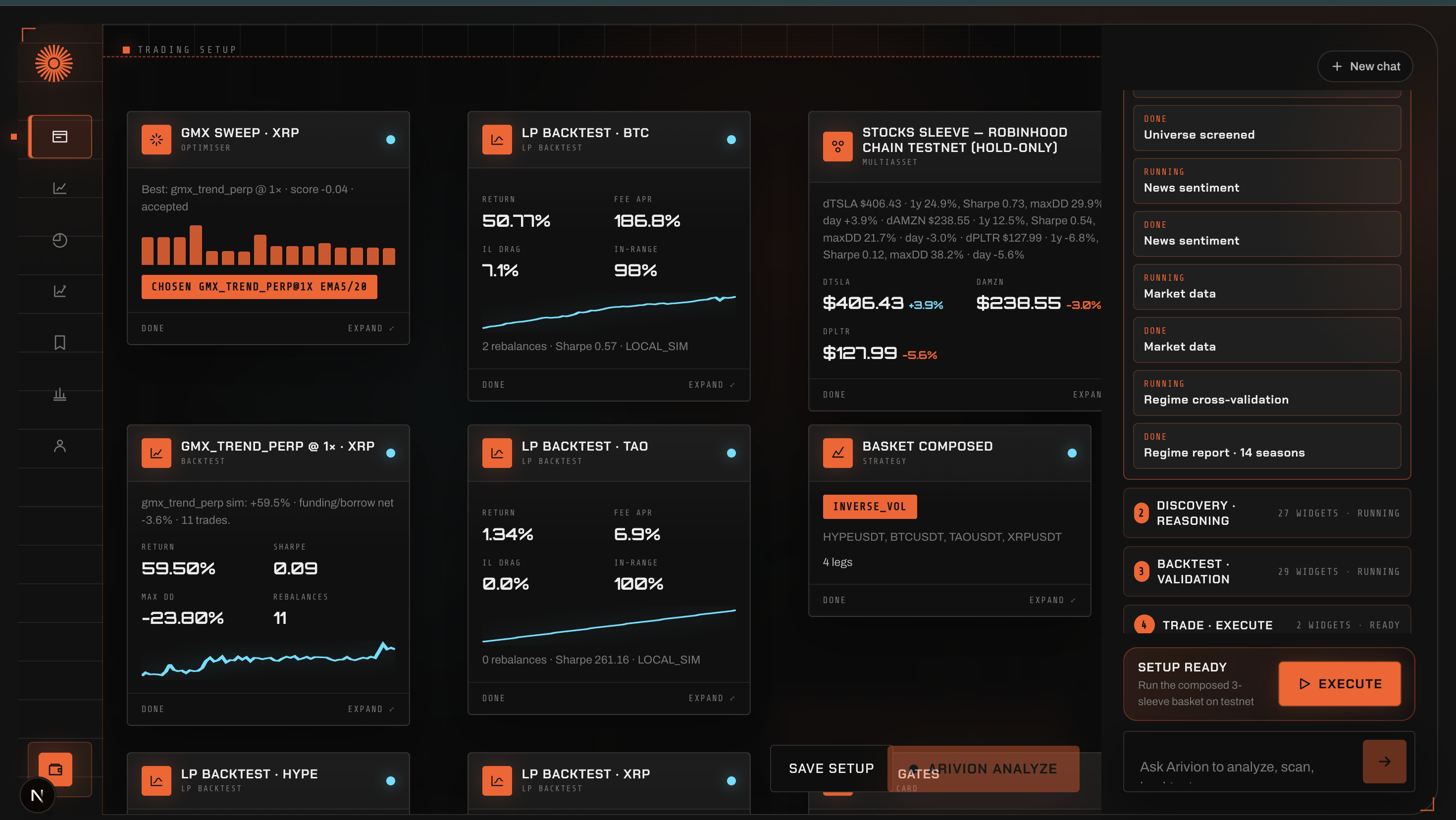
AI trading tools often stop at surface level recommendations. They can summarize markets, but they rarely connect that reasoning to live data nor test strategy logic, risk constraints, and verifiable execution assumptions.
Arivion helps users move from market research to tested strategy in one workflow. Discover opportunities, analyze live market conditions, build trading logic, run backtests, simulate portfolios, monitor positions, and prepare execution with clear evidence behind every decision.
Most Agents can summarize headlines, explain indicators, or suggest a trade idea, but they do not carry that idea through the full professional workflow. Arivion Copilot is different because it connects market context, opportunity discovery, strategy construction, backtesting, risk review, portfolio planning, and execution preparation inside one governed system.
Every recommendation from Arivion is designed to be backed by measurable outputs. Backtest results, paper trading performance, drawdown, risk exposure, fill assumptions, data coverage, and verification status. This makes Arivion more useful for serious traders because it does not just answer “what looks good?” It helps answer “why should I trust this setup?”
Stage 1: Real-World Market Context
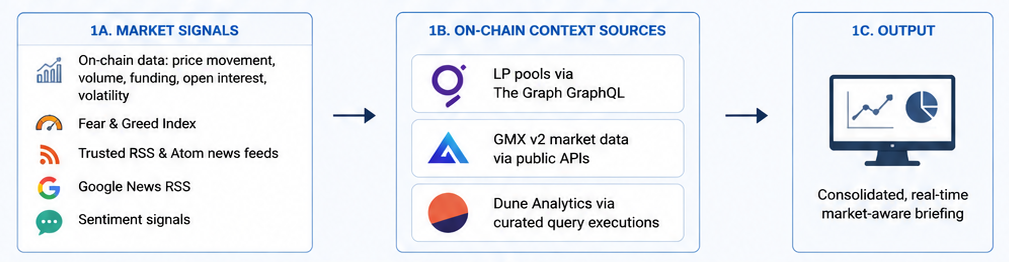
Before making a recommendation, Arivion builds a live market briefing. It reads on chain data for price movement, volume, funding, open interest, and volatility. It adds Fear & Greed data, trusted RSS and Atom news feeds, Google News RSS, and sentiment signals. For on chain context, it checks LP pools through The Graph GraphQL, GMX v2 market data through public APIs, and Dune Analytics through curated query executions. This gives the agent a market aware view before it begins screening or strategy design.
Stage 2: Discovery and Screening
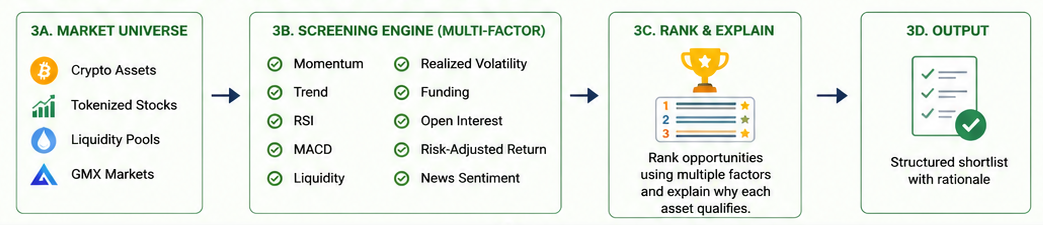
The agent then screens assets across crypto, tokenized stocks, liquidity pools, and GMX markets. The screening engine evaluates momentum, trend, RSI, MACD, liquidity, realized volatility, funding, open interest, risk-adjusted return, and news sentiment. Instead of just listing “top movers,” Arivion ranks opportunities using multiple factors and explains why each asset qualifies. This turns broad market noise into a structured shortlist the user can actually evaluate.
Stage 3: Backtesting and Validation
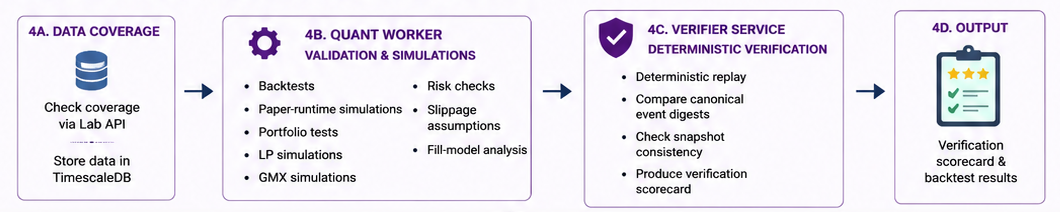
Once a setup is selected, Arivion checks data coverage through the Lab API and stores data in TimescaleDB. The Quant Worker then runs validation, backtests, paper-runtime simulations, portfolio tests, LP simulations, GMX simulations, risk checks, slippage assumptions, and fill-model analysis. If the result is meaningful, the Verifier service performs deterministic replay, compares canonical event digests, checks snapshot consistency, and produces a verification scorecard.
Stage 4: Execution Plan and Guardrails

After validation, Arivion creates a practical execution plan. Allocation, venue route, entry rules, exit rules, stop-loss, risk caps, and required approvals. If the user chooses testnet execution, the system uses EVM JSON-RPC through ethers, Chainlink AggregatorV3-style price reads, ERC-20 approvals, token mints, Robinhood Chain testnet stock-vault calls, and Arbitrum Sepolia AMM routes. GMX v2 live routes are separately guarded by confirmation phrases, kill switches, leverage caps, collateral caps, and owner-scoped ledgers. The agent can plan and act, but only inside controlled boundaries.
Core Backend Services
apps/api is the Lab API. It is an Express service on port 4000, with auth, owner scoping, strategy CRUD, paper sessions, backtests, backfill queue control, data coverage, chain/wallet/DEX routes, testnet intents, GMX guarded live routes, and stock-order routes. It also boots the BullMQ backfill worker and the tokenized-stock order engine.
apps/agent is the Copilot service on port 4500. It owns threads, messages, runs, SSE streaming, credits, LLM gateway/metering, memory, knowledge retrieval, triggers, managed paper positions, market analysis, and multiasset setup flows. It connects to MCP using the user’s owner token.
apps/mcp is the tool facade. It exposes MCP tools grouped as data, build, live, DEX, portfolio, wallets, testnet, verifier, ingestor, and sandbox tools. In Compose it runs in passthrough auth mode, meaning calls use the caller’s owner JWT rather than a shared service identity.
Workers
apps/worker is the Quant Worker. It is a FastAPI service for heavy quant computation: semantic strategy validation, backtests, optimizer runs, paper runtime, bot runs, portfolio runs, LP valuation/simulation, multiasset planning, Stocks catalog/session logic, and risk evaluation. It also runs two always-on managers: LivePaperManager for live paper sessions and LivePortfolioManager for multiasset paper sessions.
apps/data-ingestor is the market-data worker. It backfills and streams market candles, mark/index candles, funding, open interest, long/short ratios, instruments, L2 snapshots, trades, DEX pools/swaps/candles, LP positions, and live prices. On startup it launches a REST live poller, a GMX realtime WebSocket collector, optional raw WS collector, and DEX live poller.
apps/verifier is the trust/replay worker. It verifies “passports” by replaying canonical runs, comparing event digests and metrics, rejecting mismatches, and returning signed verification metadata for trusted tiers like backtest verified or live-paper verified.
apps/sandbox-runner is the untrusted-code worker. It statically scans user strategy code, blocks dangerous imports/names, then executes in an isolated subprocess with resource limits, cleared environment, blocked filesystem/network/process access, and a read-only container in Compose
There are also “workers” inside Node services: the API boots a BullMQ backfill worker in and a stock order engine for testnet tokenized- tock orders. The Agent boots a Redis trigger subscriber, position monitor, and scheduled reflection loop.
Data Architecture
Postgres/TimescaleDB is the source of data storage. It stores users, strategies, candles, funding, L2/trades, backtests, paper sessions/events/fills, optimizer runs, bots, DEX pools/swaps/candles, wallet links, testnet intents, agent threads/runs/messages, memory, knowledge vectors, credits, approvals, positions, GMX orders, and stock orders. Redis is used for BullMQ queues, token/session revocation checks, realtime pub/sub and live session updates.