
Decentralized synthetic data marketplace
Bittensor Subnet Ideathon · Privacy-preserving AI training data, generated on-demand by a competitive network of miners
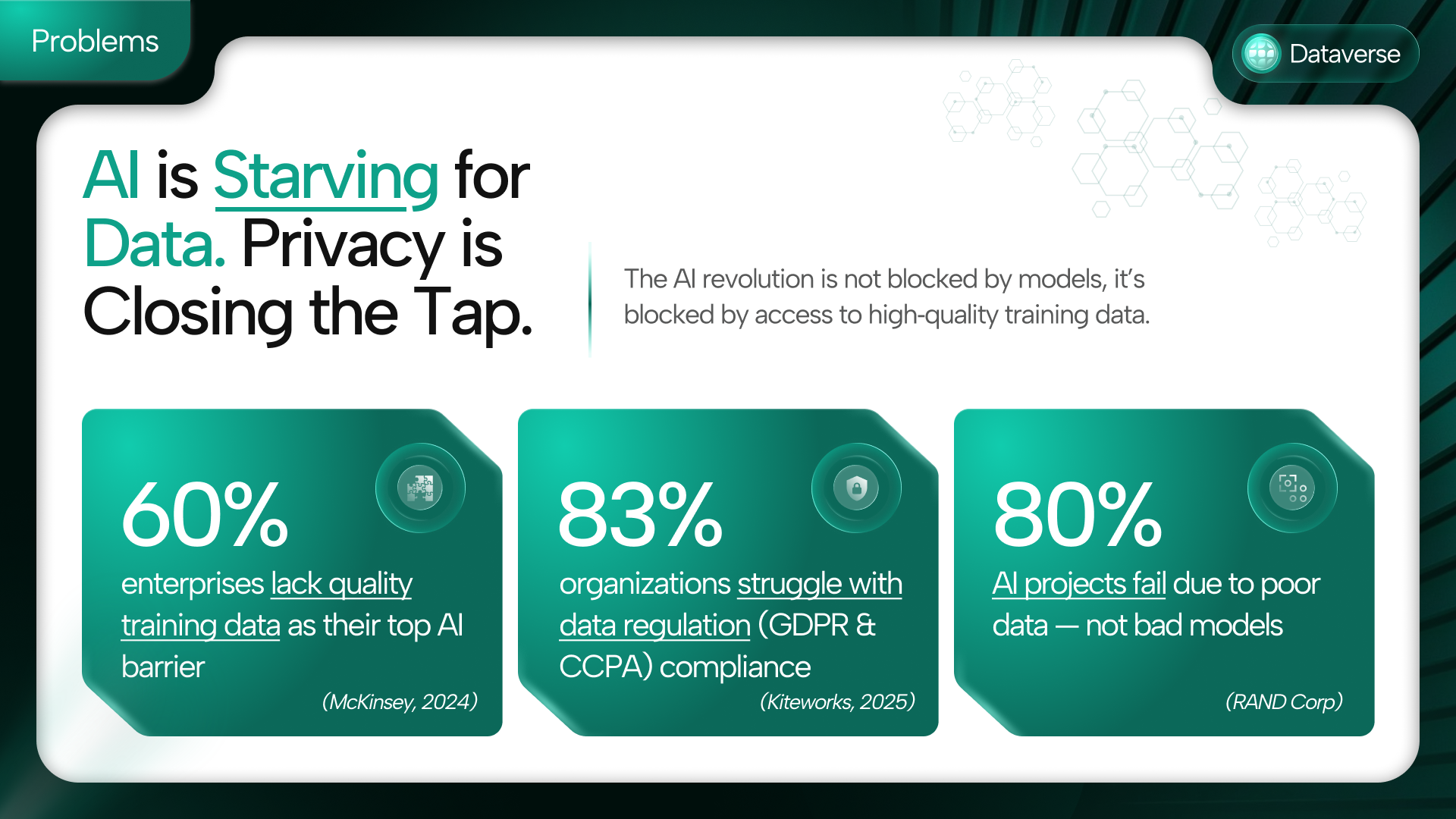
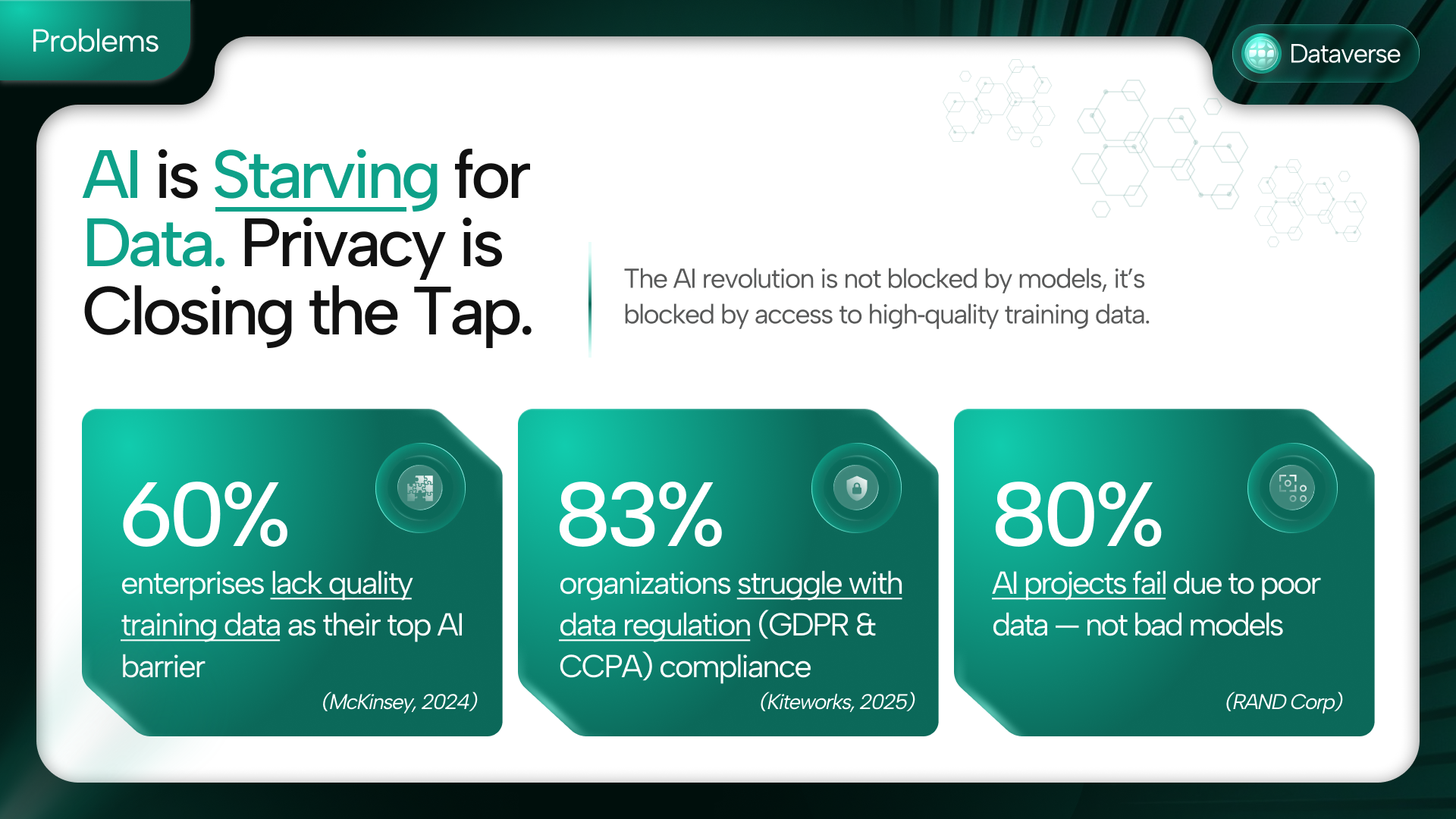
The pace of AI model development has far outstripped the availability of legally compliant training data. For regulated industries — healthcare, finance, insurance — accessing real data is not a technical problem. It's a legal and compliance nightmare.
7–13 months of compliance overhead just to access healthcare data: IRB review, HIPAA authorization, legal DUAs, and audits — before a single training run.
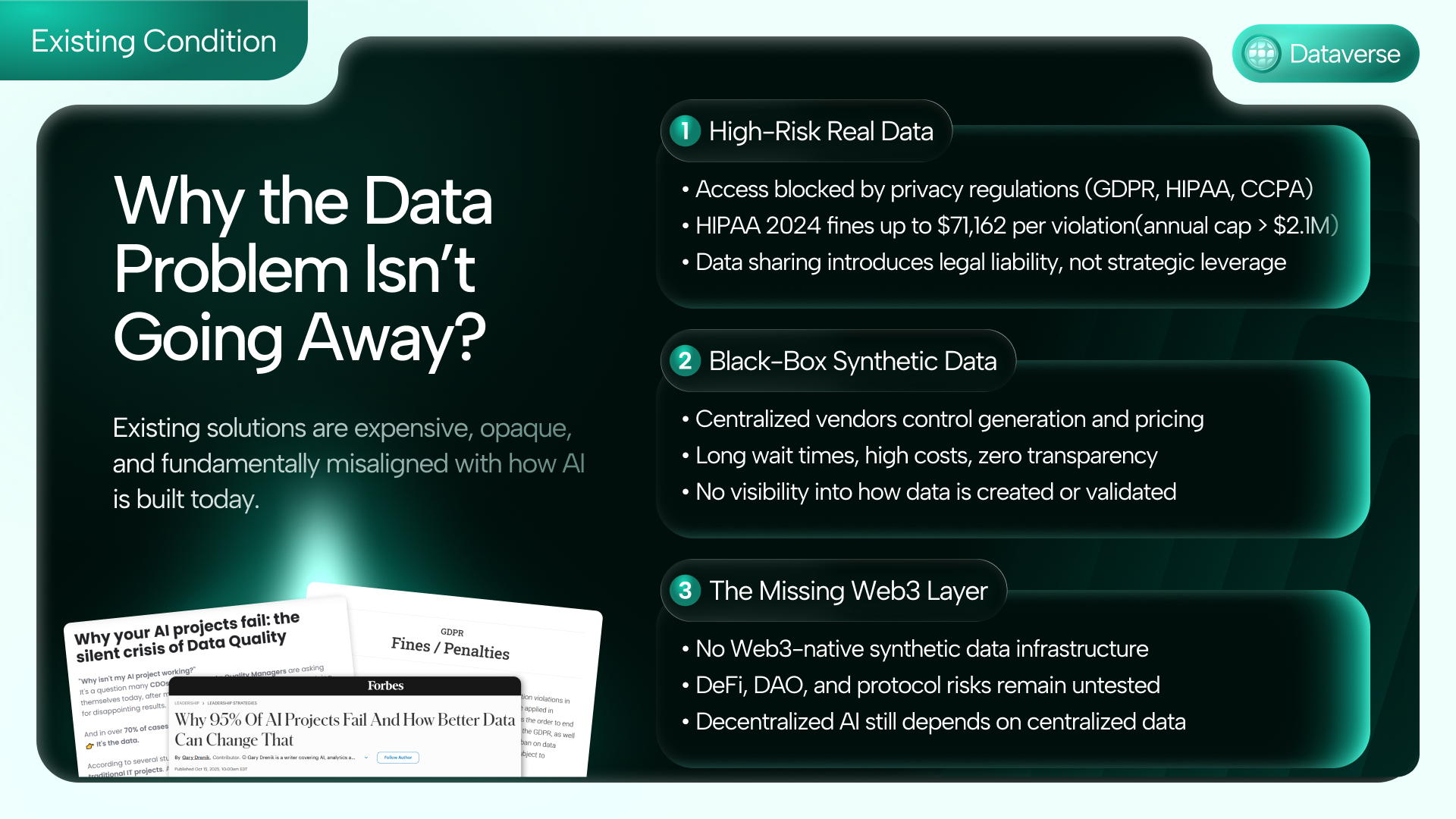
Up to $71,162 per HIPAA violation; up to 4% of global annual revenue for a GDPR breach.
Centralized vendors like Gretel, Mostly AI, and Syntho are black boxes — opaque pipelines, weeks of wait time, and a single point of failure. Gretel was acquired by NVIDIA in March 2025, concentrating the market further.
Enterprises know exactly what model they need to build. They just can't get the data to build it.
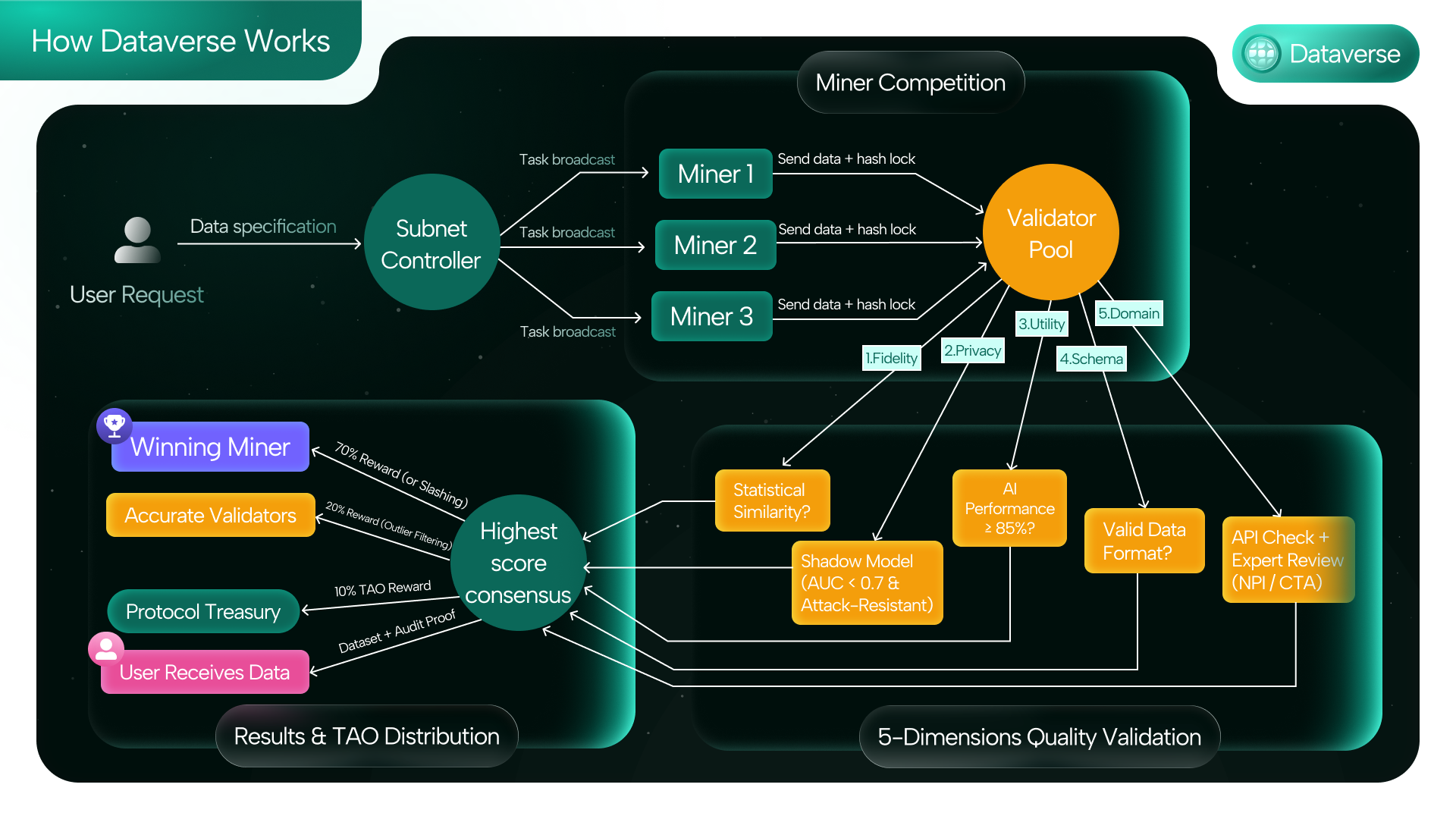
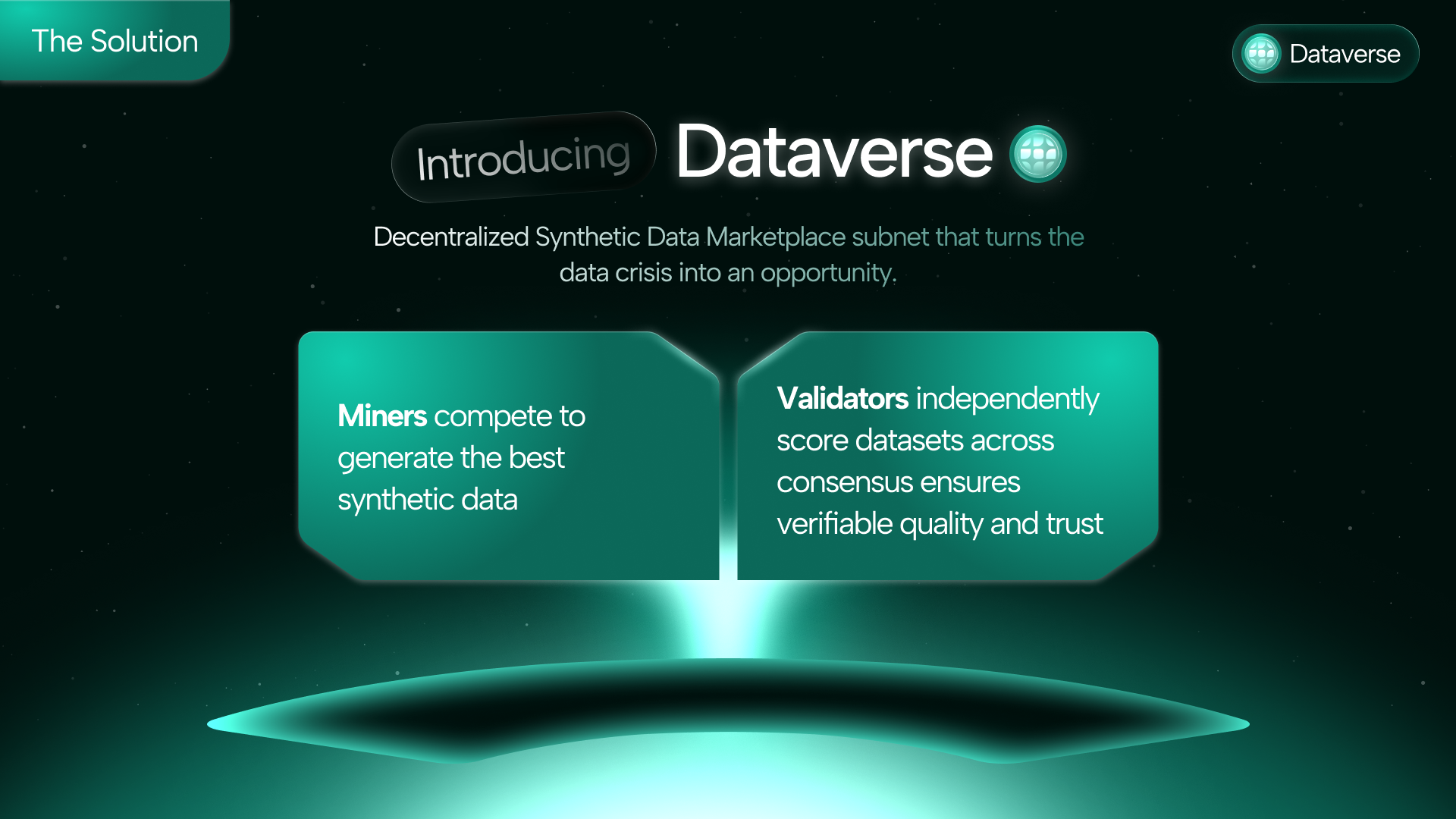
Dataverse is a Bittensor subnet that turns synthetic data generation into a competitive AI marketplace. Instead of relying on a single provider, Dataverse deploys a decentralized network of miners that each:
Parse the user's schema and domain requirements (healthcare, finance, retail, etc.).
Generate a competing synthetic dataset using their best model — GAN, LLM, rule-based, or hybrid — with differential privacy applied at generation time.
Submit the dataset for independent scoring across 5 dimensions: statistical fidelity, privacy resistance, downstream utility, schema compliance, and domain authenticity.
Validators score every submission and reach consensus. Rewards distribute via softmax — better models earn disproportionately more. The network gets smarter over time, automatically.
Provider | Wait Time | Verifiable Quality | Decentralized | Privacy Proof |
|---|---|---|---|---|
Gretel (acq. NVIDIA) | Days–weeks | ❌ | ❌ | ❌ |
Mostly AI | Days–weeks | ❌ | ❌ | ❌ |
Syntho / Tonic.ai | Days–weeks | ❌ | ❌ | ❌ |
Dataverse | Minutes–hours | ✅ Signed certificate | ✅ | ✅ Explicit ε report |
Dataverse isn't just using Bittensor — it's designed around it. Synthetic data generation is compute-intensive, highly variable in quality, and perfectly parallelizable: a natural fit for Bittensor's incentive model where intelligence is the commodity, not hardware.
The subnet introduces Proof of Generative Intelligence: miners invest in model quality, not GPU arms races. Validators are rewarded based on how closely their scores align with network consensus — making collusion unprofitable at any scale below a majority. Every dataset delivery comes with a cryptographically signed Quality Certificate documenting generation methodology, privacy parameters used, and all five dimension scores.
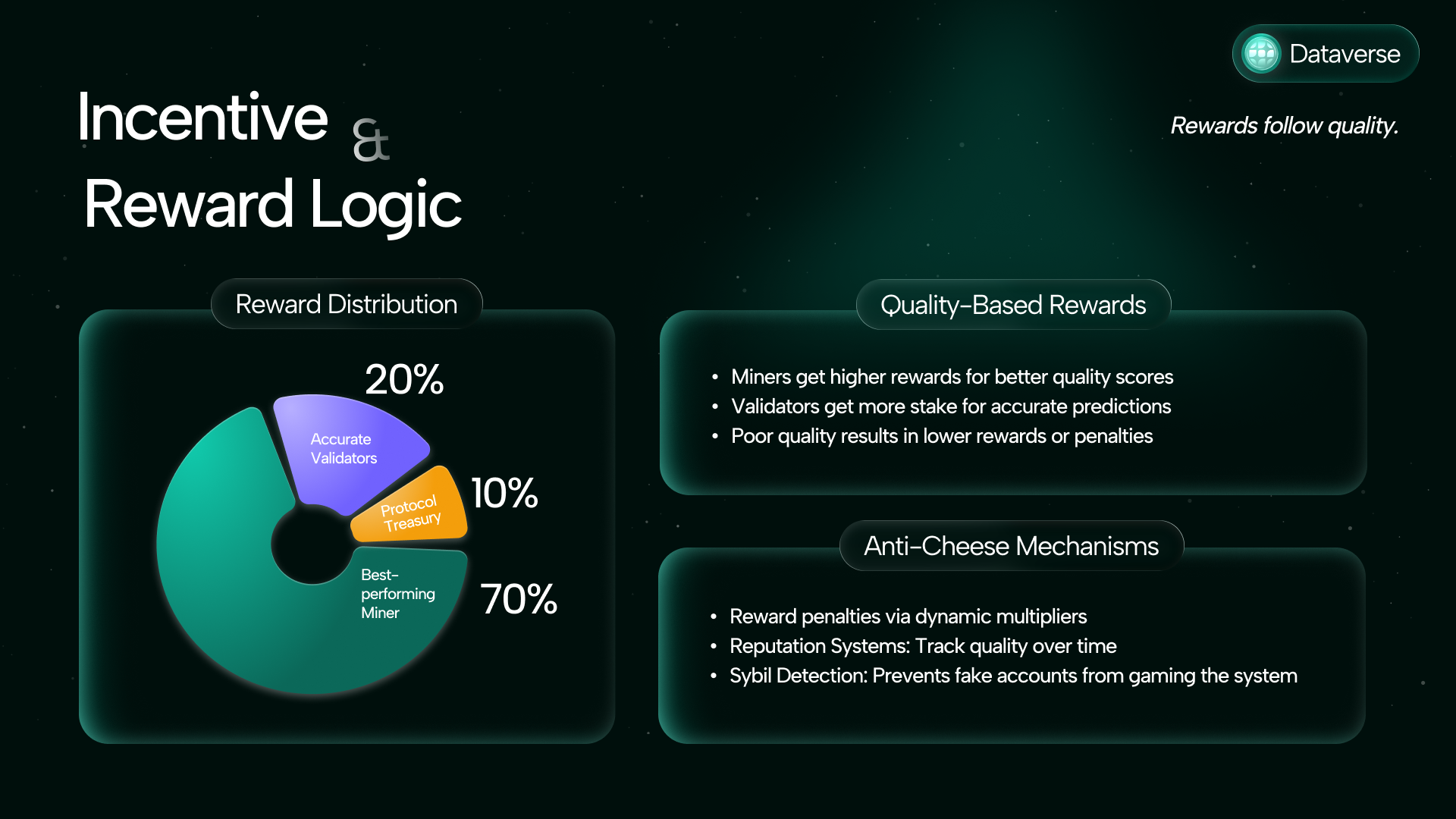
TAO emissions flow through a balanced structure: 70% to miners (quality-weighted), 20% to validators (accuracy-weighted), 10% to the protocol treasury. Users attach TAO to their requests — creating sustained buy pressure proportional to network usage. No separate fee layer. Protocol revenue scales directly with the network's utility.
Year 1 target: ~$1.6M ARR in protocol revenue · ~$16M annual network GMV
Month 6: 2 enterprise + 20 SMB customers → $440K GMV/month
Month 12: 7 enterprise + 50 SMB customers → $1.34M GMV/month
The synthetic data market is growing from ~$350–580M (2024) to $1.8B–$6.5B by 2030–2032 (CAGR 35–42%, four independent analyst sources). The fastest-growing segment — privacy-constrained regulated industries — is exactly where Dataverse's decentralized, compliance-grade approach has the strongest structural advantage.
Dataverse enters as a drop-in API for any AI team needing compliant training data, with a clear path from SMB self-serve → enterprise pilots → long-term SLA contracts as the network's track record and domain coverage scale up.
Curious about the full architecture, 5-dimensional scoring system, and go-to-market strategy?
→ Read the full whitepaper to see how Dataverse works under the hood.
Dataverse entered the Ideathon at the concept stage. Over the course of the hackathon, we built the full technical and economic blueprint for a production-ready Bittensor subnet. Here is what was completed:
Defined the full Proof of Generative Intelligence consensus mechanism — how miners compete, how validators score, how rewards flow.
Designed the 5-dimensional scoring system: Statistical Fidelity, Privacy Protection, Utility Performance, Schema Compliance, and Domain Authenticity — with explicit weights and measurement methodology for each dimension.
Specified the anti-collusion mechanism: validators are rewarded based on consensus alignment (Gaussian accuracy decay), making score inflation economically irrational.
Designed the penalty system: tiered infractions from -5% (slow submission) to permanent ejection (systematic gaming).
Finalized the TAO emission split: 70% miners (quality-weighted softmax), 20% validators (accuracy-weighted), 10% protocol treasury.
Built a full bottom-up revenue model: enterprise and SMB pricing tiers, monthly GMV and protocol ARR projections through Month 12.
Documented the TAO sink mechanics: how request volume translates to recurring TAO acquisition, buy pressure, and self-reinforcing growth dynamics.
Designed bootstrapping incentives: 2× reward multiplier for first 50 miners, elevated validator share (25%), and $5K compute credits from treasury for top early performers.
Implemented miner base class with abstract generate() interface, reputation-aware should_compete() logic, and cryptographic provenance recording.
Implemented GAN Miner: Generator/Discriminator architecture, domain-specific checkpoints, Gaussian differential privacy mechanism with ε/δ reporting.
Implemented LLM Miner: schema-to-prompt builder, JSON batch parsing, type enforcement, and domain expertise routing.
Implemented all 4 validator scoring modules: Statistical Fidelity (KS tests against public reference distributions), Privacy Protection (membership inference attack simulation via RandomForest), Utility Performance (TSTR benchmark with GradientBoosting), and Schema Compliance (null rate, type, range, categorical checks).
Implemented ValidatorConsensus: median-based consensus scoring and Gaussian accuracy decay for validator reward calculation.
Specified the full REST API and SDK examples (TypeScript + Python) for data request submission, status polling, dataset download, and quality certificate retrieval.
Researched and documented the competitive landscape: Gretel (acq. NVIDIA, 2025), Mostly AI, Syntho, Tonic.ai — pricing, transparency, and failure modes.
Aggregated market size projections from four independent analyst sources (Grand View Research, Next Move Strategy, Mordor Intelligence, ResearchAndMarkets) — $350–580M in 2024 to $1.8B–$6.5B by 2030–2032.
Documented supported reference datasets for 6 initial domains (Healthcare, Finance, Retail, Insurance, HR, Web3) — all publicly accessible, no private data required.
Phase | Timeline | Key Deliverable |
|---|---|---|
Foundation | Q1 2026 (now) | Spec finalization, public reference dataset curation, pre-trained GAN checkpoints |
Testnet | Q2 2026 | Live GAN/LLM miners, full validator suite, bootstrap validator set (10–20) |
Pilot | Q3 2026 | 5–10 paying customers, real TSTR benchmarks, incentive calibration |
Mainnet | Q4 2026 | Permissionless participation, community governance, open onboarding |
Dataverse is currently in its pre-seed stage — bootstrapped and unfunded. The hackathon submission represents our first public milestone and the foundation for our first external funding conversation.
Funding raised to date: $0 (bootstrapped)
Stage: Pre-seed — seeking initial capital to fund the Testnet phase
Team commitment: Full-time focus on Dataverse through mainnet launch (Q4 2026)
Use of Funds | Allocation | Purpose |
|---|---|---|
Miner Infrastructure | 40% | GPU compute credits for GAN/LLM training, pre-trained checkpoint preparation for 4 initial domains |
Core Development | 35% | Full validator suite implementation, API gateway, SDK, and testnet orchestration |
Bootstrap Incentives | 15% | $5K compute credit grants for top 10 early miners (per bootstrapping plan) |
Operations & Legal | 10% | Entity setup, compliance review, tooling, and initial community management |
Dataverse is designed to be self-sustaining from network activity — not dependent on continuous fundraising. The protocol's 10% treasury cut scales proportionally with request volume. At target scale:
Month 6: ~$44K/month protocol revenue → ~$440K network GMV/month
Month 12: ~$134K/month protocol revenue → ~$1.34M network GMV/month → ~$1.6M ARR
2027+: $10M+ ARR as enterprise adoption scales and domain coverage expands
We are actively seeking strategic investors and advisors who understand the Bittensor ecosystem and the synthetic data market opportunity. If you are building in this space or have portfolio companies with data compliance challenges, we would like to talk.