
Collatera
Collatera - Transparent Lending. Trusted Repayment.
视频
技术栈
描述
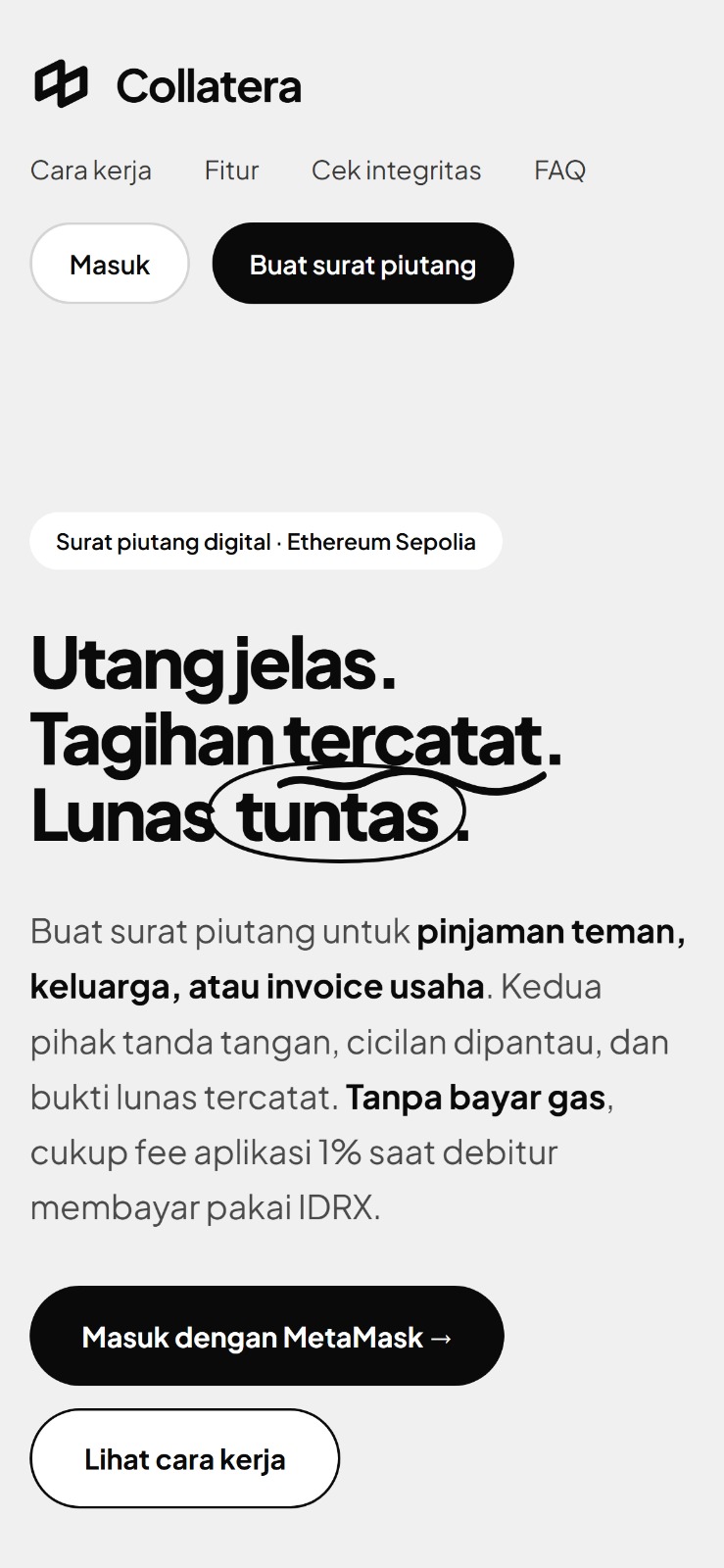
Collatera is a Web3 platform designed to make everyday lending clearer, safer, and more transparent. It helps people who lend or borrow money create digital debt agreements, confirm the terms through mutual signatures, and track repayments through the blockchain.
In many communities, lending money between friends, family members, and small businesses is a common practice. However, these agreements are often made informally, without proper documentation or a reliable way to track payments. Collatera aims to improve this process by bringing loan agreements into a digital environment where the terms and repayment records can be verified.
Built on the Ethereum Sepolia testnet, Collatera uses smart contracts to support digital debt records and repayment tracking. It also uses IDRX for repayments, allowing users to follow their outstanding debt through recorded transactions.
Our goal is simple: to make lending more transparent, reduce misunderstandings, and help both parties build trust through clear and verifiable records.
2. Problem
Informal lending is a common way for people to support one another financially. Someone may lend money to a friend, help a family member during an emergency, or provide short-term financial support to a small business.
However, these arrangements often rely on chat messages, paper receipts, or personal memory rather than a clear and organized system. Although this approach may seem convenient at first, it can create several problems over time.
Unclear loan agreements. The lender and borrower may remember different loan amounts, repayment dates, or payment conditions. Without a single agreed-upon record, even a small misunderstanding can become a serious dispute.
Difficult repayment tracking. When a loan is paid in several installments, it can be difficult to calculate how much has already been paid and how much remains outstanding. Payment deadlines may also be forgotten or overlooked.
Limited proof of repayment. After the borrower makes several payments, both parties may struggle to find complete and reliable records. The borrower may have difficulty proving that the debt has been fully paid, while the lender may have difficulty confirming the remaining balance.
Limited transparency and accountability. When agreements and payment records are scattered across different platforms, it becomes harder to verify the history of a loan and ensure that both parties are following the same terms.
These challenges show that informal lending needs a better way to record agreements, monitor repayments, and provide reliable proof of what has happened.
3. Solution
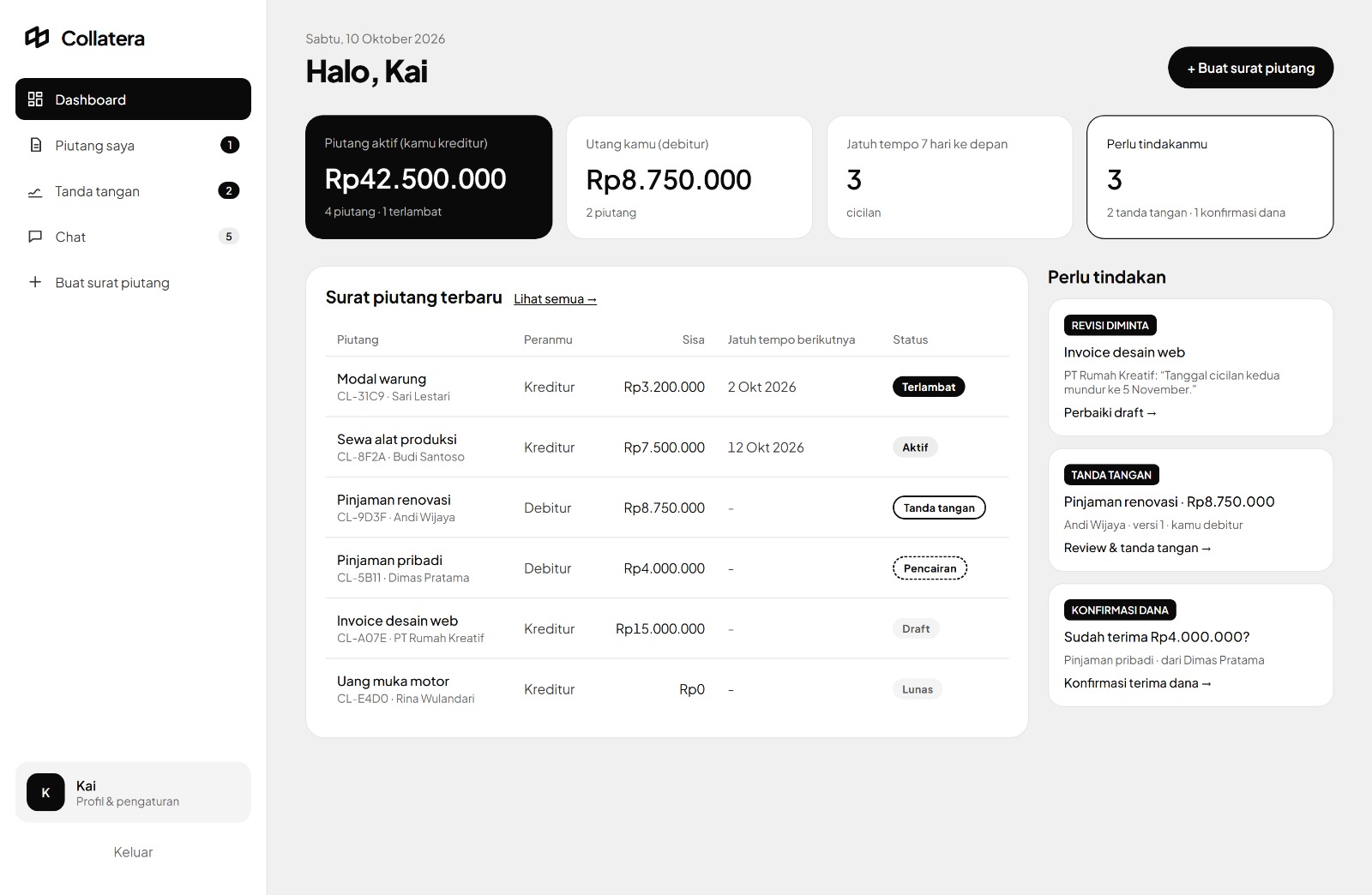
Collatera provides a digital debt management system that brings the loan agreement and repayment history into one process.
Instead of relying only on conversations or paper documents, users can create a digital debt agreement that contains the loan amount, repayment schedule, and supporting documents, such as receipts or business invoices.
The agreement is then shared with the other party for review. Both the lender and borrower must sign the same terms before the debt record can be created. If either party requests a revision, the agreement can be updated and signed again so that both parties agree to the latest version.
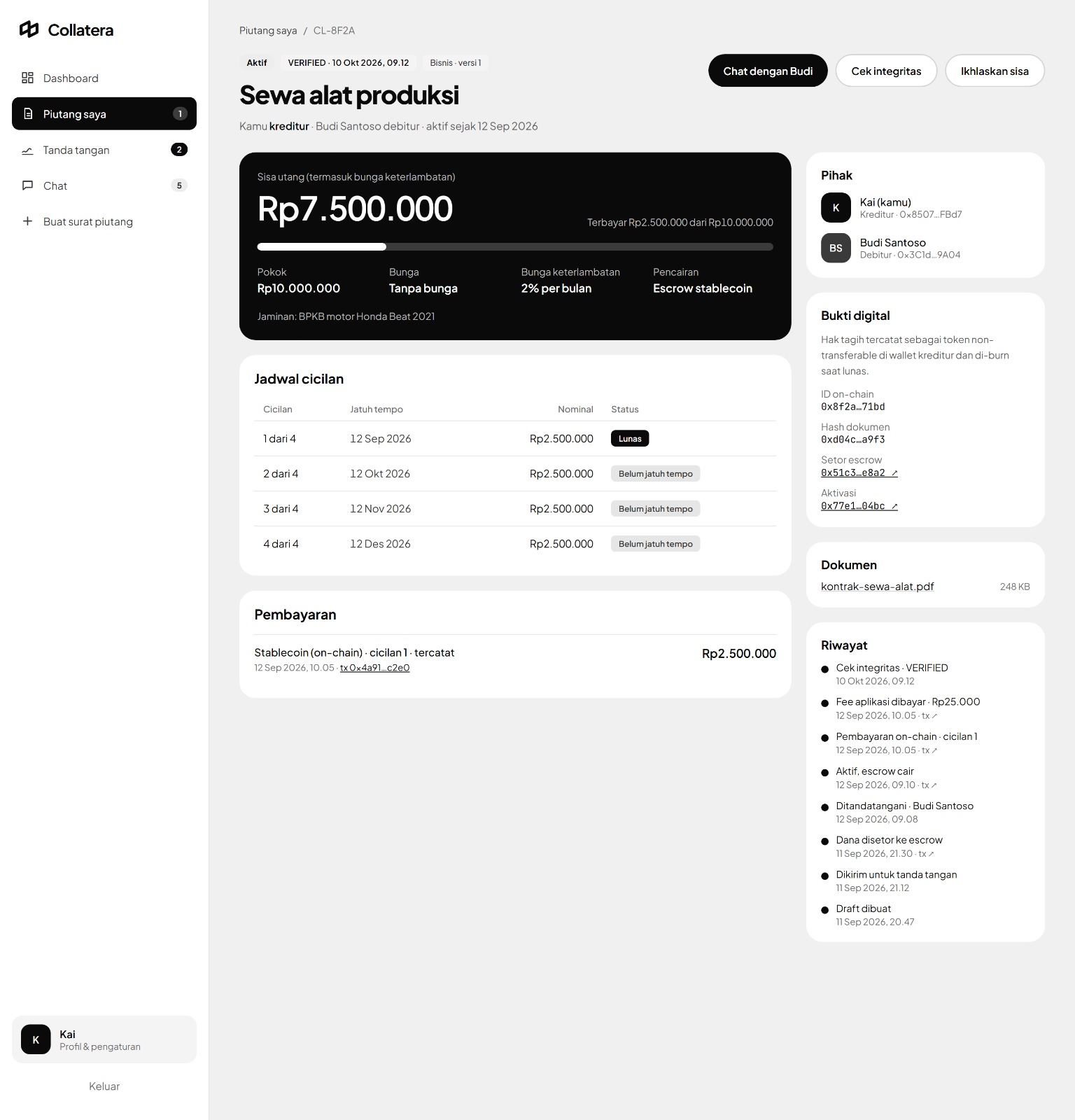
Once the agreement is confirmed, Collatera records the debt using its smart contract system. The borrower can make installment payments using IDRX, while the remaining balance is updated and recorded on the blockchain.
Collatera also uses document hashing to help detect unauthorized changes to the original agreement. Personal information and supporting documents remain off-chain, while selected records and their hashes are stored on-chain.
Through this approach, Collatera offers several key benefits:
- Clear agreements: Both parties can refer to the same digital debt record.
- Verified consent: The agreement requires signatures from both the lender and borrower.
- Transparent repayments: The payment history and outstanding balance can be tracked.
- Reliable records: Document hashes help identify changes to the original agreement.
- Digital proof of repayment: When the outstanding balance reaches zero, the record shows that the debt has been fully repaid.
Collatera is designed to support lending arrangements between people who already know each other. It focuses on making existing lending relationships more organized, rather than acting as a marketplace that provides loans.
4. Why Blockchain?
Blockchain is important to Collatera because debt agreements require records that both parties can verify and trust.
A traditional database can store loan information, but its records depend on the system that manages them. Blockchain introduces a shared, verifiable transaction history that helps make debt records and repayments more transparent.
Transparency and verification
Important debt and repayment records can be checked through the blockchain. This gives both parties a clearer view of recorded transactions and helps reduce uncertainty about payment history.
Data integrity
Collatera stores a digital fingerprint, known as a hash, of the agreement and its supporting documents. If the stored document changes, its recalculated hash will no longer match the original record. This helps detect unauthorized changes and supports further review when an issue is found.
Smart contract automation
Smart contracts support the logic behind debt agreements and repayment tracking. They help enforce the rules programmed into the system, reducing the need to calculate and update every record manually.
Traceable repayments
IDRX repayments are recorded on-chain, creating a verifiable history of payments. This allows the outstanding debt to be tracked as installments are made.
Privacy protection
Not all information needs to be public. Collatera keeps personal details, such as names and phone numbers, and supporting documents on its server. Selected debt information and document hashes are recorded on-chain instead.
By combining blockchain transparency with off-chain data storage, Collatera aims to balance accountability, data integrity, and user privacy.
5. Tools and Smart Contract Addresses
Collatera combines a web application, blockchain infrastructure, and smart contracts to support the digital lending process.
Technology Stack
Ethereum Sepolia Testnet
The blockchain network used to deploy and demonstrate Collatera's smart contracts. Sepolia provides a test environment for developing and evaluating the prototype.
MetaMask
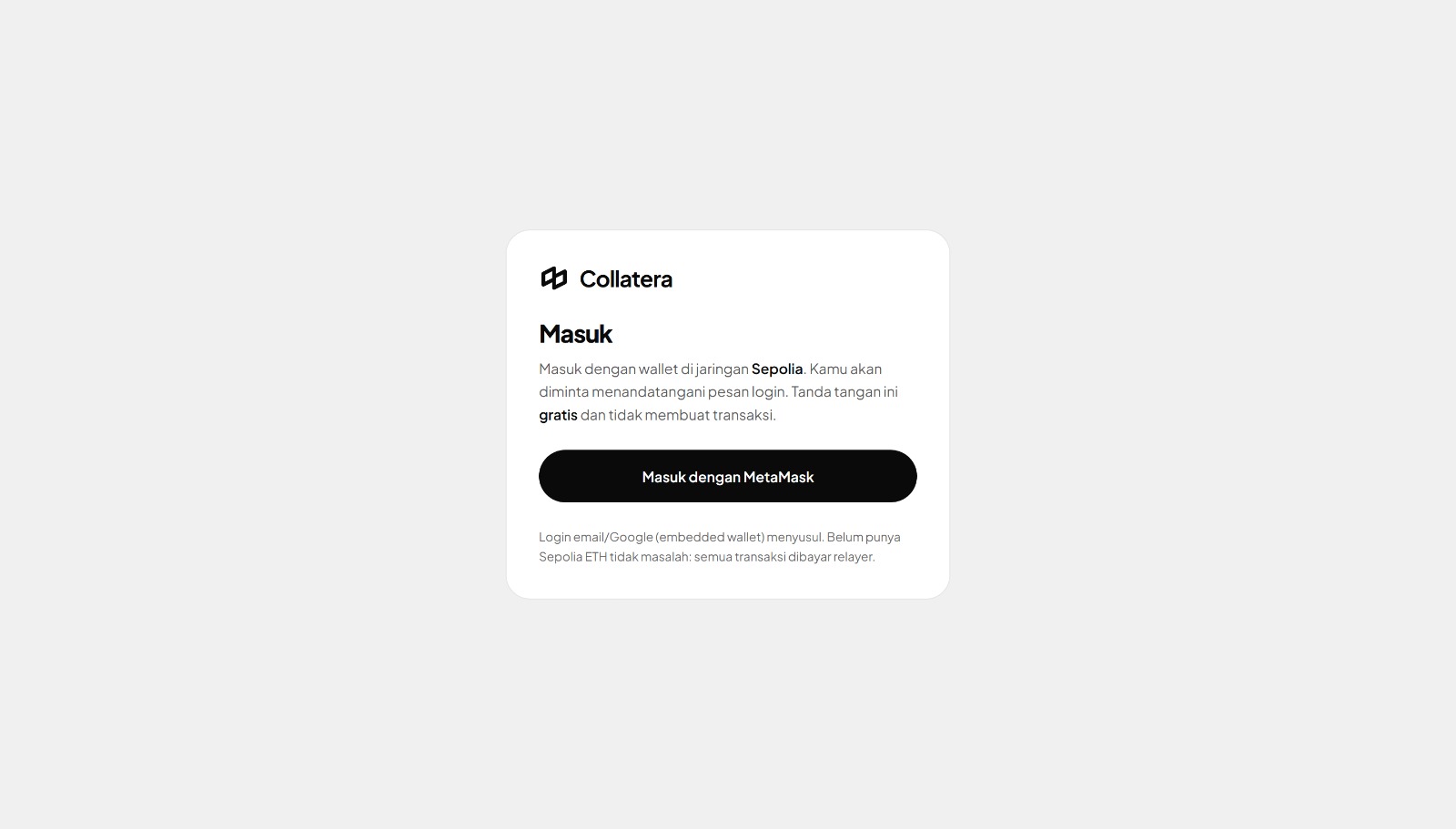
A cryptocurrency wallet that allows users to connect to Collatera and interact with the blockchain through their wallet.
IDRX / MockIDRX
IDRX is used as the repayment token in the platform's intended payment flow. MockIDRX serves as the test token for the prototype, allowing the payment process to be demonstrated in a test environment.
DebtNote
The smart contract component associated with issuing digital debt records. It represents the recorded debt agreement within the platform's blockchain implementation.
DebtManager
The smart contract component that manages the debt-related logic and repayment records.
CollateraForwarder
The forwarding contract used as part of the relayer mechanism to support user transactions.
Relayer
The relayer helps submit transactions on behalf of users, so they do not need to manage network gas fees directly. The application states that its relayer covers the network gas costs.
Vercel
The deployment platform used to host the Collatera web application and make the prototype accessible online.
Smart Contract Addresses
Network: Ethereum Sepolia Testnet
1. MockIDRX
0xD4E56a15B66B5a51f84d3Ae84ea64a0168ce05a9
[View contract on Etherscan](https://sepolia.etherscan.io/address/0xD4E56a15B66B5a51f84d3Ae84ea64a0168ce05a9)
2. CollateraForwarder
0x249147cc728f6b6c4518159cE63f2A94BaB2c6E7
[View contract on Etherscan](https://sepolia.etherscan.io/address/0x249147cc728f6b6c4518159cE63f2A94BaB2c6E7)
3. DebtNote
0xa707C66A9eD14957dFd9e10F52E99B15dE4418f4
[View contract on Etherscan](https://sepolia.etherscan.io/address/0xa707C66A9eD14957dFd9e10F52E99B15dE4418f4)
4. DebtManager
0x121d3Bbb150A53660f44241893B018F61cF84aBb
[View contract on Etherscan](https://sepolia.etherscan.io/address/0x121d3Bbb150A53660f44241893B018F61cF84aBb)
Project Links
- Live Application: https://collatera-app.vercel.app/
- GitHub Repository:*https://github.com/k41ts/collatera
本次黑客松进展
During the hackathon, we started by identifying a common problem in everyday financial relationships: informal loans often lack clear agreements, organized repayment records, and reliable proof of repayment.
We explored how blockchain could help address these challenges without making the process too complicated for everyday users. Instead of building a complex financial platform, we focused on a specific use case: helping two parties record and manage a debt agreement from the moment it is created until it is fully repaid.
Step 1: Identifying the problem
We examined the difficulties that lenders and borrowers can face when agreements depend on chat messages, paper receipts, or memory. This helped us define our main objective: to create a clearer and more transparent way to manage informal lending.
Step 2: Designing the solution
We designed a digital debt agreement workflow in which users can enter loan details, set repayment schedules, and attach supporting documents. The agreement must be reviewed and signed by both parties before the debt record is created.
Step 3: Developing the smart contract structure
We built the blockchain components around the main functions of the platform. DebtNote supports digital debt records, DebtManager handles debt-related logic, MockIDRX supports the test payment flow, and CollateraForwarder supports the relayer mechanism.
Step 4: Adding transparency and data integrity
We incorporated agreement hashing so that changes to the original documents can be detected. We also designed the data flow to keep personal information and supporting documents off-chain while storing selected records and hashes on the blockchain.
This approach allows the platform to benefit from blockchain verification without putting all private information on a public network.
Step 5: Integrating repayment tracking
We incorporated IDRX into the repayment workflow and designed the system to track the remaining debt as payments are recorded. This makes it easier for both parties to understand the repayment progress and confirm when the recorded balance reaches zero.
Step 6: Deploying the prototype
We deployed the web application on Vercel and prepared the smart contract components on the Ethereum Sepolia testnet. The prototype brings together the user interface, digital debt agreement workflow, and blockchain components in one application.
Through these development steps, we turned an everyday financial problem into a Web3-based prototype focused on transparency, accountability, and trust.