
Eliezer Suite is an AI freight logistics platform on Arbitrum that reduces payment risk and fraud using confidential escrow, on-chain compliance, and digital Bills of Lading for secure trade.
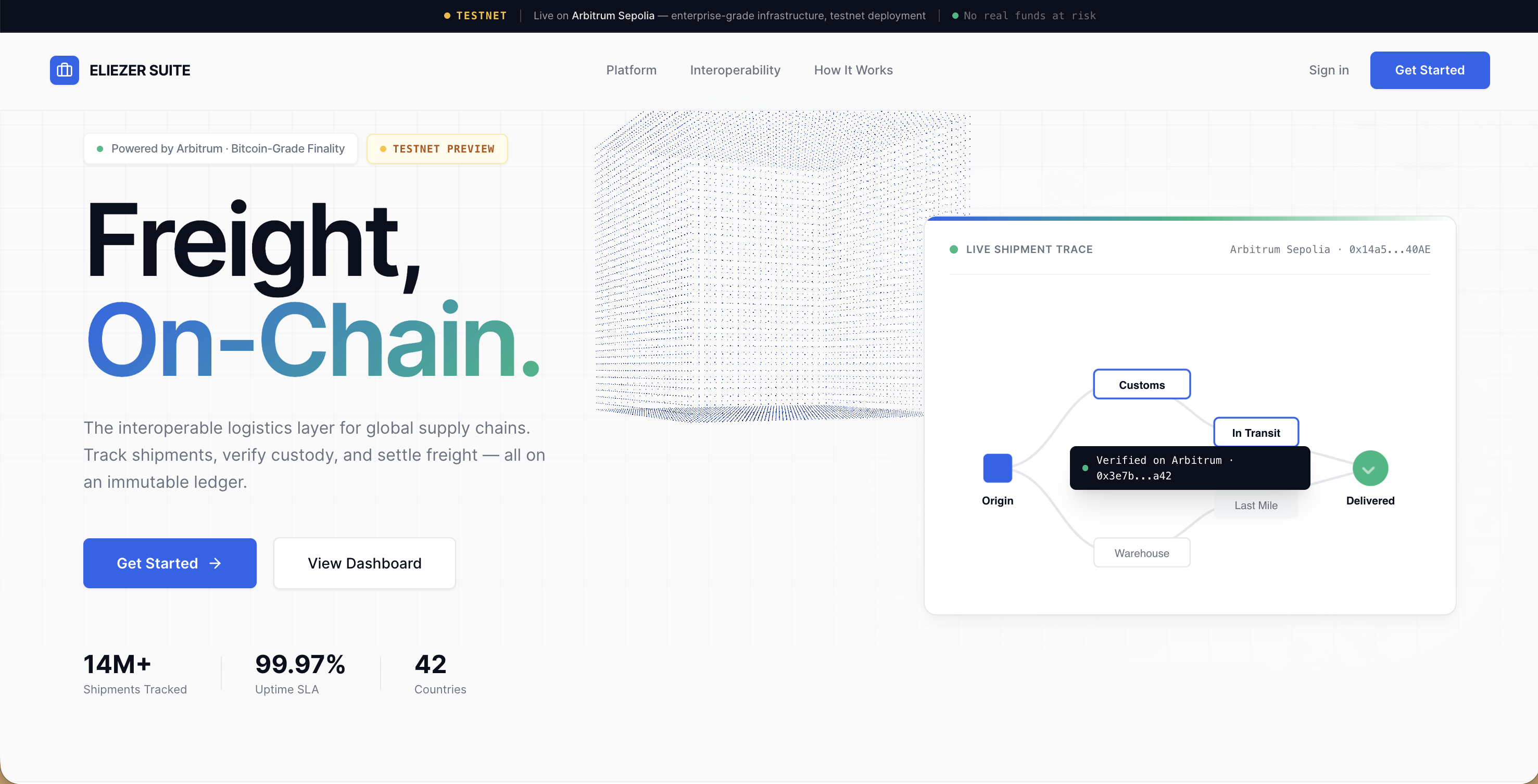
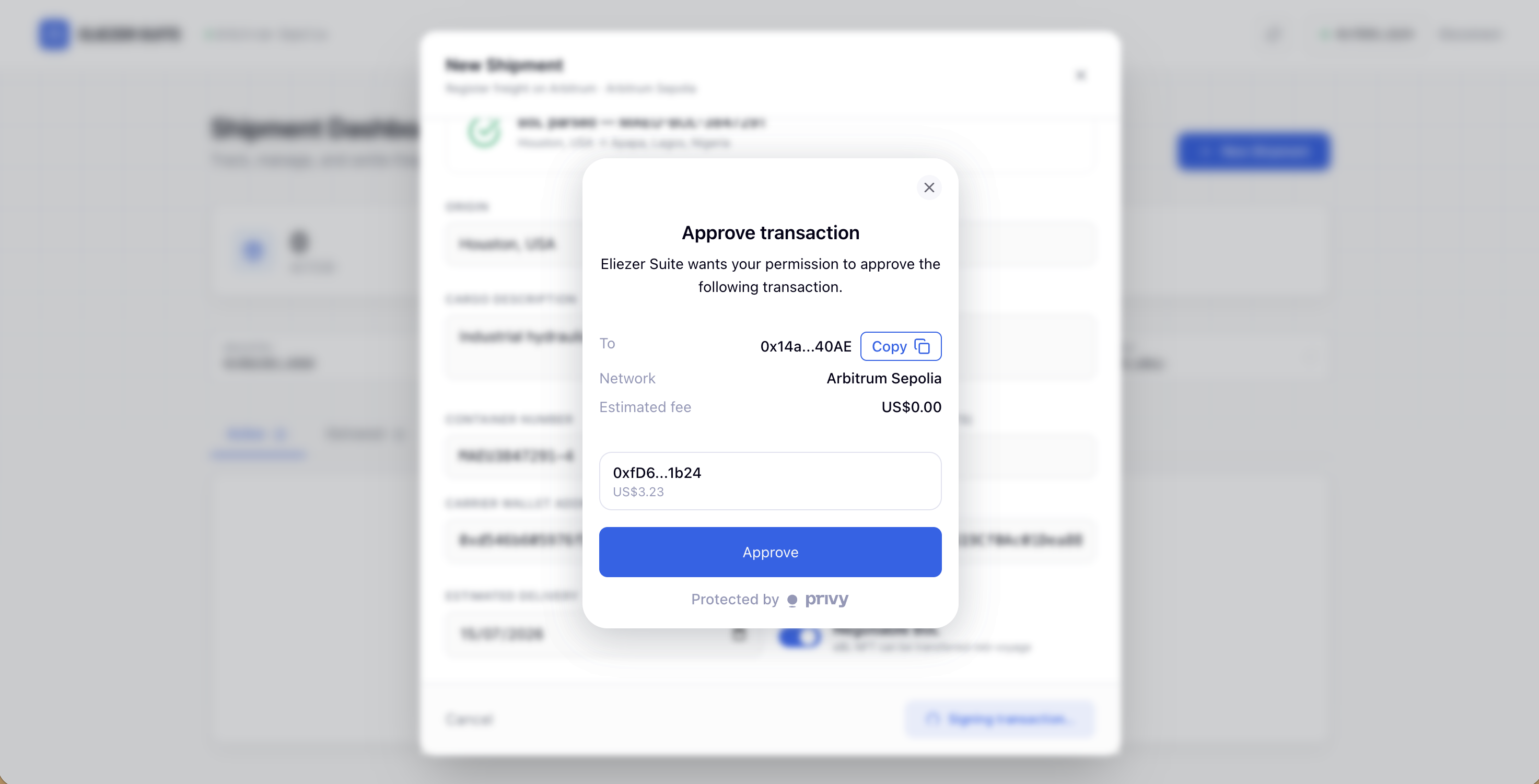
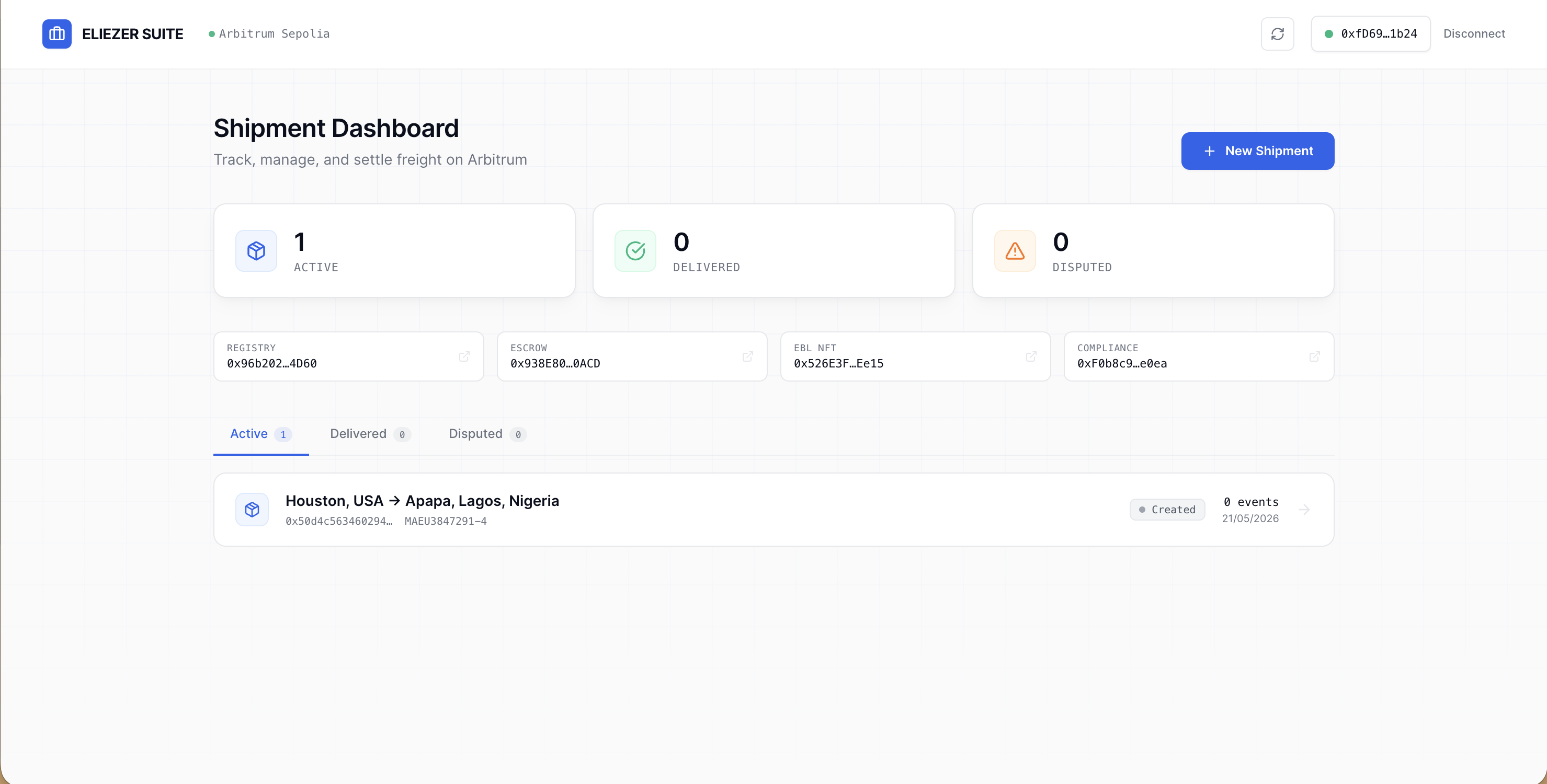
Eliezer Suite is a trust-minimized freight operations platform for cross-border importers. It replaces the fragile, opaque, and intermediary-heavy infrastructure of international trade with a composable stack of on-chain primitives, AI agents, and confidential compute, deployed on Arbitrum.
The target user is a small to medium-sized importer sourcing goods from China and Southeast Asia. This user is currently underserved in every dimension: they pay freight forwarder markups they cannot audit, wire money to suppliers with no recourse if goods do not arrive, manually navigate HS code classification and customs compliance, and have no credible enforcement mechanism when disputes arise. Eliezer Suite addresses each of these failure modes directly.
The Problem With How International Trade Works Today
International freight operates on a web of trust between parties who have no reliable way to verify each other's claims. A supplier in Shenzhen ships a container. The importer in Toronto wires payment in advance or uses a letter of credit that takes weeks to settle. If the goods are incorrect, damaged, or never shipped, the importer's options are limited: dispute through the bank (a lengthy and expensive process), sue in a foreign jurisdiction (an impractical option), or absorb the loss.
Compliance is worse. Every shipment crosses multiple regulatory layers. Customs agencies require correct HS tariff codes. Sanctions lists must be checked against suppliers, carriers, and routes. Export control licenses may apply. Insurance policies require specific documentation. A single classification error can hold a container at port for weeks. Most small importers outsource this process to freight forwarders and never see the underlying data.
The bill of lading is the central document of international trade. It is simultaneously a receipt, a title document, and a contract. Yet most bills of lading are still paper-based, or at best, PDF documents emailed between parties, even in 2025. Title transfer, which determines who legally owns the cargo in transit, requires physical endorsement and courier delivery.
Eliezer Suite treats these not as industry conventions to accommodate, but as engineering problems to solve.
The On-Chain Trade Stack
ShipmentRegistry: The Shipment Lifecycle on Chain
Every shipment in the Eliezer Suite starts with an on-chain registration. The ShipmentRegistry contract records the parties (shipper, carrier, receiver), cargo hash, origin and destination, estimated delivery date, and container number.
As the shipment moves through different stages, approved, in transit, at customs, cleared, and delivered, the agent wallet calls updateStatus() with the location and an event hash. Every custody event becomes immutable and queryable.
The result is a tamper-proof shipment audit trail. Any party involved in the transaction can verify the current status and full history without relying on a freight forwarder's portal, carrier tracking page, or manual communication.
The cargo hash links off-chain documents to the on-chain record, making document substitution cryptographically detectable.
Disputes are first-class. Any party can call raiseDispute() to pause the shipment lifecycle and route it to the governance system. Resolution requires community voting rather than a unilateral carrier decision.
ShippingEscrow: Payment That Enforces Delivery
The ShippingEscrow contract holds USDC from the importer to the supplier and releases it only when delivery is confirmed.
The flow requires two transactions: the importer calls approve() on the USDC contract, then calls createEscrow() with the escrow ID, shipment ID, supplier address, and amount. Funds are locked.
Release happens through markDelivered() followed by releasePayment(). Refunds happen through refundEscrow() if delivery fails. Disputes escalate to the DisputeGovernor for community resolution.
This is the core value proposition of the platform: suppliers get payment certainty, importers get delivery certainty, and neither side needs to trust the other. The smart contract enforces the agreement.
The escrow also captures the supplier's preferred payout method at creation time: Alipay, WeChat Pay, or USDC wallet. When funds are released, the payout instruction is available on-chain for the Alchemy Pay off-ramp to execute.
Cross-border fiat settlement becomes a mechanical process rather than a negotiation.
BillOfLading: Title as an NFT
The BillOfLading contract is an ERC-721 implementation of the electronic bill of lading (eBL). Each eBL is an NFT tied to a shipment, carrying the cargo hash, shipper, origin, destination, and negotiability flag.
Title transfer becomes an on-chain token transfer. There is no paper courier process, no physical endorsement requirement, and no need for both parties to be online simultaneously.
Negotiable eBLs can be transferred to any address, enabling documentary credit instruments and financing structures. Non-negotiable eBLs are surrender-only, meaning the holder burns the token to confirm delivery and release the shipper's obligations.
The titleHolder() function returns the current owner of the eBL for a given shipment. Any party, including banks, insurers, or customs agents, can verify ownership on-chain without contacting a freight forwarder.
ComplianceRecord: Auditable Compliance on Chain
The ComplianceRecord contract stores the results of five compliance checks per shipment:
Sanctions screening
HS code verification
Document completeness
Customs clearance confirmation
Cargo insurance status
Each check records whether it passed, an evidence hash linking to the full API or AI response stored off-chain, and notes from the agent.
The approveDeparture() function acts as the compliance gate. The agent must pass all five checks before the shipment is approved to proceed.
Customs authorities and auditors can query the full compliance history of any shipment at any time. The evidence hashes make the underlying documents verifiable without requiring access to a proprietary system.
This replaces a compliance officer's checklist spreadsheet with a cryptographic audit trail.
The AI Agent Layer
OpenRouter Orchestration
Eliezer Suite's AI agents run through OpenRouter, routing requests to Claude and other models through a pay-per-token model.
There is no dependency on AWS Bedrock, no monthly baseline infrastructure cost, and no additional AI infrastructure to maintain. A single API key and model selector provide the AI execution layer.
The bedrock-orchestrator.ts module (named before the AWS dependency was removed) classifies user intent from the shipping assistant and routes requests to the appropriate specialist system prompt: compliance expert, routing advisor, document parser, or general assistant.
Each specialist returns a structured response that the frontend renders directly.
CargoClassifier: HS Code Determination From Plain English
The most friction-heavy step in cross-border shipping compliance is identifying the correct HS tariff code.
An incorrect code can result in incorrect duty rates, customs delays, and potential legal liability. Most importers rely on freight forwarders who may apply codes heuristically.
The CargoClassifier agent takes a plain-English description of the goods, origin country, and destination country and returns:
Six-digit HS code
Official chapter description
Estimated duty rate
Risk flags:
SANCTIONS_RISK
DUAL_USE_ITEM
REQUIRES_EXPORT_LICENSE
RESTRICTED_GOODS
HAZARDOUS_MATERIAL
CITES_PROTECTED
License requirements
Confidence rating
The result is recorded on-chain through ComplianceRecord.recordCheck() with a keccak256 evidence hash. If the shipper, receiver, and customs agent are provided, the classification is also submitted to the
ConfidentialCargoRecord CoFHE contract, where the HS code, risk level, and license requirement are stored as encrypted values accessible only to authorized parties.
The CargoClassifier.sol contract stores classifications on-chain, accessible through getClassification(shipmentId) for verification.
BillOfLading Parser
The parse-bol agent accepts a bill of lading document, extracts text through PDF parsing, and returns structured data:
Shipper
Consignee
Notify party
Carrier
Origin
Destination
Container number
Cargo description
Weight
Volume
HS codes
Special handling instructions
The parsed data is used to pre-fill shipment registration and compliance checks.
This eliminates manual data entry between documents and systems, which is currently one of the highest-error steps in freight operations.
Status Sync and Payment Release Agents
The sync-status agent runs on a scheduled basis, querying carrier APIs and updating shipment status on-chain through the agent wallet.
The payment release agent monitors escrow contracts for releasable conditions and triggers payment release when delivery is confirmed and the required release window has passed.
Both agents use the ZeroDev Kernel smart account for on-chain writes, submitting UserOperations through Alchemy's ERC-4337 bundler with gas sponsored by the Alchemy Gas Manager policy.
Confidential Compute: CoFHE Integration
Cargo data is commercially sensitive. An importer's HS code can reveal exactly what they are sourcing. Quantity can reveal inventory velocity. Supplier information can expose their supply chain.
This information has real commercial value and can be exploited by competitors or unauthorized parties.
Eliezer Suite integrates CoFHE (Confidential Fully Homomorphic Encryption) for on-chain data that requires privacy.
ConfidentialCargoRecord
The ConfidentialCargoRecord contract stores three encrypted values per shipment:
HS code as euint32
Risk level as uint8
License requirement as ebool
These values are encrypted through the @cofhe/sdk before submission. On-chain, only ciphertext handles are stored.
Access permissions are scoped during record creation. The shipper, receiver, and designated customs agent receive decryption authorization through FHE.allow().
Unauthorized parties see only ciphertext references.
Authorized parties decrypt through the CoFHE client in the frontend.
The compliance page displays decrypted classification data to authorized users without the underlying values ever appearing in plaintext on-chain.
ConfidentialEscrow
The ConfidentialEscrow contract mirrors the ShippingEscrow lifecycle but stores escrow amounts as euint64 instead of a public uint256.
Competitors cannot determine transaction sizes from blockchain data.
Arbitrators can be granted access through grantArbitratorAccess() when dispute resolution requires amount visibility.
Agent Identity: ERC-8004 Registry
Every AI agent in Eliezer Suite has an on-chain identity.
The AgentRegistry contract implements ERC-8004 as an ERC-721-based identity system, minting one NFT per registered agent. Each agent NFT contains metadata including the agent name, role, model ID, and metadata URI.
The REPORTER_ROLE allows the platform's agent wallet to call updateReputation() after each completed task, recording whether the task succeeded.
The reputation system tracks:
Total tasks completed
Successful tasks
Reputation score from 0 to 100
Over time, agents build verifiable on-chain performance histories.
Eight agents are registered:
BoLParserAgent
ShippingRoutesAgent
ComplianceCheckAgent
InsuranceAgent
CargoClassifierAgent
StatusSyncAgent
PaymentReleaseAgent
ShippingIntentAgent
Each agent is discoverable through the /api/agents/registered endpoint, which reads AgentRegistered events from the registry contract.
This is not just a visual feature. Importers can verify which model processed their classification, review its historical performance, and confirm whether the agent has an active on-chain identity.
When agents manage real capital and compliance decisions, accountability infrastructure becomes essential.
Community Governance: Dispute Resolution Without Traditional Arbitrators
The DisputeGovernor contract handles freight disputes without relying on a designated arbitrator.
Any governor-role wallet can vote on a dispute. Disputes require a minimum vote threshold before resolution.
The final outcome, whether the buyer or seller wins, is executed on-chain by calling:
ShippingEscrow.resolveDispute()
The current governor set consists of the platform's foundation wallets. The architecture is designed to transition to token-weighted governance once the community reaches sufficient scale.
The mechanism is already implemented.
Evidence is stored through IPFS CIDs. Any party can submit evidence after filing a dispute. The dispute detail page displays evidence history, vote counts, and the final resolution outcome.
The Shipping Intent Market
The ShippingIntentMarket contract allows importers to publish shipping intents and freight solvers to submit bids.
An intent includes:
Origin port
Destination port
Cargo weight
Cargo category
Maximum USDC price
Deadline
Solvers submit bids containing a price and a staked GMX collateral commitment as a performance guarantee.
The importer selects the preferred bid. Delivery confirmation releases the solver's collateral.
The SolverRegistry contract tracks approved solvers, including:
Logistics providers
Freight forwarders
Carriers
Registered solvers submit business credentials and jurisdiction information on-chain.
This creates a permissionless freight marketplace where new shipping corridors, cargo categories, and solver types can participate without centralized approval.
The order book is transparent, and pricing is verifiable.
ZeroDev Kernel: The Agent Wallet
All on-chain actions from the agent are submitted through a ZeroDev Kernel smart account.
The private key never directly signs transactions.
Instead, the agent submits UserOperations through Alchemy's ERC-4337 bundler. Gas sponsorship is provided through the Alchemy Gas Manager policy when configured.
The agent wallet address:
0x103F3c7498A90aeD72B77102dC5716fCD2e02Be3
holds:
ORACLE_ROLE on ShipmentRegistry and ComplianceRecord
ARBITRATOR_ROLE on ShippingEscrow and DisputeGovernor
REPORTER_ROLE on AgentRegistry
If the session key is compromised, it can be rotated without redeploying contracts.
Role permissions are assigned to the smart account address rather than the underlying key.
This provides a stronger security model for autonomous agents managing real freight operations.
Capital Efficiency: GMX Yield on Idle USDC
Idle USDC waiting for shipment settlement generates no value when held in a wallet. The YieldWidget component integrates with GMX GM Pools on Arbitrum, allowing importers to deploy waiting capital into liquidity pools and earn trading fees while funds are not actively used. The current APY is displayed live from GMX contracts.
Deposits and withdrawals remain available, and funds can move from yield positions into new escrow agreements when needed. This converts idle settlement periods into productive capital deployment.
Fiat On-Ramp: Alipay, WeChat Pay, and Bank Transfer
The primary importers using the Eliezer Suite source goods from China. Their capital is often held in CNY, while suppliers may prefer receiving USDC on Arbitrum.
The Alchemy Pay integration enables importers to fund wallets through:
Alipay
WeChat Pay
Bank transfer
The ramp converts fiat currency into USDC on Arbitrum and sends it directly to the connected wallet.
When escrows are released to suppliers who prefer Alipay or WeChat, the Alchemy Pay off-ramp converts USDC back into CNY and delivers it to the supplier account.
The complete payment cycle, CNY in, USDC on-chain, goods delivered, and CNY settlement out, occurs without the importer needing to use a crypto exchange.
→ Deployed all 11 contracts to Arbitrum Sepolia and verified source code on Arbiscan: ShipmentRegistry, ShippingEscrow, BillOfLading, ComplianceRecord, CargoClassifier, AgentRegistry, DisputeGovernor, SolverRegistry, ShippingIntentMarket, ConfidentialEscrow, ConfidentialCargoRecord
→ Integrated CoFHE confidential compute: cargo HS codes, risk levels, and license requirements are encrypted on-chain; only the shipper, receiver, and customs agent can decrypt
→ Deployed ERC-8004 AgentRegistry: all 8 platform agents have on-chain NFT identities with live reputation tracking updated after every task
→ Migrated agent wallet from raw EOA to ZeroDev Kernel smart account (ERC-4337): gas sponsored via Alchemy Gas Manager, with key rotation enabled without contract redeployment
→ Replaced AWS Bedrock (cost-prohibitive) with OpenRouter: full AI agent stack running on pay-per-token pricing with zero infrastructure overhead
→ Built CargoClassifier agent: classifies cargo from plain English to HS codes, flags sanctions risk, dual-use items, and license requirements, and records results on-chain in ComplianceRecord
→ Integrated Alchemy Pay on-ramp: importers fund wallets via Alipay, WeChat Pay, or bank transfer; USDC lands directly on Arbitrum
→ Built supplier escrow creation flow with payout preferences: importer locks USDC on-chain and selects Alipay, WeChat Pay, or USDC wallet as supplier payout method at escrow creation
→ Deployed DisputeGovernor with evidence upload to produce the hash to be stored on-chain, community vote UI, and on-chain resolution routing back to ShippingEscrow
→ Deployed ShippingIntentMarket and SolverRegistry: importers post freight RFQs; registered solvers bid with GMX collateral bonds
→ Integrated GMX GM pool yield: idle USDC earns trading fees between shipments, with live APY displayed from on-chain GMX contracts
→ Launched production deployment at eliezer-suite.netlify.app with all environment variables managed via env files and zero hardcoded addresses in application code
About to raise $350,000 pre-seed.