
Self-custodial payments on Arbitrum. Get paid with a link or a QR code, send to a username, and skip the seed phrases and gas. Your money stays yours.
GatoPago. Money without borders. Always yours.
The problem. Sending money across borders still takes days and costs too much. Stablecoins fix the speed and the cost, but using them today means choosing between an exchange that holds your money and a wallet that expects you to manage seed phrases, gas and networks. Most people give up, or leave their dollars with a custodian.
We start in Bolivia, where people turned to digital dollars during three years of restricted access to bank dollars: transactions with virtual assets grew more than 630% in a year, to USD 294M in the first half of 2025 (Central Bank of Bolivia).
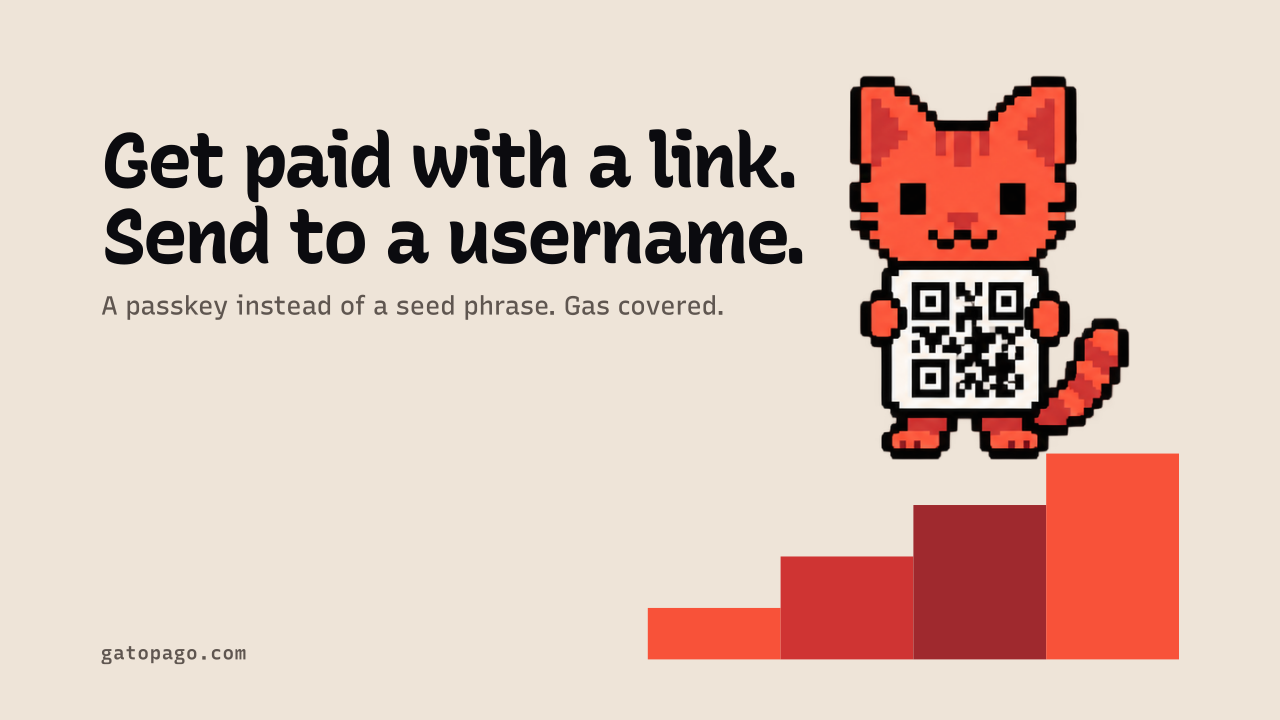
What it is. A self-custodial account that works like a payments app. You sign up with a passkey (your fingerprint or face), get paid with a link or a QR code, and send to a username, a QR code or any address. GatoPago never holds the funds: every payment needs your passkey. The backend can submit the transaction and pay the gas, but it can't move money on its own.
Working today, on Arbitrum Sepolia
Sign-up with a passkey, no seed phrase
Payment links and QR codes
Payments to a username, a QR code or an address
Activity with a receipt for every payment, deposit and swap
In-app swaps with Uniswap routing
Contacts, push notifications and an installable PWA
How it works. ERC-4337 smart accounts authorized by WebAuthn passkeys and deployed at deterministic addresses. A paymaster sponsors gas with signatures that expire after a few minutes. Accounts support several passkeys, batched calls, upgrades and guardian recovery with a 48-hour delay.
Why Arbitrum. Low, predictable fees, gas charged for what you use, EIP-712, a canonical and verified ERC-4337 EntryPoint, and liquidity for swaps. Everything is ready to move from Sepolia to Arbitrum One.
Next (not part of this submission): cash-out to Bolivian bolivianos with a regulated partner, then PIX; yield on idle balances; a card; and a payments API for merchants and apps.
Contracts (Arbitrum Sepolia, 421614)
EntryPoint v0.9: 0x433709009B8330FDa32311DF1C2AFA402eD8D009
ERC7913WebAuthnVerifier: 0xb7fA10dEe75042D6973676A7d7882e4621B806d6
AccountWebAuthnV2 (implementation): 0xa450bc49a0dA738FA348445980b542d78A22527e
AccountFactoryV2: 0x75c7761dcED5F8eCc708E750bDe5CA7d4557EDEB
ParmeliaPaymaster: 0x31f357a64cF5899da21337f0D9e28ef8D6385753
Explorer: sepolia.arbiscan.io/address/0x75c7…EDEB
GatoPago existed before the buildathon as a generic prototype, under the name Parmelia and on another chain. During Arbitrum Open House London I moved it to Arbitrum and rebuilt it for real users.
Contracts. Deployed and verified the V2 stack on Arbitrum Sepolia: WebAuthn verifier, account factory and paymaster. Deterministic CREATE2 addresses; several passkeys per account, batched execution, upgrades and guardian recovery with a 48-hour timelock; paymaster signatures that expire so they can't be replayed; compiler tuning to keep the account under the 24 KB limit.
App. A mobile-first flow for sending, charging, QR codes, swaps, statements, contacts and receipts. History read from a ledger, with a cron job that picks up deposits made outside the app. Swaps routed through Uniswap. An installable PWA with push notifications.
Backend. A Cloudflare Worker with D1, RPC failover, Turnstile, passkey and email-link login, analytics, and tests for the parts that handle money: swap encoding, fees, slippage, validation and the paymaster.
After the buildathon the project was renamed GatoPago. Everything listed above works and can be demoed; the roadmap items are plans.
Bootstrapped. Open to Arbitrum ecosystem grants and milestone-based support.