
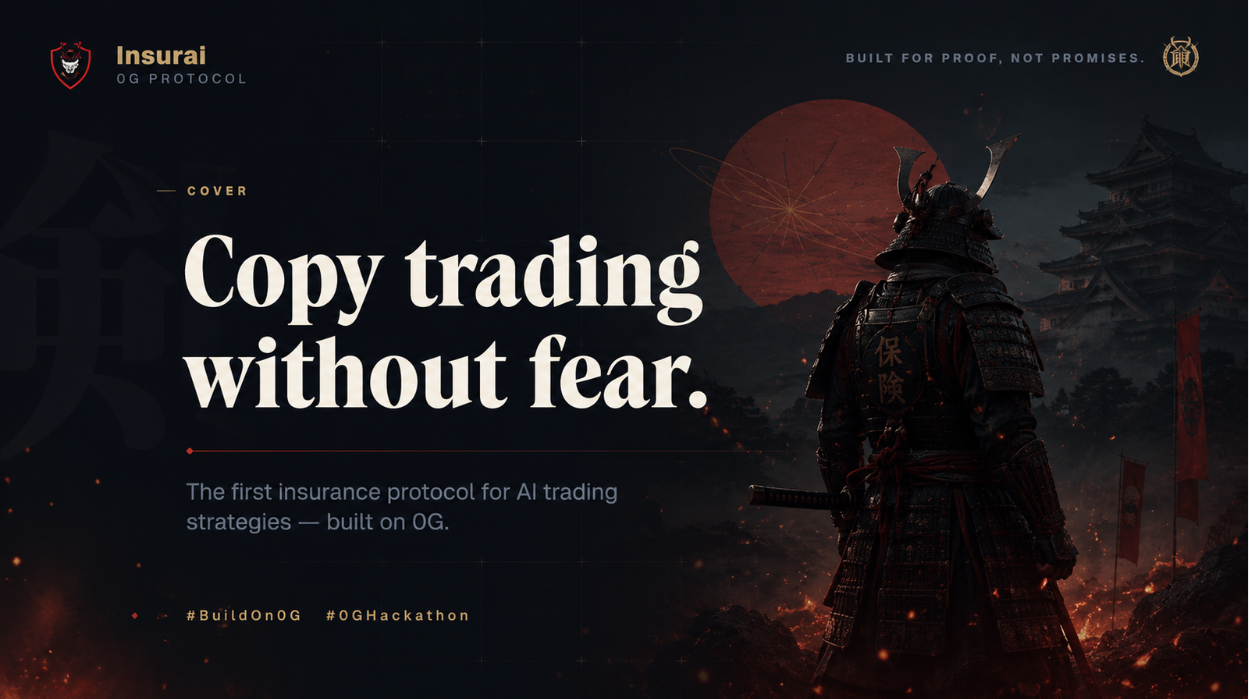
The first insurance protocol for AI copy trading on 0G. Strategy runs verifiable in TEE. Claims trigger automatically on-chain. Built for proof, not promises.
PITCH DECK: https://canva.link/z0k5xx871ww7xao
AI copy trading has a problem nobody has solved. The best strategies can't go public and the edge disappears the moment it's exposed. But copiers won't follow a black box with no protection. Both sides are stuck. Adoption stays frozen.
Insurai breaks the deadlock.
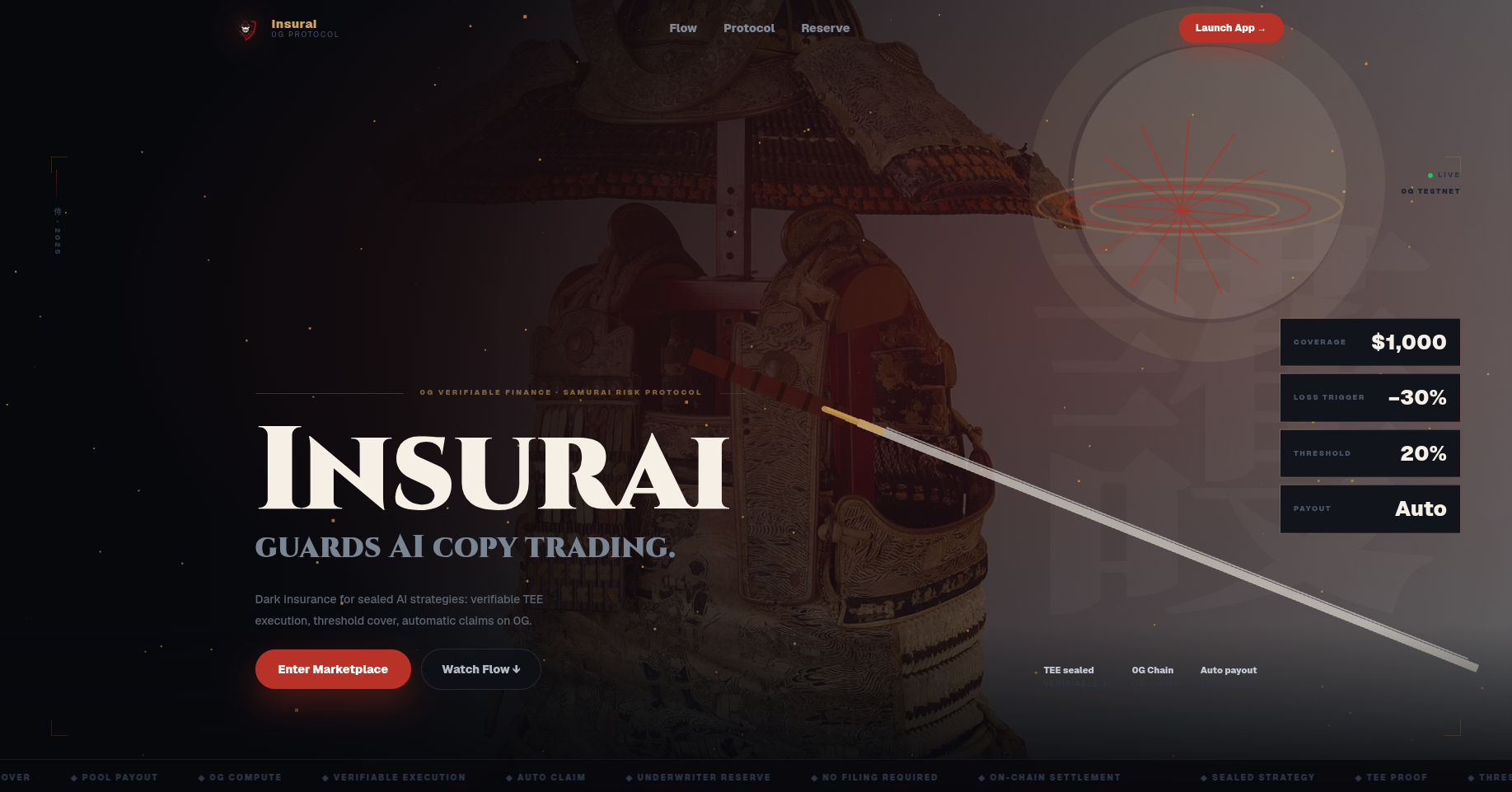
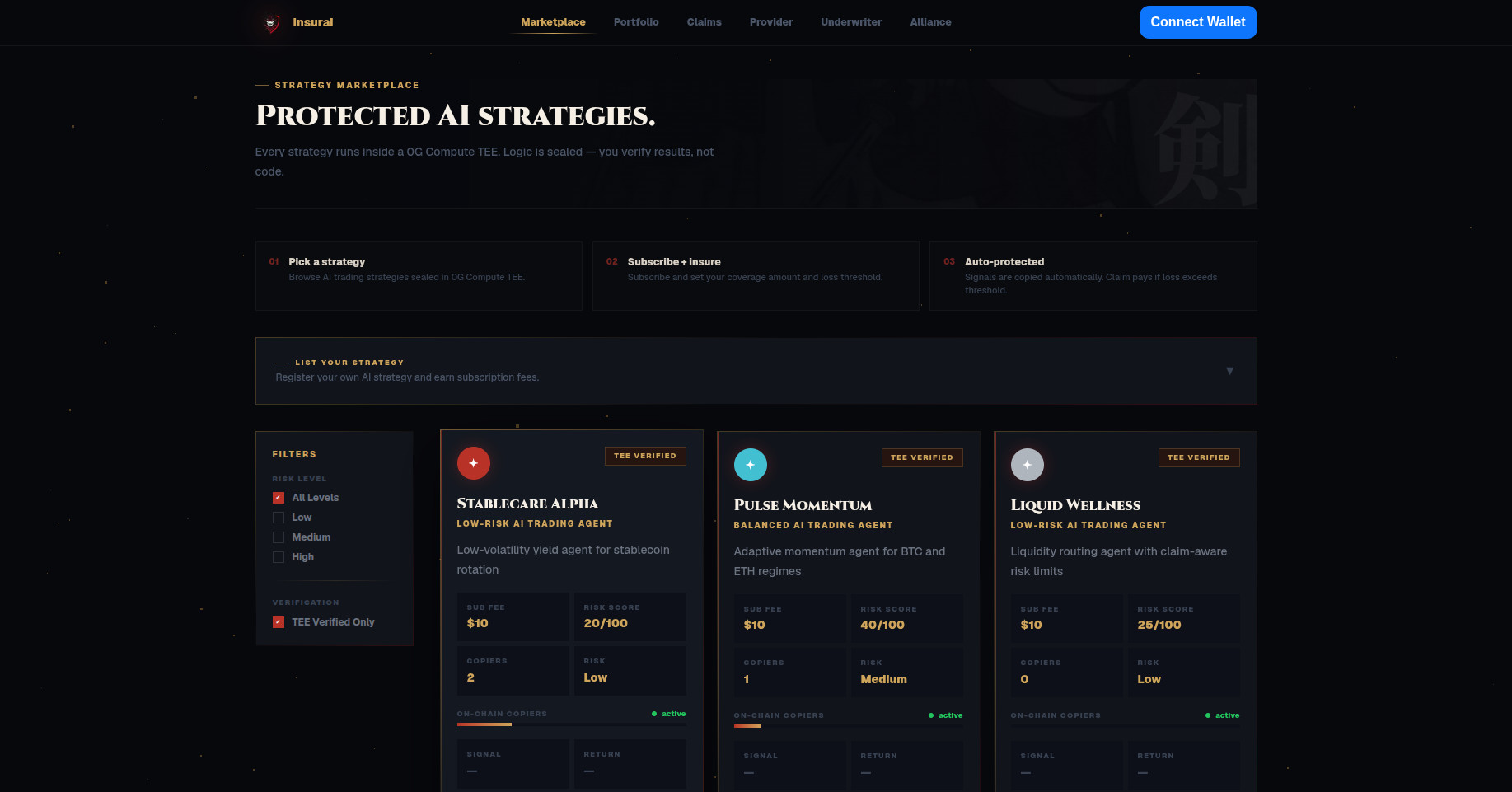
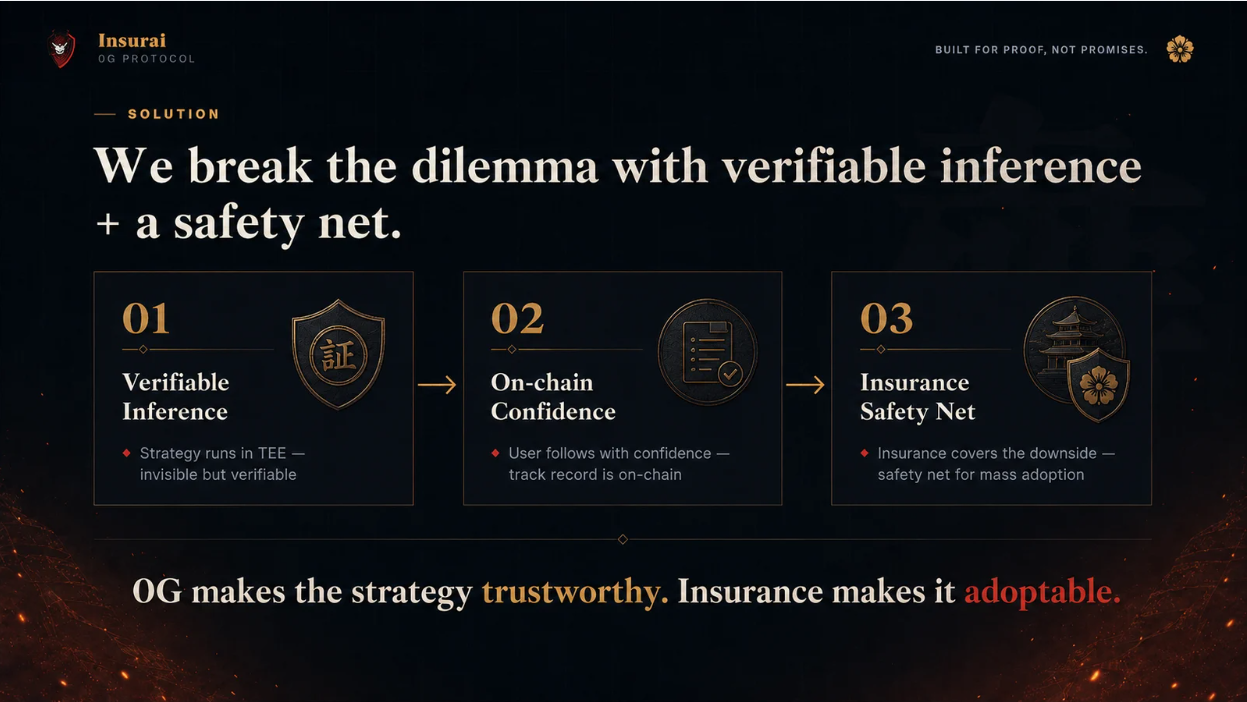
Strategy providers deploy sealed AI trading agents on 0G Compute. The logic runs inside a TEE and invisible to everyone, including the node operator. The execution trail is real, verifiable, and stored permanently on 0G Storage. Copiers subscribe, set a loss threshold, and buy insurance cover. When the strategy breaches that threshold, the claim settles automatically from the underwriter pool. No form to fill. No dispute to raise. The contract pays.
This is not a DeFi vault. Nobody is pooling capital into a shared strategy and hoping for the best. You follow a specific AI agent, you know exactly what loss threshold triggers your payout, and you get it automatically when that line is crossed.
The flywheel is self-regulating:
A strategy performs well → premium drops → more copiers subscribe → provider earns more fees
A strategy underperforms → premium rises → market signals danger before you lose more
The pool grows → underwriters earn more yield for taking quantified risk
Nobody can cheat. That's why Insurai is built end-to-end on 0G and is structurally inseparable from all four primitives:
0G Chain — strategy registry, policy creation, premium pricing, pool accounting, automatic claim settlement. Remove it and there's no enforceable insurance.
0G Storage — execution payloads, market fingerprints, proof hashes, and attestation artifacts archived permanently. Remove it and the audit trail disappears.
0G Compute (TEE) — strategy logic runs sealed inside an enclave. Remove it and every provider's edge is exposed.
0G Explorer / Chain State — policy state, pool reserves, attestations, and claim outcomes are fully on-chain and inspectable. Remove it and there's no verifiable track record.
No manual claim review. No trusted backend deciding who gets paid. No black box the copier has to believe in.
By the numbers: 4 mainnet contracts on Chain ID 16661 · StrategyRegistry · PolicyManager · InsurancePool · DemoUSDC · Express + TypeScript backend with 0G Compute and 0G Storage integration · Next.js 16 frontend with 7 app surfaces · TEE-signed attestations · automatic on-chain claim triggers.
Everything was built from scratch during the hackathon period:
Smart Contracts (0G Chain, Mainnet 16661)
- StrategyRegistry — strategy registration, subscriber management, TEE attestation recording with on-chain proof anchoring, risk scoring, and fee claiming (288 LOC)
- PolicyManager — policy creation, dynamic premium calculation, claim trigger, and payout routing with threshold enforcement (288 LOC)
- InsurancePool — underwriter deposit/withdraw, utilization tracking, reserve exposure locking, and atomic claim payout (145 LOC)
- DemoUSDC — mock stablecoin for premiums, deposits, and payouts
- 532 LOC of Foundry integration tests covering full protocol flow
Oracle & Backend Service (0G Storage + 0G Compute)
- Execution payload upload pipeline to 0G Storage with on-chain storageRef anchoring
- TEE inference pipeline through 0G Compute with sealed strategy key custody
- On-chain attestation recording (returnBps, proofHash, marketFingerprint) as public performance signal
- Routes: strategy execution, attestations, pool management, copy trade scheduler, demo flow
Frontend (Next.js)
- 6 production surfaces: marketplace, provider dashboard, underwriter pool, claims, portfolio, partnership
- RainbowKit + viem + wagmi wallet integration
- Live copy trade feed with auto-run scheduler
- Claim trigger UI with policy threshold validation
Not fundraising. Built for the 0G APAC Hackathon 2026.