
Decentralized provenance layer for AI-generated content. Cryptographic birth certificates using TEE attestation, 0G Storage & on-chain NFT records. One changed pixel = tamper detected.
PAICO — Proof-Attested AI Content Origin
The internet is filling up with AI-generated content, but there’s still no reliable way to prove where something came from, who created it, or whether it has been changed after generation.
PAICO solves that problem by creating a verifiable provenance layer for AI-generated media.
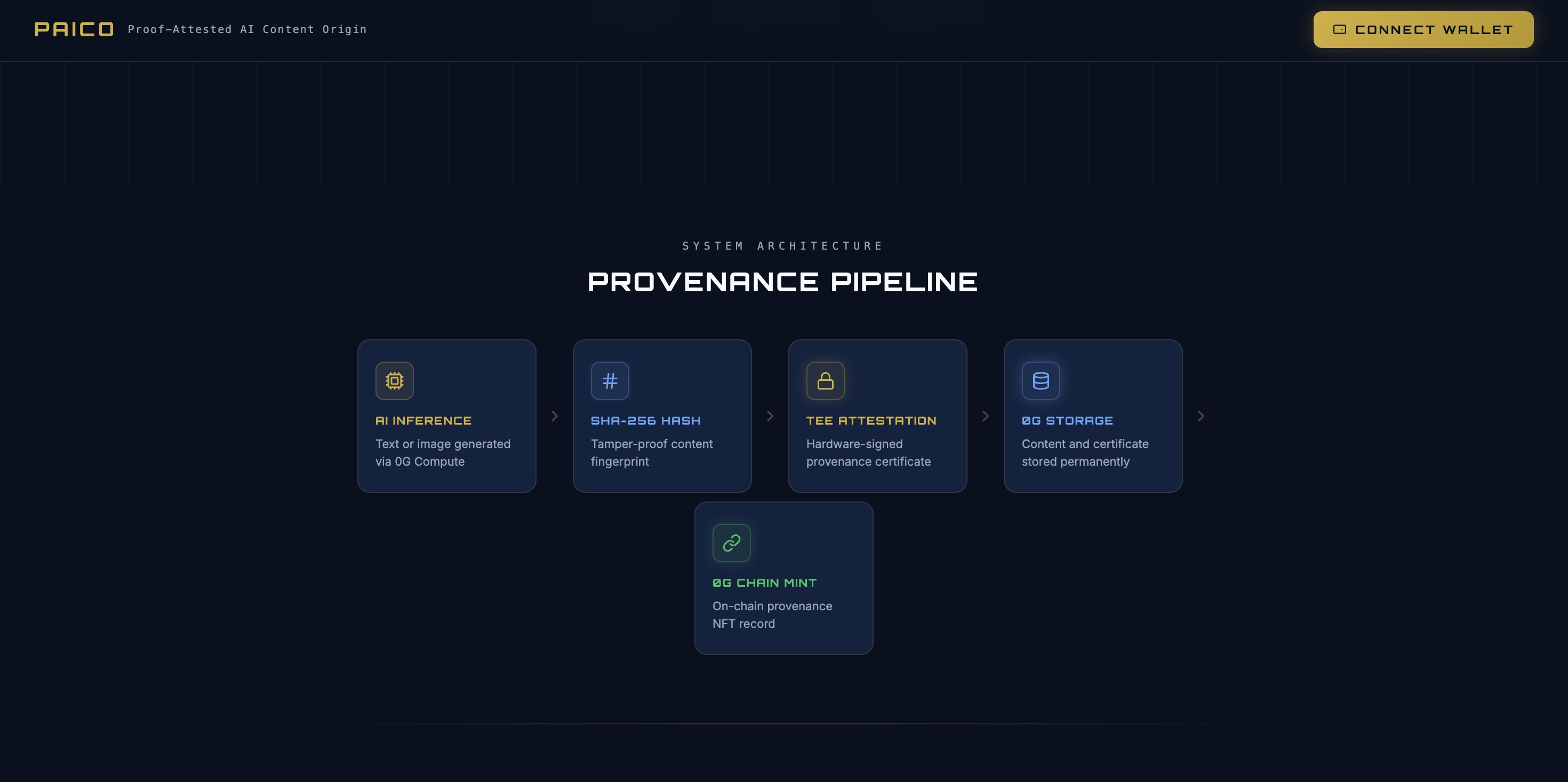
Every piece of AI-generated text or image receives a cryptographic certificate of origin. The content is SHA-256 hashed, attested through a Trusted Execution Environment (TEE), stored on 0G Storage, and permanently registered on 0G Chain as a provenance record.
Verification is simple and permissionless. Anyone — journalists, platforms, researchers, courts, or everyday users — can verify whether a piece of content matches its original attested version. Even a single modified pixel or edited word produces a completely different hash, instantly exposing tampering.
PAICO is not a watermark that can be removed or hidden. It is not just a label or badge. It is cryptographic proof recorded on-chain and verifiable forever.
Built using 0G Chain, 0G Storage, and TEE-backed AI infrastructure, PAICO demonstrates what trusted AI content infrastructure could look like: decentralized, transparent, censorship-resistant, and mathematically verifiable.
As AI-generated media becomes impossible to distinguish from reality, systems like PAICO become essential infrastructure for the post-deepfake internet.
We built PAICO end-to-end during this hackathon, from blank repo to
a fully working provenance protocol across frontend, backend, smart
contract, and decentralized storage.
CORE PROTOCOL
- Designed and implemented the full provenance pipeline:
Prompt → AI inference → SHA-256 hash → TEE attestation → 0G Storage
→ on-chain NFT mint → QR verification
- SHA-256 hashing implemented both server-side (Node crypto) and
client-side (SubtleCrypto) — no server round-trip for verification
- TEE attestation layer built using ECDSA signing, architecturally
identical to 0G Compute Sealed Inference (single endpoint swap to go live)
- ecrecover() verification baked directly into the smart contract —
attestation is verified on-chain, not trusted off-chain
SMART CONTRACT
- Designed and deployed PAICORegistry.sol on 0G Testnet
- ERC-721 provenance NFTs — each attested output is an ownable,
transferable certificate of origin
- On-chain ECDSA signature verification via ecrecover()
- Duplicate hash prevention — same content cannot be minted twice
- Live transactions verifiable on 0G Chain Explorer
0G INTEGRATION
- 0G Chain: live contract deployment with real on-chain transactions
- 0G Storage: content + attestation certificates uploaded via SDK,
with graceful fallback for indexer availability
- Architecture documented and ready for 0G Compute integration
AI GENERATION
Text pipeline: 0G Compute Router (Testnet) — qwen/qwen-2.5-7b-instruct via router-api-testnet.integratenetwork.work/v1, TEE-backed inference from pc.testnet.0g.ai
Image pipeline: 0G Compute Router (primary, qwen/qwen-image-edit-2511) with Pollinations.ai flux-schnell as fallback — output hashed via SHA-256 and attested through the same TEE pipeline
- Two-step UX: generate first → preview draft → user explicitly
chooses ATTEST THIS. Only final, intentional outputs get certified.
FRONTEND
- Full React + Vite app with wallet connection (auto-switches to 0G Testnet)
- ProvenanceCard + ImageProvenanceCard with hash display, explorer links,
QR code
- ProvenanceTimeline: 6 timestamped cryptographic events per output
- AuthenticityScore: animated SVG ring, 4 independent verification checks,
max score 100
- TamperComparison: drag-drop two files, side-by-side hash diff with
character-level visualizer and avalanche effect percentage
- VerifyPanel: fully client-side verification — no server, no trust required
- RecentActivity: live feed from on-chain contract events
- ArchitectureFlow: 6-step pipeline visualization for judges and users