
Bloomberg-style whale intelligence for Injective. Discover Helix traders, stream their fills, frame your risk.
On Injective, the trades that move markets are already public, but they are not easy to see. A meaningful Helix clip might hide inside an authz MsgExec, a MsgBatchUpdateOrders payload with simultaneous creates and cancels, or a derivative margin update that the explorer renders as opaque JSON. Staking dashboards answer a different question entirely: who holds INJ, not who is actively trading BTC perps at size. Social channels fill the gap with screenshots and hype, but rarely with clip-level history, side classification, or risk context tied to your own book.
Podium Finance is built to close that gap. It is a live intelligence layer for Injective mainnet and Helix that watches inj1 wallets you care about, ingests their exchange activity from the Injective Explorer API, and translates raw chain events into a workflow traders and researchers already understand from traditional markets: a whale tape, a profile, an alert, and a plan.
When you add a wallet, Podium backfills recent history and begins polling for new transactions. A dedicated stream worker matches global and per-account flows against your watchlist, decodes Helix spot and perpetual messages using the on-chain market registry (tick sizes, tickers, base assets), and persists structured events: activity type, asset, execution side, fill price, USD notional, and estimated realized or unrealized P&L where the ledger allows FIFO matching. Nothing in the feed is mocked. Every row traces to a mainnet transaction with injective_explorer_live provenance.
The Discover experience addresses the cold-start problem. Instead of importing static address lists dominated by stakers, you scan recent ecosystem activity and surface copy-worthy Helix traders wallets with repeated perp or spot fills, meaningful clip sizes, and multi-asset flow. Results are scored and tiered so you can import the addresses that actually trade on the exchange, then backfill them into your watchlist in one step.
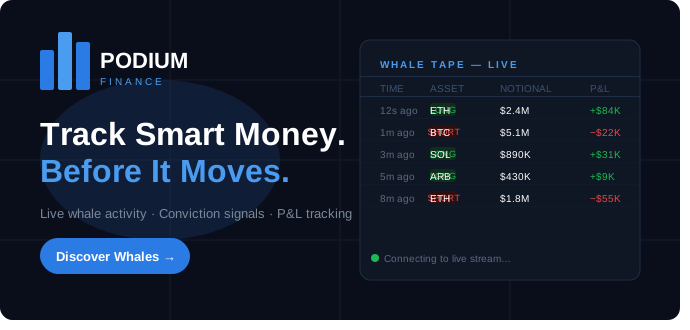
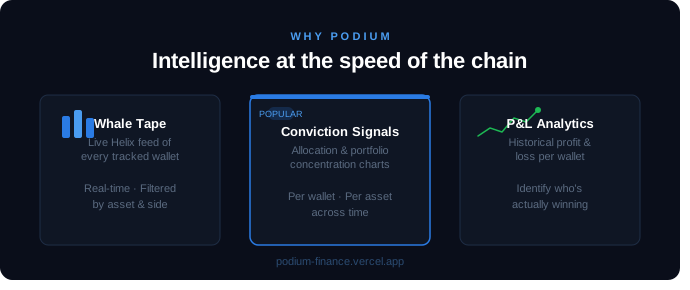
The dashboard is where flow becomes readable. A live alert strip pushes notable clips over WebSocket when smart rules detect anomalies: a new asset for a wallet, a clip far above its recent median, or exchange activity that crosses configurable USD thresholds. Below that, metrics compress behavior into conviction, win-rate proxy, portfolio mix, and a P&L sparkline for the selected whale. The whale tape itself is the centerpiece, it is sortable, filterable, and annotated with AI-assisted narratives that explain what happened in plain language while remaining tied to real block data.
Quant profiles go deeper than a single trade. Over a rolling window, Podium estimates directional bias, profit factor, per-asset exposure, and a strategy fingerprint, whether a wallet behaves like a momentum chaser, a mean-reversion trader, or someone leaning on liquidity provision. That context matters when you are deciding if a clip is signal or noise.
The execution blueprint is Podium’s answer to the copy-trade dilemma. Judges and users should understand: this is not a bot that routes orders. It is an educational risk frame. Select any event, supply your portfolio size and drawdown tolerance, and Podium returns a bounded hypothetical allocation — Kelly-damped, capped by conviction, with stop and take-profit bands derived from direction and volatility proxies. The goal is to help Injective natives ask the right question — “What size is rational for me?” — instead of mirroring whale notional because a Telegram channel said so.
Technically, Podium is Injective-native by design, not by branding. The decoder understands nested authz execution, batch order creates versus cancel-only batches, and margin open/close semantics on Helix. Notionals are validated against external price marks so a single bad tick does not collapse the feed into placeholder values. Redis handles deduplication and alert pub/sub; FastAPI exposes REST and WebSocket endpoints; Next.js delivers the product surface. The API is deployed and reachable today at https://podium-finance.onrender.com, with health and OpenAPI docs for reviewers who want to verify behavior under the hood.
Podium matters for the Injective ecosystem because it treats order flow as the product. As Helix grows across BTC, ETH, INJ, and alt perps, liquidity and positioning will continue to concentrate in identifiable wallets but only tools that speak the chain’s exchange language will make that concentration useful. Podium is that tool: discover who trades, watch what they do, get alerted when it is unusual, quantify how they behave, and frame your own risk with discipline.
We built Podium for traders who live on Helix, for analysts who need repeatable exchange-level evidence. The chain already records the alpha. Podium makes it legible.
Educational analytics only — not financial advice, not a wallet, not auto-execution.
During the hackathon we took Podium Finance from concept to a live, mainnet-connected product: we built an Injective-native ingestion pipeline (Explorer API + stream worker + Helix tx decoder for MsgExec, batch orders, and perp margin), a FastAPI backend with watchlist, Discover scan, quant profiles, FIFO P&L, smart alerts over Redis/WebSocket, and risk execution blueprints, and a full Next.js dashboard (whale tape, metrics, profiles, blueprint slide-over). We eliminated mock data, fixed notional decoding so real whale clip sizes display correctly, deployed the API to https://podium-finance.onrender.com, pointed the frontend at production, added Render deployment docs and persistent-database handling, and shipped end-to-end flows—discover traders → import → backfill → live alerts—so users can use real inj1 wallets and see Helix activity flow through the product today.
None