
Simba Prime
Fair-launch token launchpad + Hyper-performant order-book DEX on Arbitrum & Robinhood Chain. 250 ms batch auctions solved on-chain by Stylus; tokens graduate into a real order book.
视频
技术栈
描述
The problem
Token launches are a race, and the fastest bot wins. Snipers buy in the launch block, and early buyers get dumped on. When a token survives long enough to “graduate”, it usually lands in a thin AMM pool with wide spreads, heavy slippage and no real order book. The launch is unfair, and what comes after is illiquid.
Simba Prime
A single venue that takes a token from a fair launch to a real market. It is live today on Robinhood Chain testnet and Arbitrum Sepolia.
Stage 1: a launch no bot can front-run
Orders are collected in 250 ms windows and cleared together at one uniform price. There is no ordering inside a batch, so speed buys nothing.
The clearing price is computed on-chain by an immutable Arbitrum Stylus (Rust) solver, and settled through settleBatchSolved. The operator cannot pick the price, reorder orders or under-fill a batch, and every clearing can be checked on-chain.
The Rust solver is differentially tested against our TypeScript and Solidity implementations, so all three agree on every price.
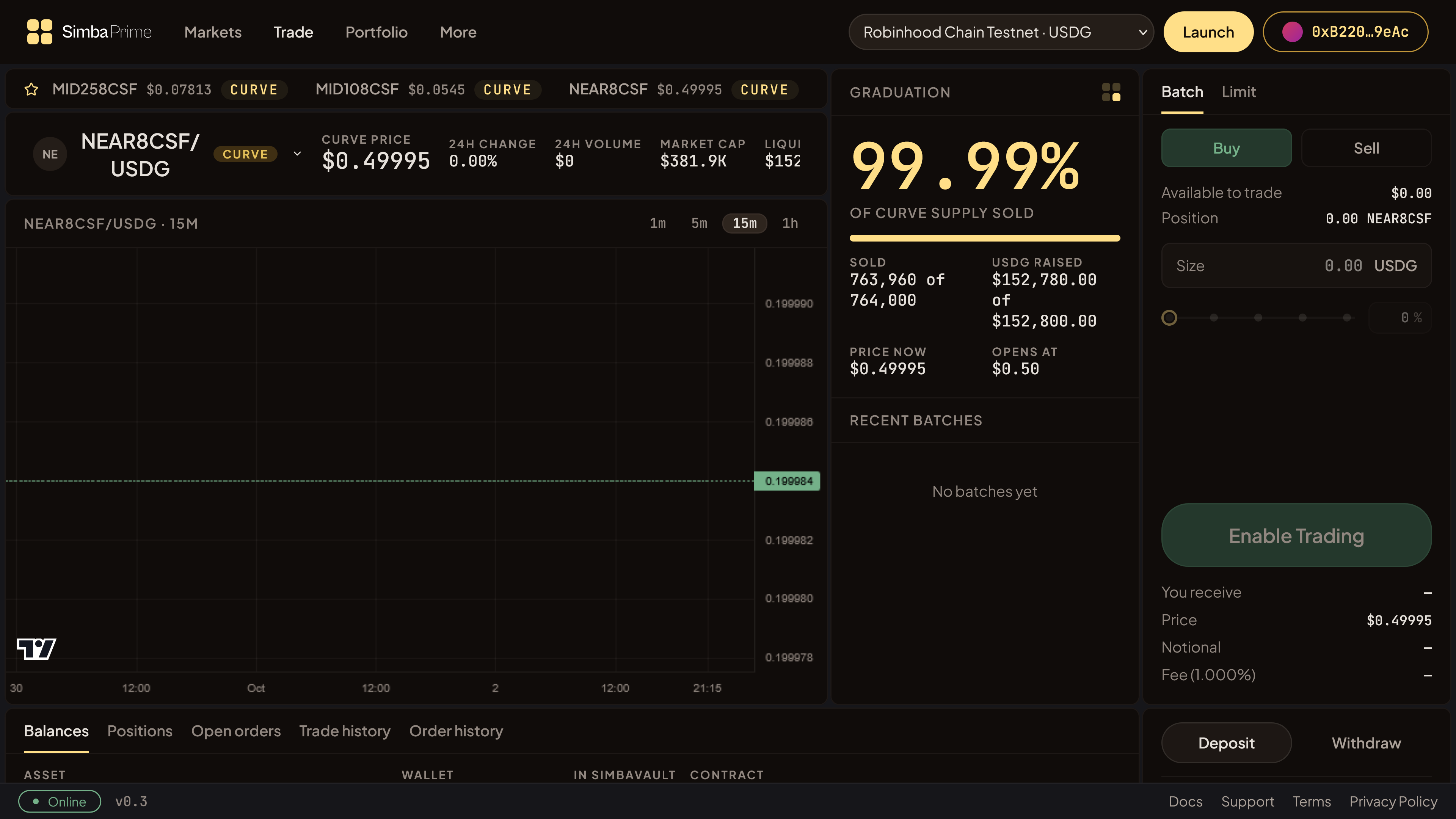
Pricing follows one public curve for every token, P(u) = 0.05 + 0.45·u², from $0.05 to $0.50 over 764,000 tokens.
Stage 2: graduation into a real order book
Graduation fires when supply hits exactly 764,000. No team, no vote, no operator decides.
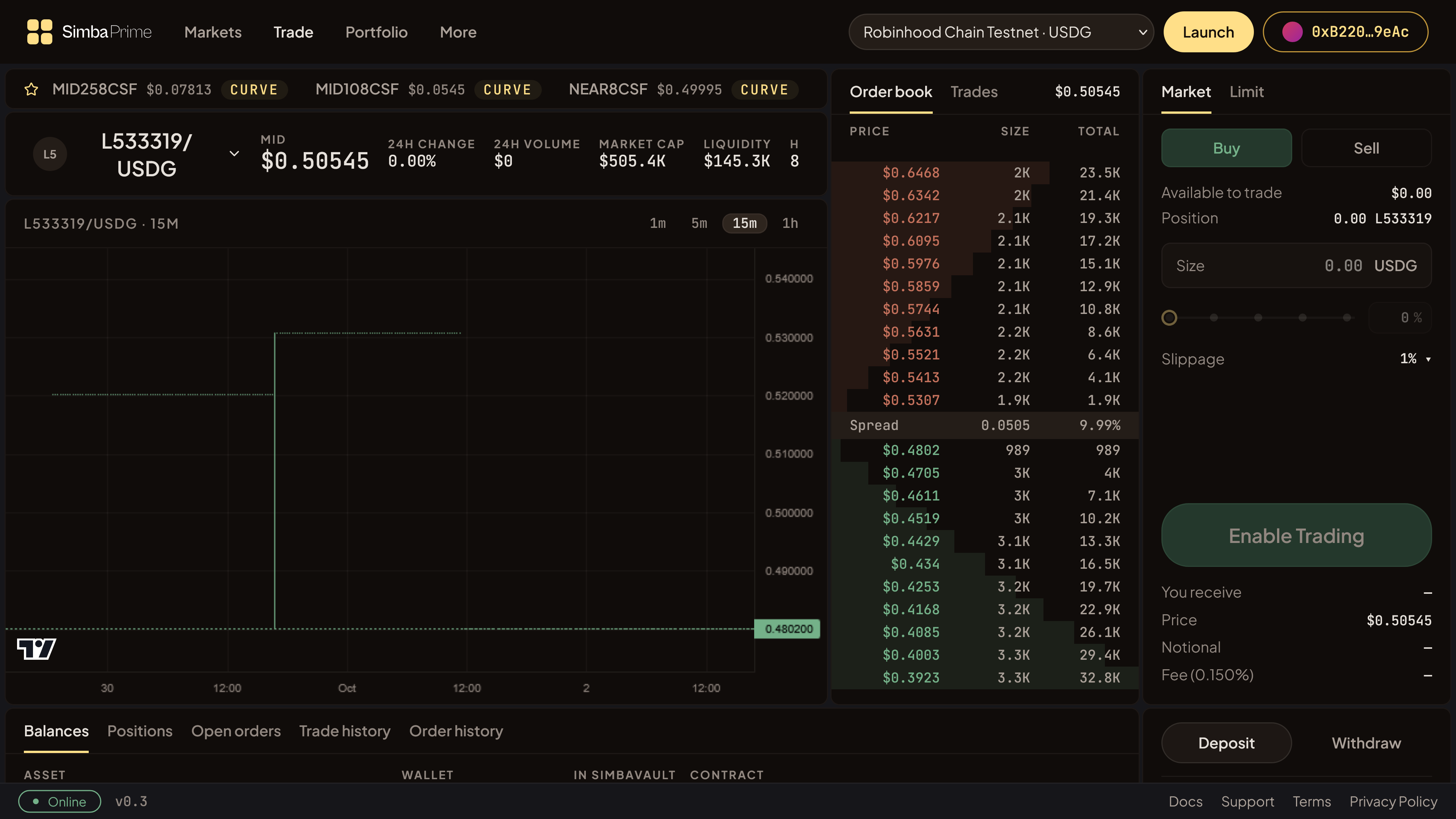
The raise does not disappear: 145,160 USDG and 236,000 tokens become protocol-owned liquidity, posted as a 40-level bid/ask ladder on a Hyperliquid-style central limit order book.
From the first second after graduation, traders get depth, a spread, and limit and market orders, instead of an empty pool.
Non-custodial throughout. Orders are EIP-712 signatures (or signatures from a session key you authorize, so you can trade without a wallet popup per order). Funds stay in an on-chain vault.
Try it
Open https://beta.simbaprime.xyz and connect a wallet.
Select Arbitrum Sepolia · mUSDG showcase and click Claim mUSDG. You get 100,000 per claim, as often as you like. You need a little Arbitrum Sepolia ETH for gas.
Deposit, then trade: on a curve market, watch your order clear in the next 250 ms batch; on a graduated market, trade against the order book.
Graduate a token yourself. https://beta.simbaprime.xyz/trade/0x7ab4767f6308e23257b95f7514991d413f87977d is about $40 away from graduating. Push it over the line and watch it become an order-book market.
Switch to Robinhood Chain testnet in the network selector to see the same stack running with USDG.
Built with
Contracts: Solidity (vault, bonding curve, token factory) and an Arbitrum Stylus batch solver in Rust.
Gateway: TypeScript (Fastify) for order intake, matching, settlement and a funding guard that backs every open order with vault balance.
Indexer: a lightweight log indexer for candles and market stats.
Frontend: Next.js with wagmi/viem.
Tests: 2,166 automated tests, plus Rust ↔ TypeScript differential vectors.
Code access
The repository is private; read access has been granted to the organizers’ judging account.
Where Simba Prime goes next
The vision: one venue, on its own chain, where every asset goes through a fair life cycle. It launches fair, graduates into a real market, and keeps trading on deep, protocol-owned liquidity. That covers memecoins today, and tokenized real-world assets tomorrow.
Phase 1: POMM, the Protocol-Owned Market Maker
Most launchpads hand graduated tokens to outside market makers or rented LP liquidity, and that liquidity can leave whenever it wants. On Simba Prime, the market maker is the protocol itself.
Funded by the launch, not by mercenaries. At graduation, 145,160 USDG and 236,000 tokens move into POMM’s inventory. Every graduated token gets a committed market maker from its first second.
Liquidity that can’t be pulled. The inventory is protocol-owned, so there’s no withdrawal, no rug and no “MM left” moment.
Quotes that follow the market. Today POMM posts a fixed 40-level ladder. Next, each side re-centres on the market using x·y=k curves, and orders are swapped atomically. Traders get continuous depth around the price after every move, like an AMM living inside the order book. The design is complete.
The spread works for the protocol. Spread and fees that would go to external market makers accrue to POMM. That deepens liquidity over time and funds the protocol.
Phase 2: Simba Chain, a dedicated L3 on Arbitrum One
Simba Prime moves onto its own Arbitrum Orbit chain, built for batch auctions and order-book trading:
Block times tuned for sub-second batches, so batches settle as fast as they clear.
A stablecoin gas token, so traders hold one asset for both gas and trading.
Stylus native from day one, with the batch solver running as a first-class part of the chain.
Sequencer fees that fund protocol liquidity instead of leaking to a general-purpose chain.
Simba Chain settles to Arbitrum One. Assets and traders bridge in from Arbitrum One and Robinhood Chain.
Phase 3: $SIMBA, the token that powers the venue
SIMBA aligns traders, market creators and the protocol. There is no token today; it launches with the mainnet.
Volume tiers. Fees fall as 14-day volume grows: taker fees from 0.15% down to 0.10%, maker fees from 0.07% down to 0.02%. This schedule is already built into the protocol.
Stake SIMBA for deeper discounts. Staking tiers stack on top of volume tiers, so committed users trade cheaper than any fee tier alone allows.
Pay fees in SIMBA. Paying in SIMBA gives an additional discount.
Stake to build. SIMBA staking is what gives the right to create markets (see SIP below), so the token secures the venue as well as discounting it.
Phase 4: SIP, permissionless markets (Simba Improvement Proposals)
Inspired by Hyperliquid’s permissionless spot and perp deployments, any team or community can create a Simba Prime market without asking us:
Dutch-auction listing slots. New market slots are sold in recurring Dutch auctions. The price starts high and decays until someone takes it, so listing costs are set by demand rather than by a gatekeeper.
Stake SIMBA to deploy. Deployers stake SIMBA behind their market. That stake can be slashed for malicious or broken markets, so the cost of a bad listing falls on the person who made it.
Deployers earn from their market. A share of trading fees from a market goes to the deployer who created it.
Any market type. SIP covers spot launches, and later perpetuals and RWA markets (Phase 5). The fair-launch curve and POMM stay the default, so every listed market is born fair and liquid.
Phase 5: perpetuals, including real-world assets
The same vault, order book and matching engine, extended to perpetual futures, including RWA perps (gold, oil, equities). That’s a natural fit for Robinhood Chain’s push into tokenized real-world assets. One account trades a fresh launch and a gold perp side by side.
Phase 6: from one operator to permissionless solving
Today a single operator submits batches. Multiple operator keys and parallel settlement remove the throughput ceiling. Because the Stylus solver already makes every clearing price verifiable on-chain, the end state is permissionless solving: anyone can settle a batch, and nobody can cheat it.
Phase 7: launches with identity
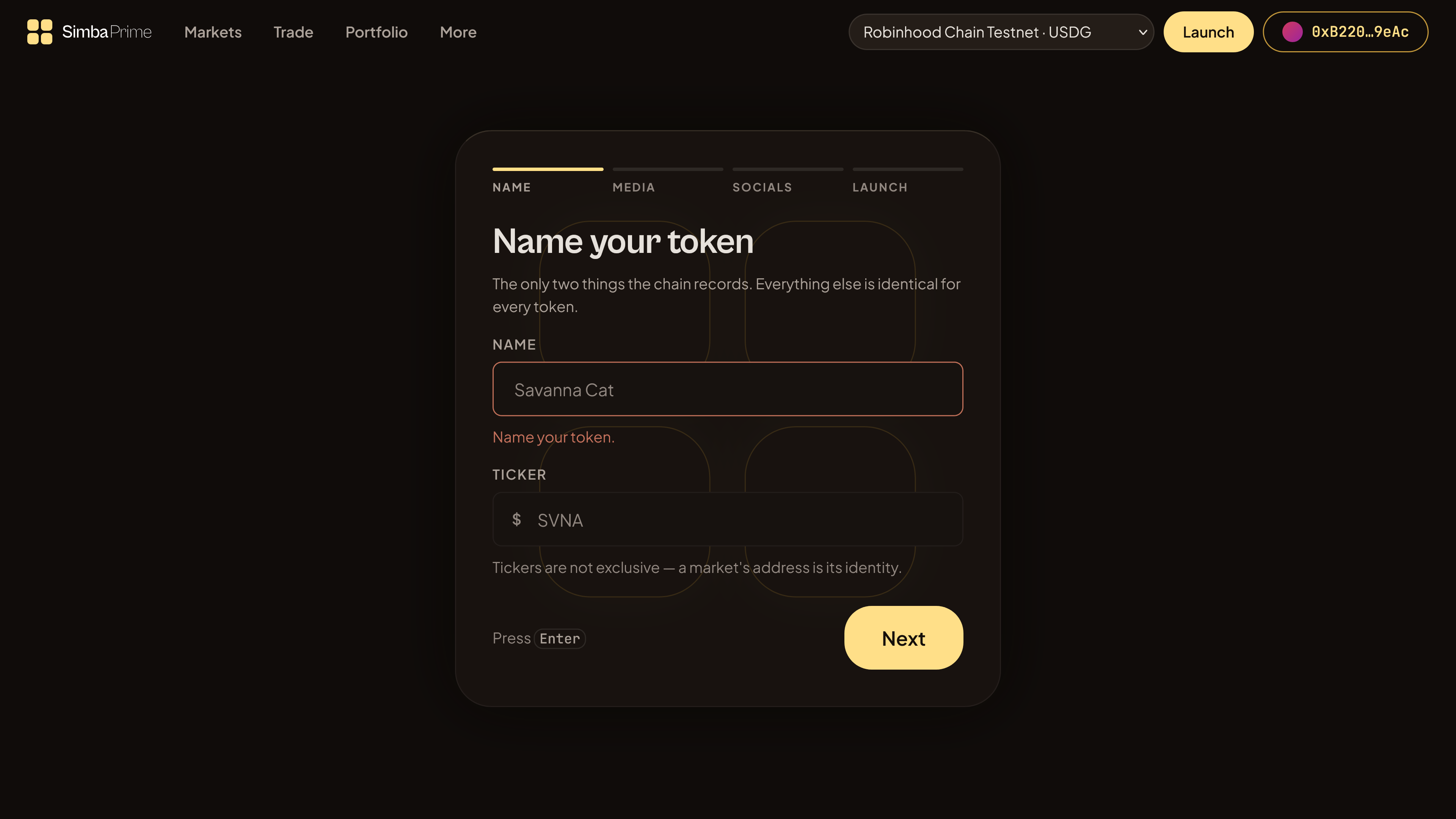
Token metadata goes on-chain at creation (logo, description, socials), so every launch carries a verifiable identity from its first batch.
本次黑客松进展
Starting point (before Sep 14): a working prototype, with Solidity contracts (vault, bonding curve, factory), curve math, an off-chain matching engine and gateway, a basic trading UI, and a first Arbitrum Sepolia deployment on Sep 14.
Built during the Buildathon, Sep 14 – Oct 1: 125 commits, 356 files changed. The test suite grew from 1,366 to 2,166.
Week 1 (Sep 14–20): hardening and session keys
Indexer with price candles and an interval switcher; market data readable without connecting a wallet.
Stress-test harness simulating a hyped launch; fixed what it found: batch re-queueing, 250 ms receipt polling, and leftover-lot pricing in both the contracts and the shared math.
Session keys end to end (contract, gateway, UI): enable trading once, then place orders without a wallet popup each time.
Approve and deposit in a single wallet confirmation, where the wallet supports bundling.
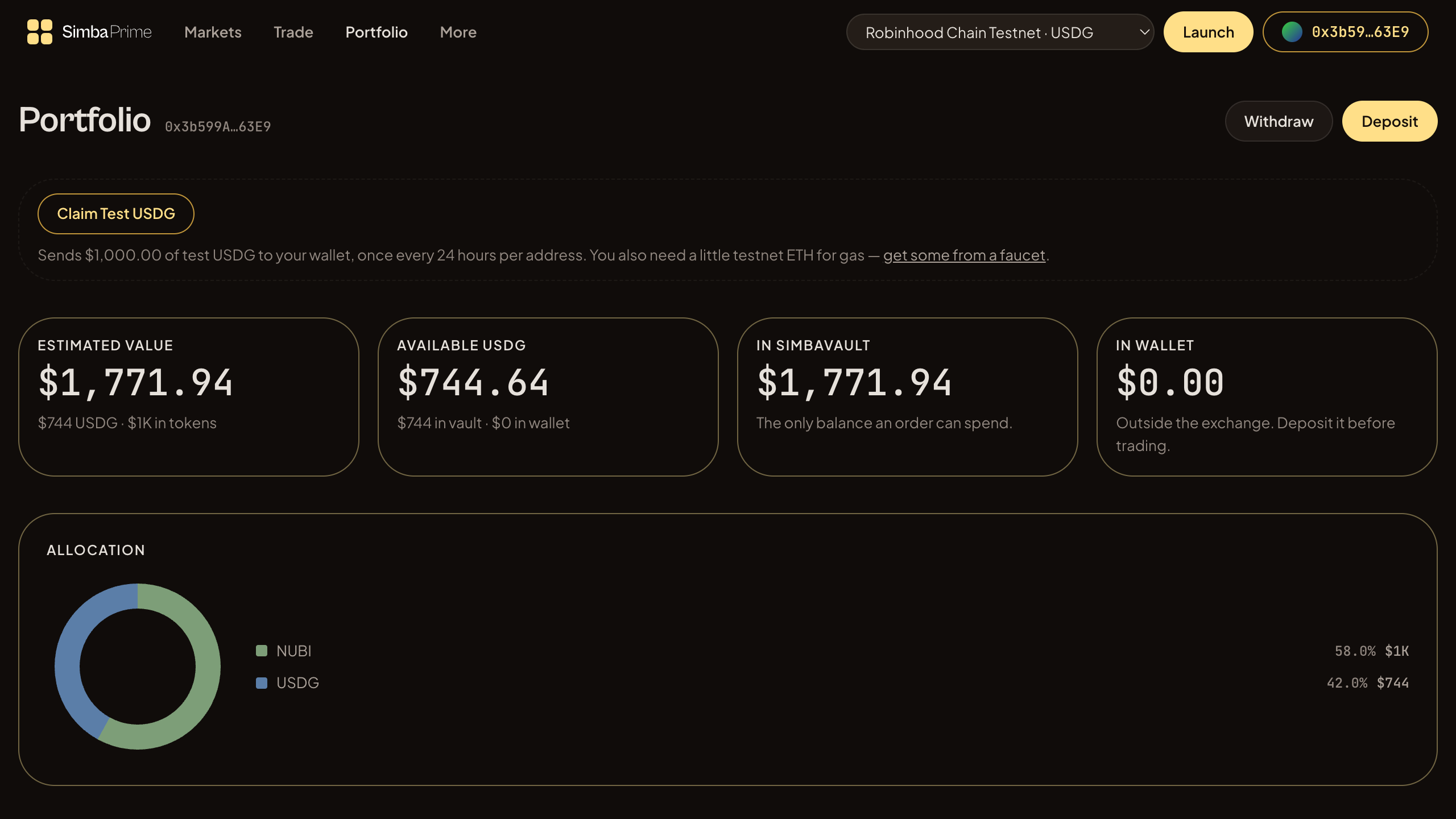
Testnet faucet on the portfolio page.
Week 2 (Sep 24–26): Robinhood Chain and Stylus
Multi-chain registry with a per-chain quote asset (USDG); deployed to Robinhood Chain testnet alongside Arbitrum Sepolia, with a network selector and wrong-network warnings.
Per-chain block timing from on-chain measurement (Robinhood Chain testnet: 168 ms median).
Cross-chain replay tests: an order signed for one chain is proven unusable on the other.
End-to-end test of the full loop on one token: launch, curve trading, graduation, order-book trade.
Deployment manifests with automated post-deploy assertions and explorer verification.
Gateway safety at boot: refuses to start if its RPC serves the wrong chain, and checks the operator's gas balance (also reported on its health endpoint).
Arbitrum Stylus: a Rust twin of the curve math and the batch solver, with Rust-vs-TypeScript differential vectors in the test suite, and a reproducible Stylus build.
Gas benchmark of the batch solver, measured on Arbitrum Sepolia, comparing the Solidity reference with the Stylus implementation.
On-chain solver and trustless settlement: a new settleBatchSolved path on an immutable Stylus solver. It is deployed and verified on both chains, and the full loop was verified on-chain.
Week 3 (Sep 27 – Oct 1): production and product
Production deployment: 3 deployment sets with their own gateways, indexers and HTTPS.
Lightweight indexer built for the production sets, replacing the heavier framework to keep charts current.
Protocol-owned liquidity service: after graduation, a 40/40 bid/ask ladder is posted to the book using session keys authorized on-chain.
Showcase seeder that creates markets at different stages of the curve, so every feature can be tried immediately.
Hyperliquid-style trade page: book with spread % and depth bars, % size slider, slippage-aware partial-fill handling, open orders and history.
The curve ticket shows when a price was solved on-chain by the Stylus solver.
Gateway safety: every open order is backed by vault balance (available = vault − reserved); the book persists across restarts; orders the gateway removed can never be replayed.
Reliability: RPC budget with batched reads and backoff, logs scrubbed of RPC URLs and keys, and wallet transactions with their own gas and fee caps.
One-click Claim mUSDG so judges can test with no setup.
融资状态
Self-funded, and staying community-owned. Simba Prime is built and funded by its founder. I have not raised outside capital, and i don't plan to sell equity or token allocations to investors. A venue built for its community should be owned by its community, not by the funds that would trade against it.
To reach mainnet on Simba Chain, my L3 on Arbitrum One, i am pursuing non-dilutive funding only:
Arbitrum Foundation and Arbitrum DAO grants, for the Orbit L3 launch and continued protocol development.
Stylus ecosystem programs, for the on-chain batch solver and the path to permissionless solving.
Arbitrum's audit support, for a full third-party security audit of the contracts and the Stylus solver before mainnet.
Infrastructure credits (cloud and RPC), to run the gateways, indexers and the chain's supporting services.
Every grant goes into shipping: the audit, the L3, POMM's re-centring engine, and the tooling that lets anyone build on Simba Prime.