
HTTPS for Media
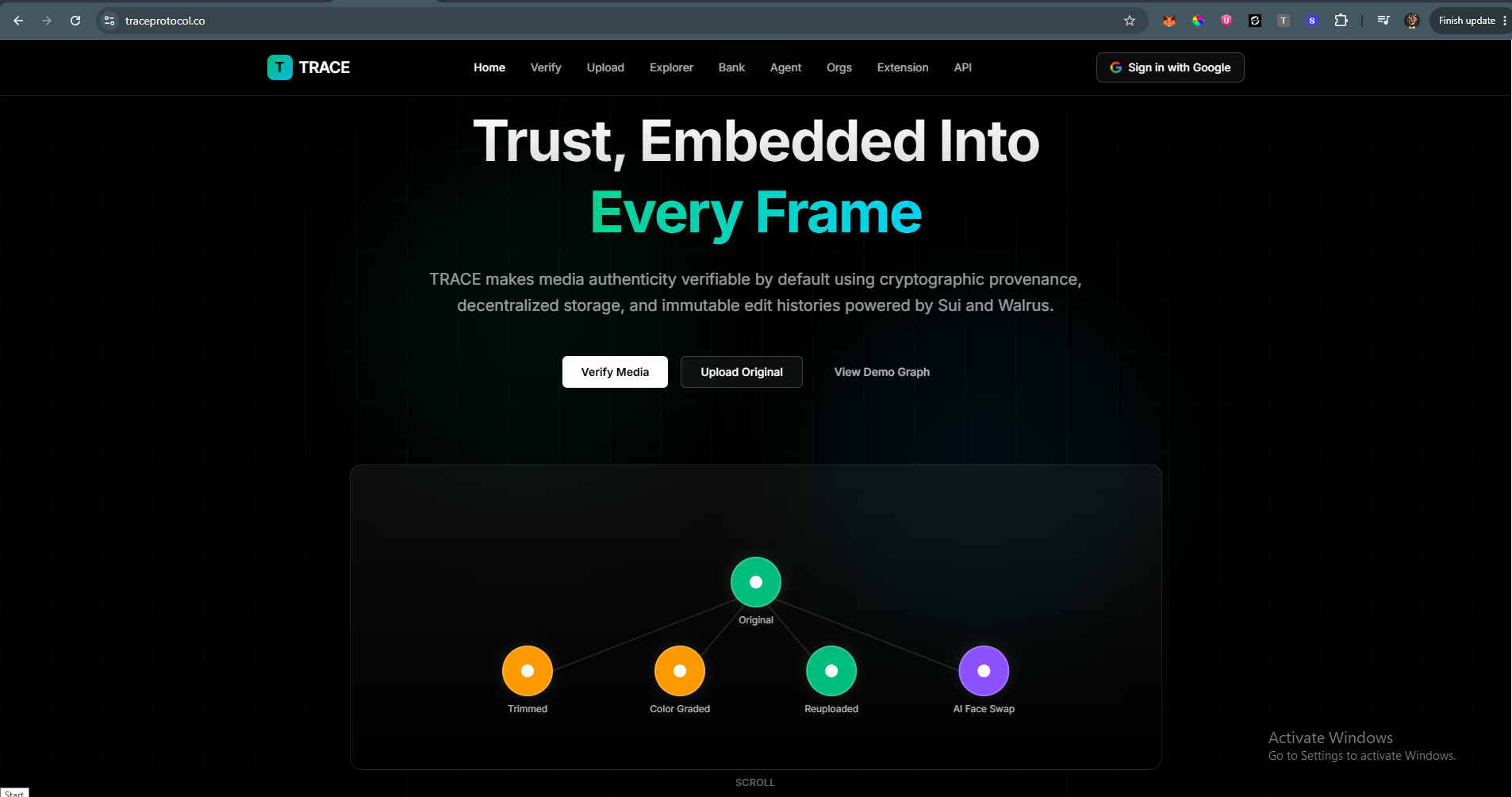
TRACE Protocol is a media intelligence and authenticity network built on Sui, Walrus, and MemWal.
Today, every media file shared online is effectively anonymous. Once it begins spreading across platforms, it becomes difficult to verify its origin, whether it has been altered, how it has evolved, and whether it can be trusted.
TRACE combines cryptographic provenance, collective memory, and autonomous AI agents to create a verifiable trust layer for digital media.
Instead of asking:
"Is this media fake?"
TRACE answers:
"Where did this media come from, how has it evolved, who modified it, and can its authenticity be proven?"
By combining Sui's object model, Walrus' decentralized storage, and MemWal's persistent AI memory, TRACE transforms media verification from a one-time action into a persistent intelligence network.
The internet has no native trust layer for media.
As AI-generated content, deepfakes, manipulated content, and misinformation continue to grow, it becomes increasingly difficult to determine:
Who originally created a piece of media
When it first appeared
Whether it has been modified
How it has spread across platforms
Which version is authentic
Current solutions focus primarily on AI detection, moderation, or content takedowns.
These approaches are reactive and often fail once content has already spread.
Additionally, AI agents today suffer from fragmented memory. They lose context between sessions, cannot share intelligence effectively, and may repeatedly investigate the same content from scratch.
The result is an internet where media lacks provenance, and agents lack memory.
TRACE creates a permanent, verifiable provenance layer for digital media.
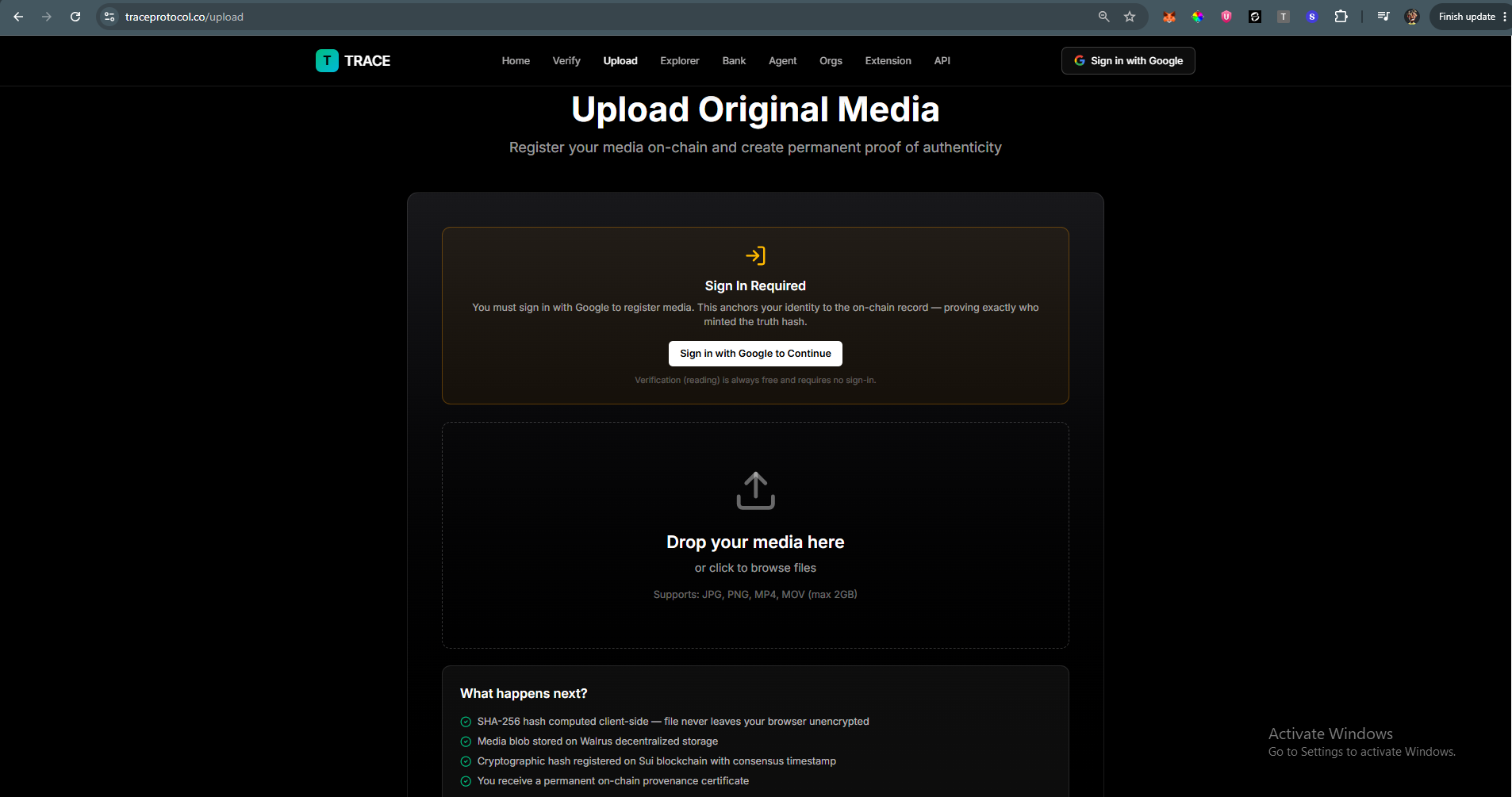
When media is uploaded:
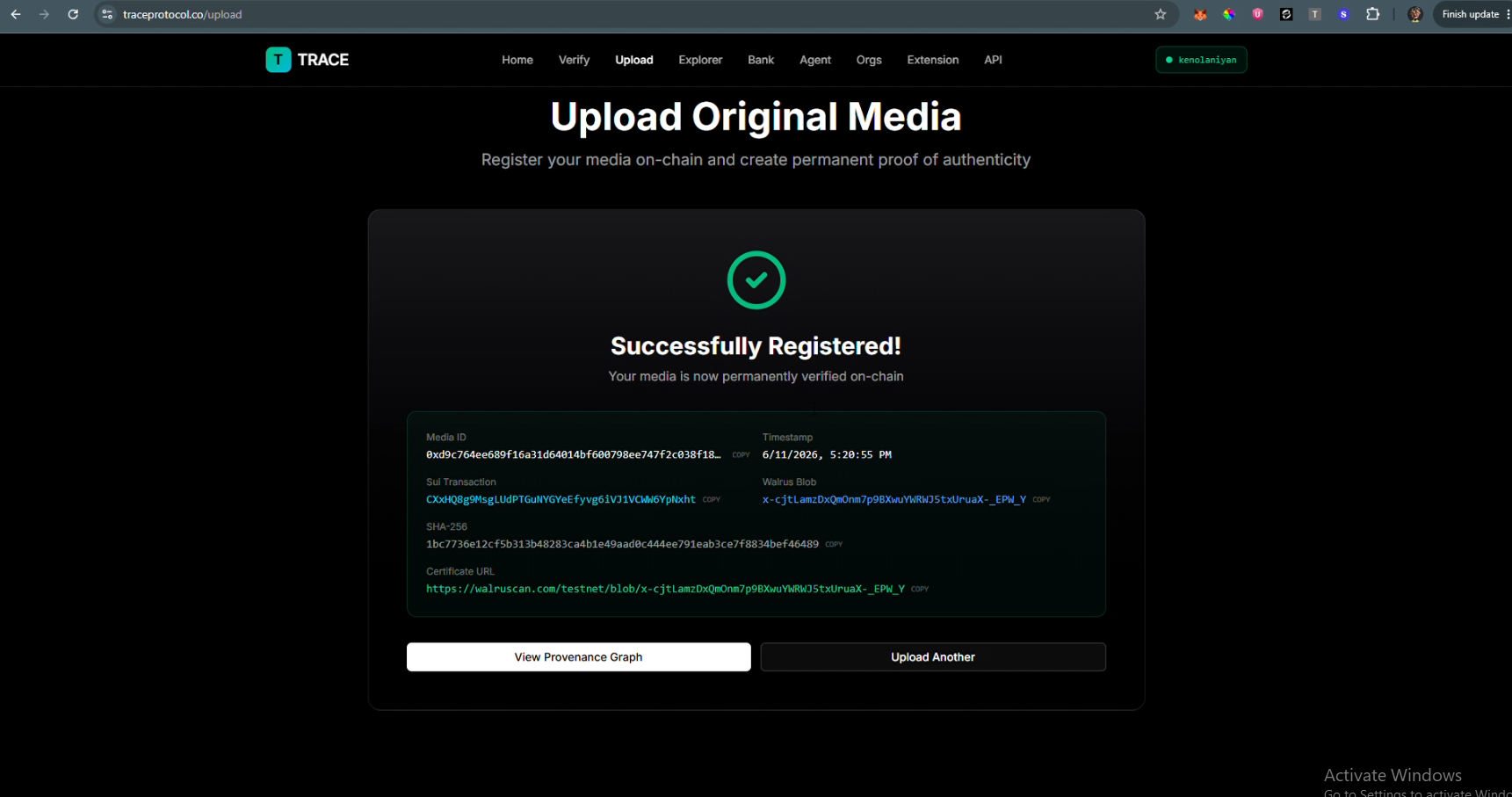
The media is stored on Walrus.
Cryptographic and perceptual fingerprints are generated.
A MediaRecord is created on Sui.
Provenance metadata is permanently anchored on-chain.
AI agents continuously monitor and investigate derivatives.
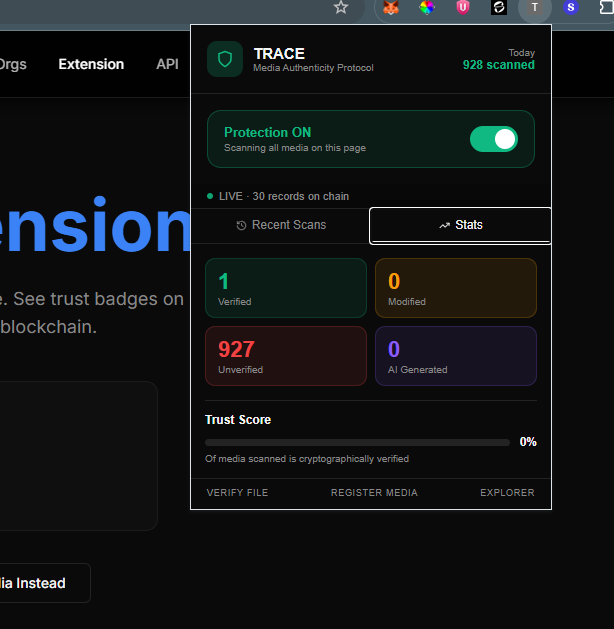
Browser extension agents sight media on every webpage, and store them in the Collective Memory Bank powered by MemWal.
This allows users, organizations, and AI agents to verify: Origin, Ownership, Integrity, Edit history, Distribution history, Trust score, AI involvement
TRACE does not merely detect manipulated content. TRACE makes authenticity provable.
Provenance Registry: Every piece of media receives a permanent on-chain identity containing (SHA-256 hash, Perceptual hash, Creator identity, Timestamp, Walrus storage proof, Integrity status, AI generation score, Parent-child relationships).
Provenance Graph: A visual lineage graph showing how media evolves over time. Tracks:
Transform type (ORIGINAL, TRIM, CROP, MERGE, TRANSLATE, SUBTITLE, AUDIO_REPLACEMENT, VOICE_CLONE, FACE_SWAP, AI_REMIX, SYNTHETIC_GENERATION).
Intent Type (JOURNALISM, EDUCATION, ENTERTAINMENT, SATIRE, COMMERCIAL, MISINFORMATION).
Trust Level (VERIFIED_CREATOR, VERIFIED_ORGANIZATION, COMMUNITY_VERIFIED, UNVERIFIED).
AI Involvement (NONE, AI_ASSISTED, AI_GENERATED, FULLY_SYNTHETIC).
Collective Memory Bank: Powered by MemWal.
Stores: First-seen records, Verification history, Derivative discoveries, Trust signals, Spread intelligence, Investigation results.
Unlike traditional systems, TRACE agents never start from zero. Every observation strengthens the network.
Multi-Agent Intelligence Layer
Sentinel Agent (Discovers derivatives and manipulated content).
Verification Agent (Validates provenance and authenticity).
Spread Analysis Agent (Tracks how media propagates across platforms).
Source Trust Agent (Builds reputation profiles for creators and publishers).
Research Agent (Generates misinformation and media intelligence reports).
Legal Evidence Agent (Produces court-ready certificate).
Browser Extension: Provides real-time verification while browsing.
Possible results: 🟢 Verified Original, 🟡 Verified Derivative, 🔴 Unverified, 🟣 AI Generated, ⚪ Unknown.
Users can instantly inspect (Origin, Provenance chain, Trust score, Edit history, Distribution history).
Authenticity Certificates: Creators can generate verifiable certificates proving:
Ownership
Timestamp
Provenance
Registration status
Storage proof
Other features like API, Organization access, and an Explorer.
Journalism: News organizations can authenticate and verify original footage before publication.
Deepfake Detection: Users can identify manipulated derivatives and trace them back to original sources.
Creator Protection: Creators can prove ownership and detect unauthorized modifications.
Legal Evidence: Generate verifiable chains of custody for courts, investigators, and law enforcement.
Social media Ai content verification: Social media companies can integrate trace protocol to display Ai watermark and an authenticity certificate as directed by the new EU act. Also, help creators automatically verify their content before it goes online.
Sui's object-centric architecture is ideal for provenance. Every media asset, edit record, and provenance relationship becomes a first-class on-chain object with ownership and history.
Benefits: Object ownership, Immutable provenance, Fast execution, Sponsored transactions, zkLogin onboarding.
Why Walrus?
Walrus provides decentralized, verifiable storage for media.
Benefits: Blob certification, Verifiable retrieval, Cost-efficient large-file storage, Permanent media archival.
Every uploaded file receives a cryptographic storage proof.
MemWal powers TRACE's Collective Memory Bank.
Benefits: Persistent memory, Cross-agent collaboration, Long-running investigations, Shared intelligence.
With MemWal, the network continuously learns and would never have to start from scratch.
During the hackathon, we successfully:
Designed the TRACE Protocol architecture
Built the MediaRecord smart contract on Sui
Integrated Walrus for decentralized media storage
Implemented provenance registration workflows
Built the Provenance Graph visualization
Integrated MemWal for persistent agent memory
Developed the browser extension prototype
Created the Verification API
Implemented autonomous agent workflows
Designed the Collective Memory Bank architecture
Created a demo video
Wrote the documentation
None Yet