
A programmable, multi-chain–agnostic decentralized payment and settlement protocol
A programmable, multi-chain–agnostic decentralized payment and settlement protocol
With a market cap in the hundreds of billions, stablecoins are now the key hub linking TradFi and Crypto. Everyone talks about mass adoption, yet we still lack a 'Stripe-like' experience for everyday payments.
The bottleneck is the high friction for traditional developers and merchants: managing private keys, handling wallet connections, and worrying about block reorgs is a far cry from Stripe’s plug-and-play simplicity.
What the market needs is a lightweight module that shields developers from Blockchain's complexity. True global circulation will only happen when stablecoin settlement becomes so easy that merchants don't even need to know what a blockchain is.
EZPay is a blockchain payment middleware providing a Stripe-equivalent stablecoin payment experience. Through a "Platform + SDK" layered architecture, it enables rapid commercialization of decentralized payment capabilities.
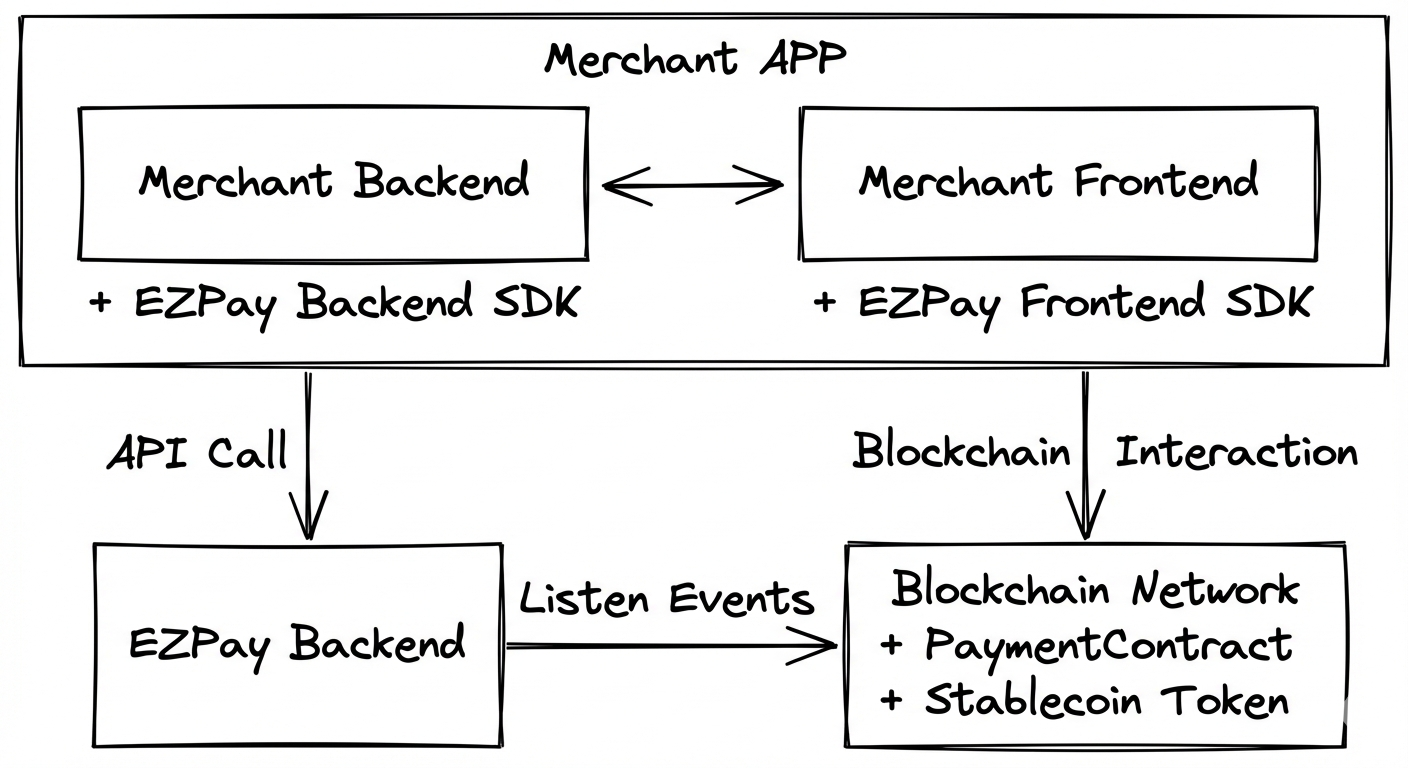
Core Layer: Provides infrastructure services including Payment Intent management, On-chain Event Monitoring, and Webhook notifications. Merchants manage API configurations and transaction data via a centralized Dashboard.
Integration Layer: Dual SDKs covering both backend and frontend scenarios:
Backend SDK: For server-side integration; allows creating payment orders with minimal code.
Frontend SDK: Plug-and-play components handling wallet connection, authorization, and the full payment lifecycle with a native UI.
Contract Layer: Utilizes a Factory Pattern to deploy independent PaymentContracts for each merchant, ensuring fund isolation and non-custodial security.
Multi-Chain Settlement: Supports stablecoin acquiring and settlement across multiple mainstream blockchains.
Easy to Integration: Provides comprehensive SDKs for rapid deployment into existing business systems.
Smart Contract Extensibility: Allows developers to deploy custom logic for business requirements such as automated revenue sharing.
Non-Custodial Architecture: A decentralized protocol where users retain full asset control; all transactions are executed via on-chain contracts.
We generate revenue through two primary channels:
Transaction Fees
By offering much lower transaction fees than those of credit cards, we can motivate users to use stablecoins for payment, thereby boosting the trading volume of stablecoins and establishing a positive adoption flywheel.
Protocol Governance and Asset Issuance Fees
The protocol will enable merchants offering subscription-based or installment-based services to tokenize their future revenue streams.
They can package subscription cash flows into new on-chain tokens, while the protocol captures value through protocol governance fees and asset issuance fees, establishing a sustainable, high–value protocol-level revenue model.
Core Feature Development ✅
Build the foundational payment protocol architecture, focusing on security, scalability, and high-performance on-chain settlement.
Primary Stablecoin Support
Enable instant payment and settlement for major stablecoins such as USDT and USDC across multiple blockchain networks, with a chain-agnostic architecture designed for future expansion, delivering low-cost transactions.
Full-Stack Integration Ecosystem
Launch SDKs supporting major frontend and backend frameworks (React, Vue, Node.js), along with comprehensive mobile integration solutions for iOS and Android.
On-chain Subscriptions & Future Flow Securitization (FFS)
Introduce smart contract–based subscription billing for recurring revenue use cases such as SaaS subscriptions and membership fees.
Building on this foundation, predictable future cash flows are unbundled and packaged into tradable on-chain digital assets—analogous to how Pendle tokenizes and trades future yield. This enables merchants to monetize expected future earnings at a discount in exchange for immediate liquidity, significantly improving capital efficiency and balance sheet flexibility.
Decentralized Dispute Resolution
Develop a smart contract-driven arbitration and dispute resolution mechanism to ensure fair and secure transactions for all parties.
Third-party Gateway Integration
Deeply integrate with leading crypto payment platforms such as Binance Pay and Coinbase Pay to expand global payment reach.
Enterprise Multi-signature Integration
Support enterprise-grade multi-signature wallets (e.g., Gnosis Safe) to enhance institutional fund security and governance.
Offline Payment Ubiquity
Deploy QR code and NFC-based payment solutions to support real-world retail and offline commerce scenarios.