
Miiso watches every contract deployed on Base and revokes dangerous token approvals before exploits drain you automatically, while you are in deep sleep.

Every time a user interacts with a DeFi protocol, they sign a token approval allowing that contract to move their assets. Most users approve unlimited amounts and forget about them. When a protocol gets exploited, attackers use these legacy approvals to call transferFrom() and drain the user's funds in seconds—often at 3 AM.
Existing solutions are strictly reactive and manual:
Tools like revoke.cash require the user to be online.
The user must be aware of the exploit.
The user must manually sign a transaction after the hack has already started.
There is no proactive system that can autonomously monitor the blockchain, identify threats on contract deployment, and protect individual user wallets without waking them up.
Miiso is an autonomous, on-chain multi-agent security swarm that watches your DeFi positions 24/7.
It scans newly deployed contracts on Base, decompiles their bytecode, runs vulnerability assessments using Venice AI's uncensored reasoning models, and automatically revokes dangerous token approvals on behalf of the user using gasless execution—before an attacker can drain the wallet.
Built using MetaMask's smart account standards, users grant Miiso a single, strictly bounded permission:
The ability to call approve(spender, 0).
The agent is mathematically restricted on-chain from ever transferring assets, swapping tokens, or touching the user's principal.
During onboarding:
The user's standard EOA is dynamically upgraded to a smart account using EIP-7702.
This enables delegating transaction execution to our security swarm while keeping the user's primary wallet address unchanged.
The user signs a scoped permission statement (wallet_grantPermissions).
The payload explicitly limits the agent to interacting only with our ApprovalRevocationEnforcer contract.
A pre-configured monthly gas budget cap is enforced.
The permission is registered as an on-chain EIP-7710 delegation.
When a threat is detected, the agent signs the revocation transaction alongside the delegation context.
This proves its authority to reset the allowance on-chain.
Traditional AI APIs block analysis of exploit code due to safety filters.
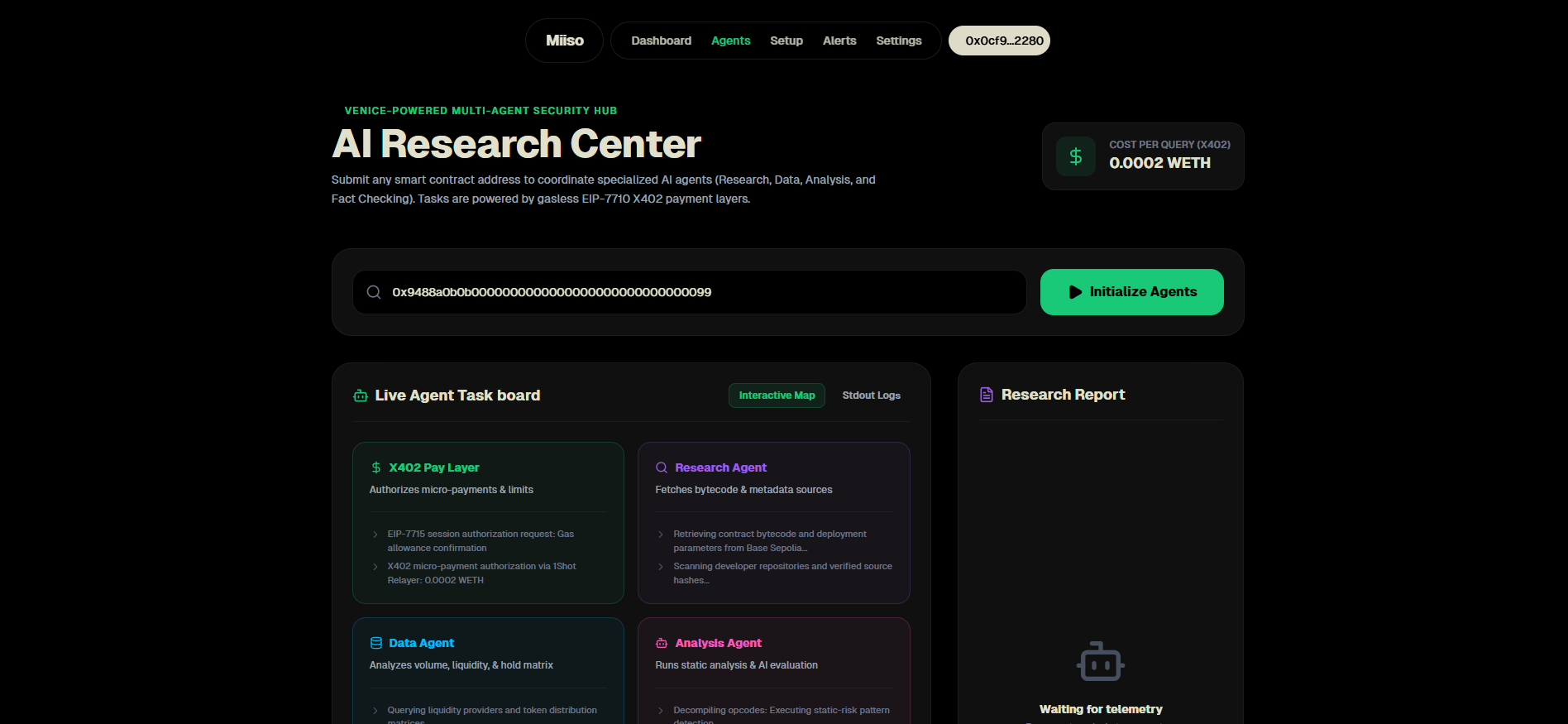
We use Venice AI's uncensored models to run a 3-Pass Reasoning Chain:
Pass 1: Vulnerability Detection
Identifies reentrancy, hidden drains, access control bugs.
Pass 2: Exploit Simulation
Maps out step-by-step how an attacker would exploit the code.
Pass 3: Confidence Critique
Self-evaluates findings to eliminate false positives.
Revocation transactions are submitted through 1Shot's gas relayer.
This abstracts gas fees entirely.
The relayer executes transactions on-chain and recovers gas fees in USDC directly from the user's pre-approved budget.
We implement x402 payments to settle:
Venice AI inference costs in USDC on a per-token basis (~$0.00000038/token).
1Shot relayer execution fees ($0.01 USDC/revocation).
Additionally, we expose four payment-gated B2B API endpoints:
Threat Intel
Exploit Analysis
Security Report
Wallet Exposure
These endpoints require x402 USDC micropayments to query.
Powered by an asynchronous event bus (PostgreSQL LISTEN/NOTIFY), seven specialized agents coordinate, share structured state, and reach a weighted quorum before taking protective actions:
Scout
Intel
Auditor
Risk
Coordinator
Executor
Reporter
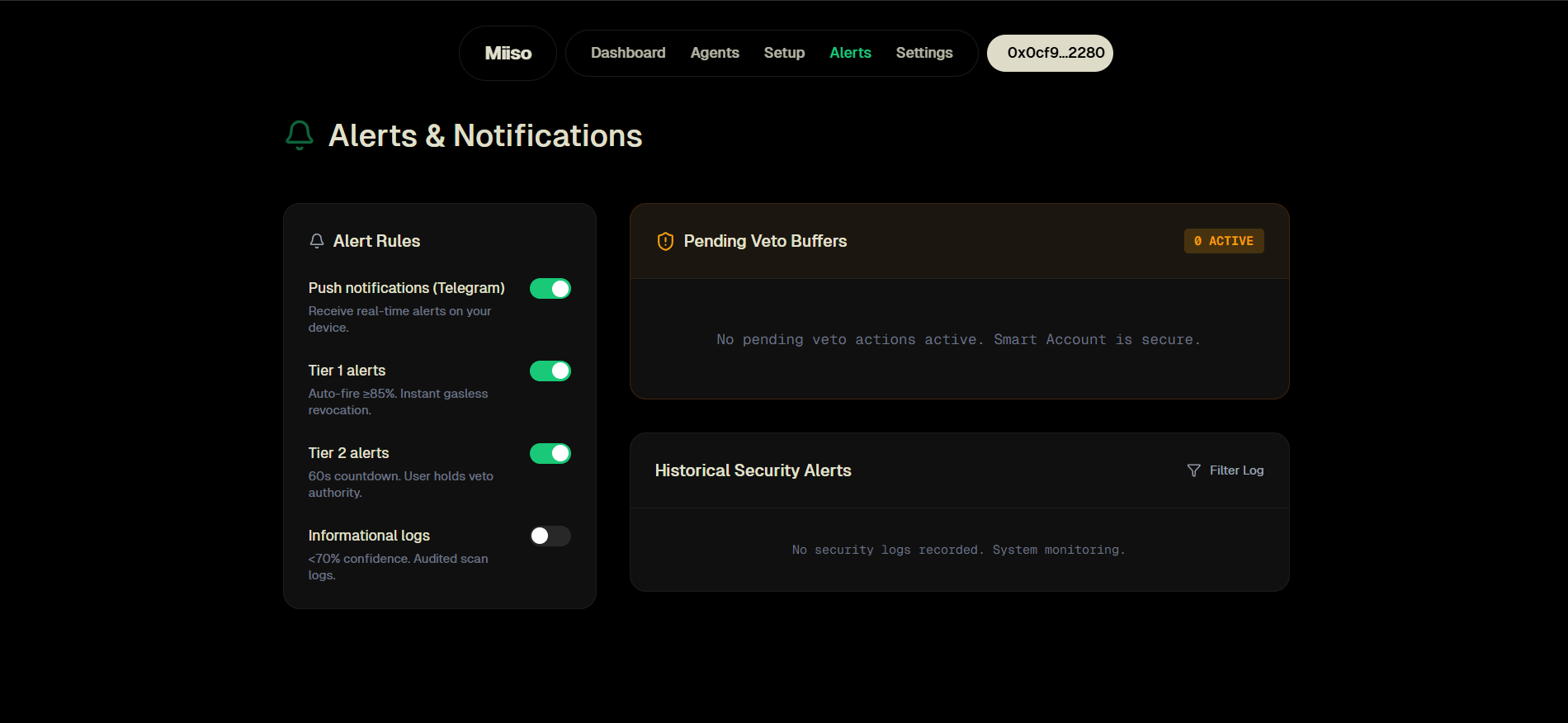
Immediate autonomous revocation.
Triggers an animated 60-second veto timer on the UI for manual cancellation.
Logged as an informational warning on the dashboard.
The ApprovalRevocationEnforcer.sol contract acts as an immutable shield.
If the agent tries to perform any action other than resetting a spender's allowance to 0, the blockchain rejects the transaction.
Natural language reports translate technical bytecode patterns into human-readable attack narratives.
These narratives are presented directly on the dashboard.
React 18
Vite
Framer Motion (for real-time Agent Swarm activity maps and animated veto rings)
Tailwind CSS
Lucide icons
Node.js
Fastify
PostgreSQL (SSE channels + Event Bus)
Drizzle ORM
Viem
MetaMask SDK / Smart Accounts Kit
Heimdall-rs (Decompiler)
Venice AI API
1Shot Relayer SDK
x402 Protocol
We built Miiso completely from scratch during this hackathon timeline, moving from a blank repository to a fully functioning autonomous security network.
Configured a parallel worker thread pool that fetches newly deployed contract bytecode on Base.
Decompiles it into readable pseudo-Solidity via a local Rust-based Heimdall decompiler execution handler (src/daemon/heimdall.ts).
Designed and implemented the core A2A orchestrator (src/agents/orchestrator.ts).
Manages structured state transitions across Scout, Auditor, Risk, and Executor agent tasks.
Integrated Venice AI's uncensored reasoning model API (src/daemon/veniceAnalyzer.ts) via SIWE authentication.
Wired the x402 USDC micropayment client (src/payments/x402Client.ts) to pay for inference on a per-token basis.
Built a custom frontend setup sequence (src/Setup.tsx and src/lib/metamask.ts).
Guides users to sign EIP-7702 smart account authorizations.
Requests scoped ERC-7715 token-approval-revocation permissions.
Implemented EIP-7710 gasless revocation payloads using 1Shot Relayer APIs (src/daemon/revocationExecutor.ts).
Verified on-chain against an active ApprovalRevocationEnforcer contract.
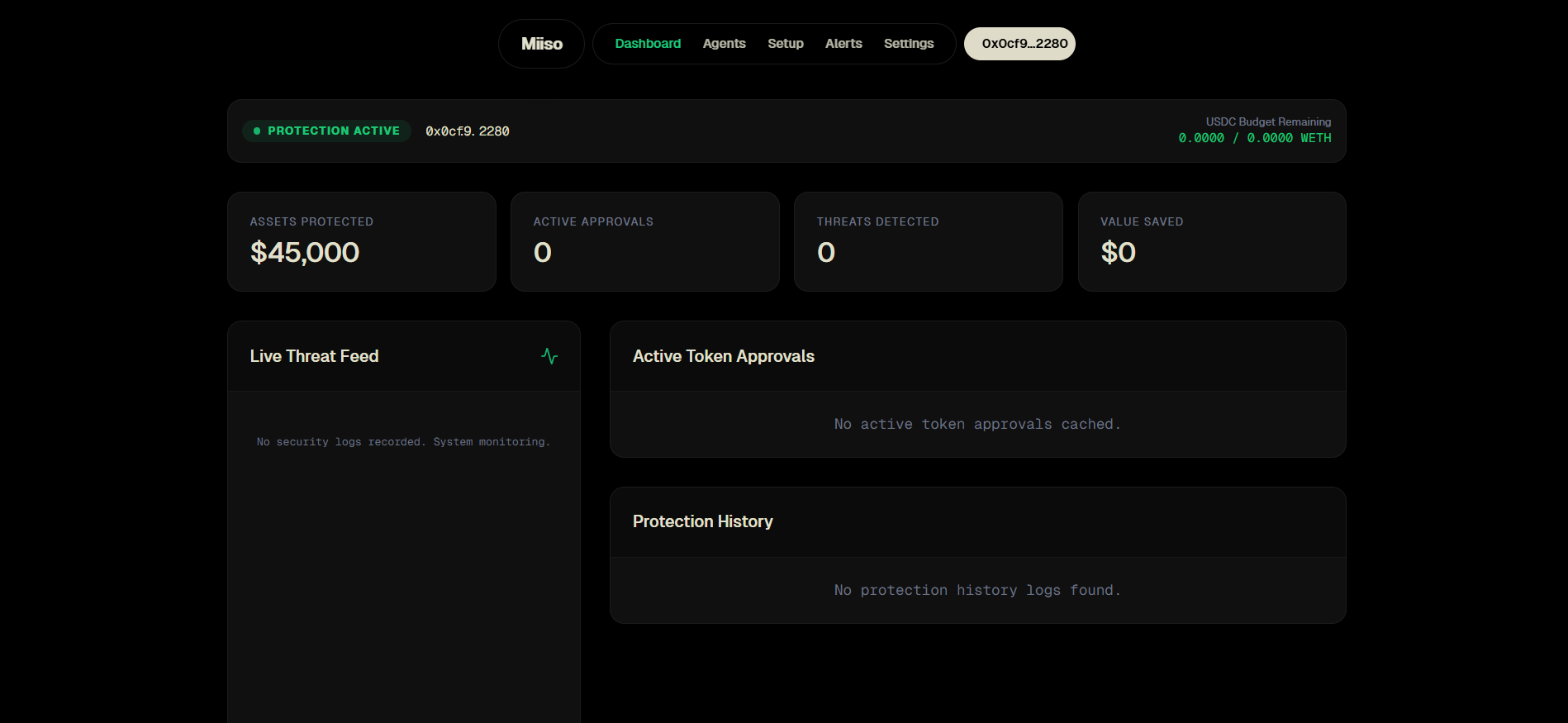
Designed a glassmorphic dashboard interface featuring:
Real-time asset protection statistics
Live scan logs
An SVG-animated countdown circular ring (src/components/dashboard/VetoTimer.tsx)
Provides a 60-second user veto countdown before automated execution.
Implemented a robust fallback block simulator (src/daemon/blockWatcher.ts).
Triggers:
Mock contract deployments
Static vulnerability flags
Venice AI confidence routing loops
Enables full demo functionality even when local blockchain forks (Anvil) are offline.
Miiso is currently bootstrapped and was developed entirely during this hackathon.
Pre-seed / Bootstrapped
Seeking grants, developer relations support, and ecosystem incubation opportunities.
We are actively looking for ecosystem grants on Base and Ethereum Layer 2 networks to support:
Smart contract audits
Production contract deployments
Security infrastructure expansion
Continued development and ecosystem growth
Fundraising Status
Miiso is currently bootstrapped and was developed entirely during this hackathon.
Current Stage: Pre-seed / Bootstrapped (seeking grants, developer relations support, and ecosystem incubation).
Funding Goals: We are actively looking for ecosystem grants on Base and Ethereum Layer 2 networks to support audit costs, contract deployments