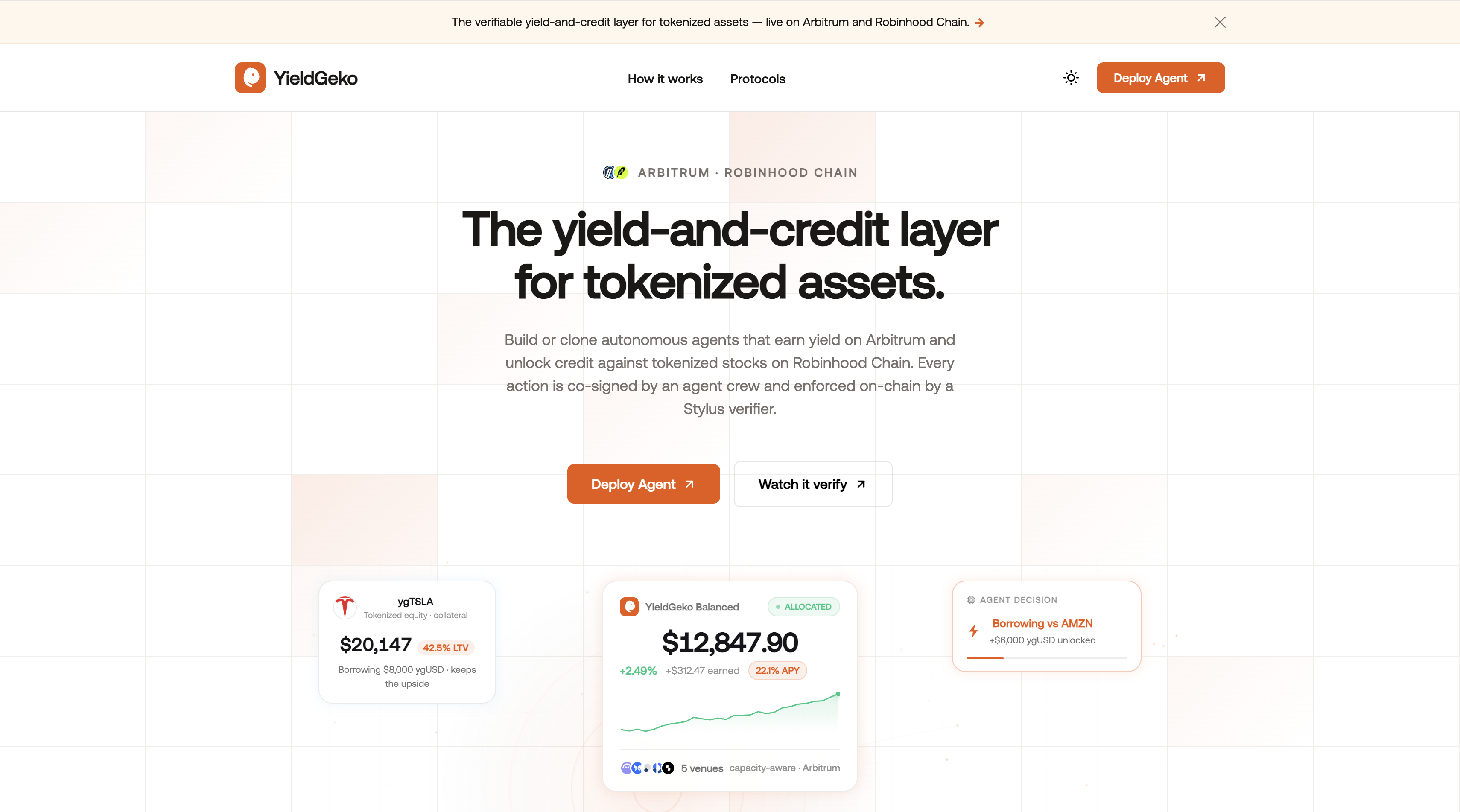
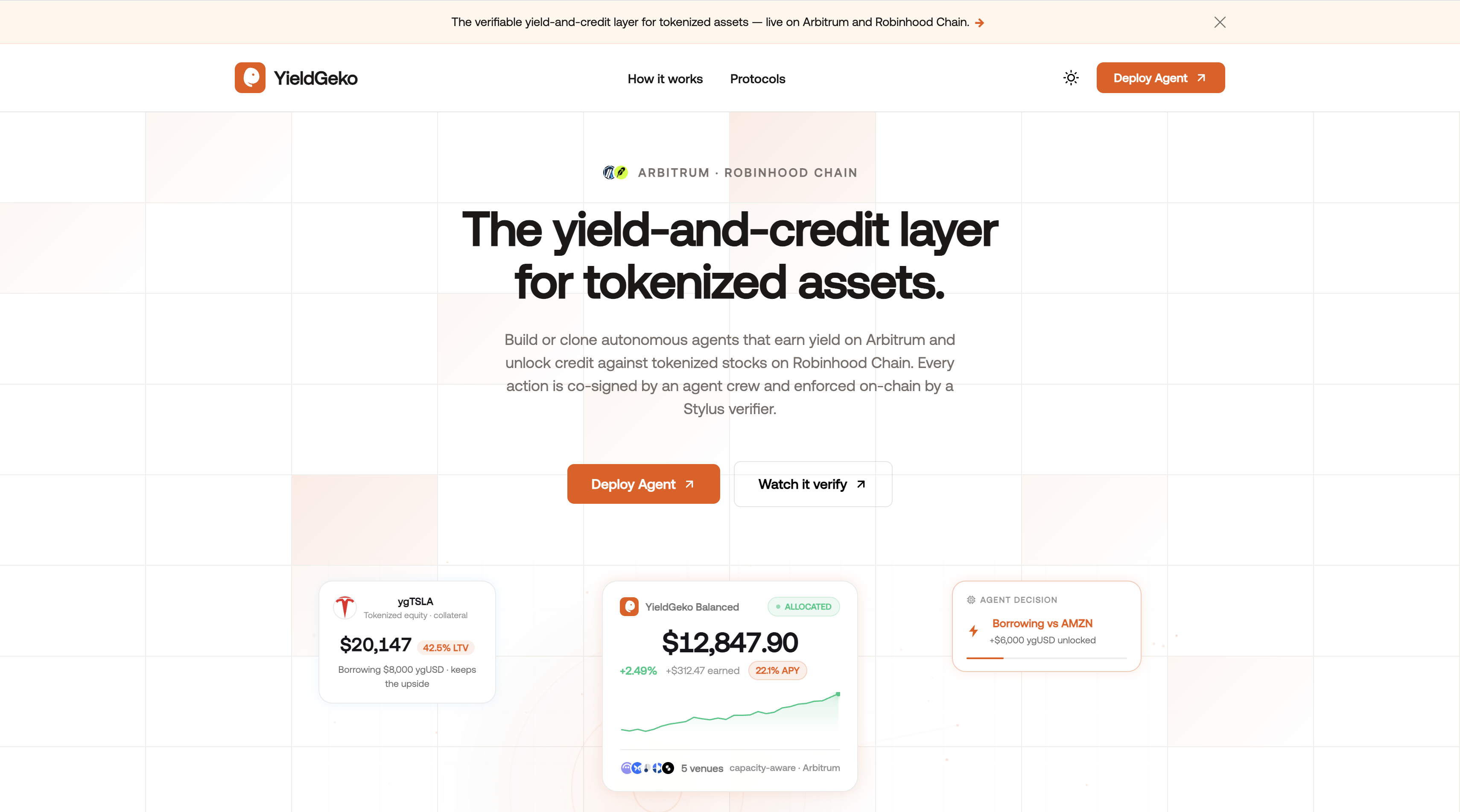
The verifiable yield-and-credit layer for tokenized assets: build or clone agents whose authority a Stylus verifier enforces on-chain. Yield on Arbitrum; equity credit on Robinhood Chain.
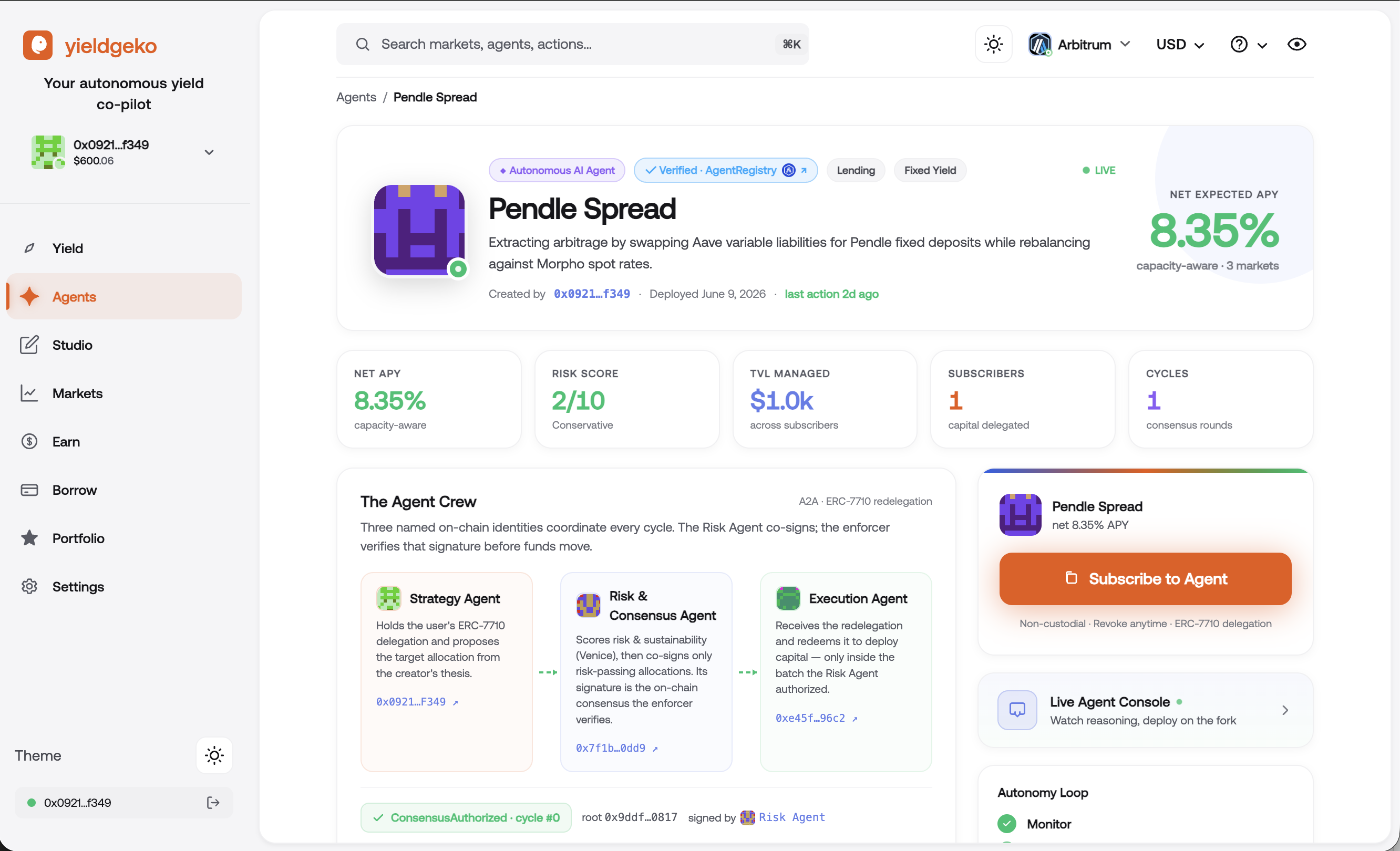
App | |
Networks | Arbitrum One · Arbitrum Sepolia · Robinhood Chain |
On-chain proof | every deployed contract + certified transaction is listed under 11 · Traction below |
YieldGeko is a non-custodial, verifiable yield-and-credit protocol for tokenized assets. An autonomous agent optimizes DeFi yield on Arbitrum and powers a self-contained lending market for tokenized equities on Robinhood Chain, with every action consensus-signed and re-verified on-chain by an Arbitrum Stylus verifier.
Networks | Arbitrum One · Arbitrum Sepolia · Robinhood Chain (an Arbitrum Orbit L2 for tokenized RWAs) |
Yield venues | Aave · Morpho · Pendle · Fluid · Silo |
Standards | ERC-7710 scoped delegation via the MetaMask Smart Accounts Kit · ERC-4337 (account abstraction, gasless) · ERC-8004 (agent track record) · ERC-4626 (vaults) |
AI | Venice: risk scoring that drives the on-chain LTV, within a hard, deterministic safety band |
Verification | Arbitrum Stylus (Rust/WASM) consensus verifier, certified identical across three chains |
Custody | None. Capital stays in the user's own smart account; the agent can rebalance, never withdraw. |
YieldGeko makes tokenized assets productive and liquid. On Arbitrum, an autonomous agent allocates capital across the top yield venues (Aave, Morpho, Pendle, Fluid, Silo), weighting every position capacity-aware and risk-adjusted so it never over-concentrates into shallow liquidity. On Robinhood Chain and Arbitrum Sepolia, it runs a self-contained lending market for tokenized equities: supply stablecoins or stocks to earn, or borrow against your stocks without selling, where lender yield is paid by borrower interest, not subsidy. A Venice-AI risk brain prices every asset and sets its on-chain LTV inside a hard safety band; a crew of agents co-signs each allocation before it can execute; and an Arbitrum Stylus verifier re-checks every signature on-chain, so a forged or replayed instruction reverts. Execution is fully non-custodial through ERC-7710 scoped delegation: users verify the agent's authority on-chain instead of trusting it.
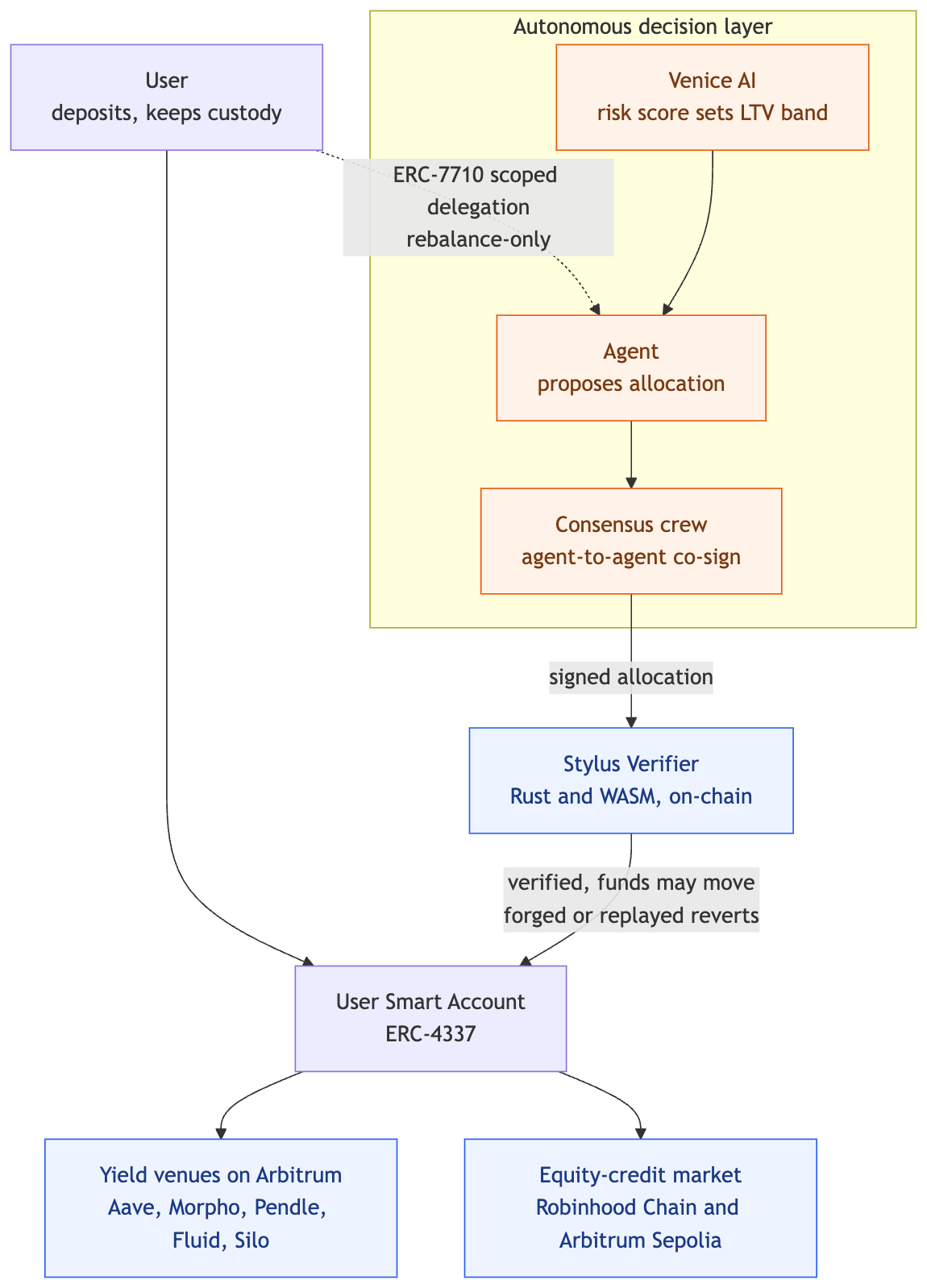
The whole system in one rule: the agent proposes, the crew co-signs, the Stylus verifier re-checks on-chain, and only then can funds move. Authority is bounded and proven, never asserted.
DeFAI (AI-driven DeFi) is the dominant agent narrative of the cycle, and tokenized real-world assets are arriving on-chain at scale. Both carry the same structural flaw, and YieldGeko is built to remove it.
Agent authority is unverifiable. Every "AI manages your DeFi" product today asks the user to trust an off-chain model, the operator running it, and (almost always) custody of the funds. There is no standard for bounding and proving an agent's authority on-chain. A leaked key, a buggy strategy, or a malicious operator drains the vault, and nothing on-chain was ever able to say no.
Tokenized assets are inert. Tokenized equities have crossed $1B+ in market value with hundreds of thousands of holders, yet they sit idle. There is no native venue to earn on them or borrow against them, so the capital is trapped, or the holder sells, triggering tax and forfeiting upside.
YieldGeko answers both with one primitive, verifiable, non-custodial autonomy, applied to yield optimization and equity credit.
One protocol, two products, run by the same verifiable agent.
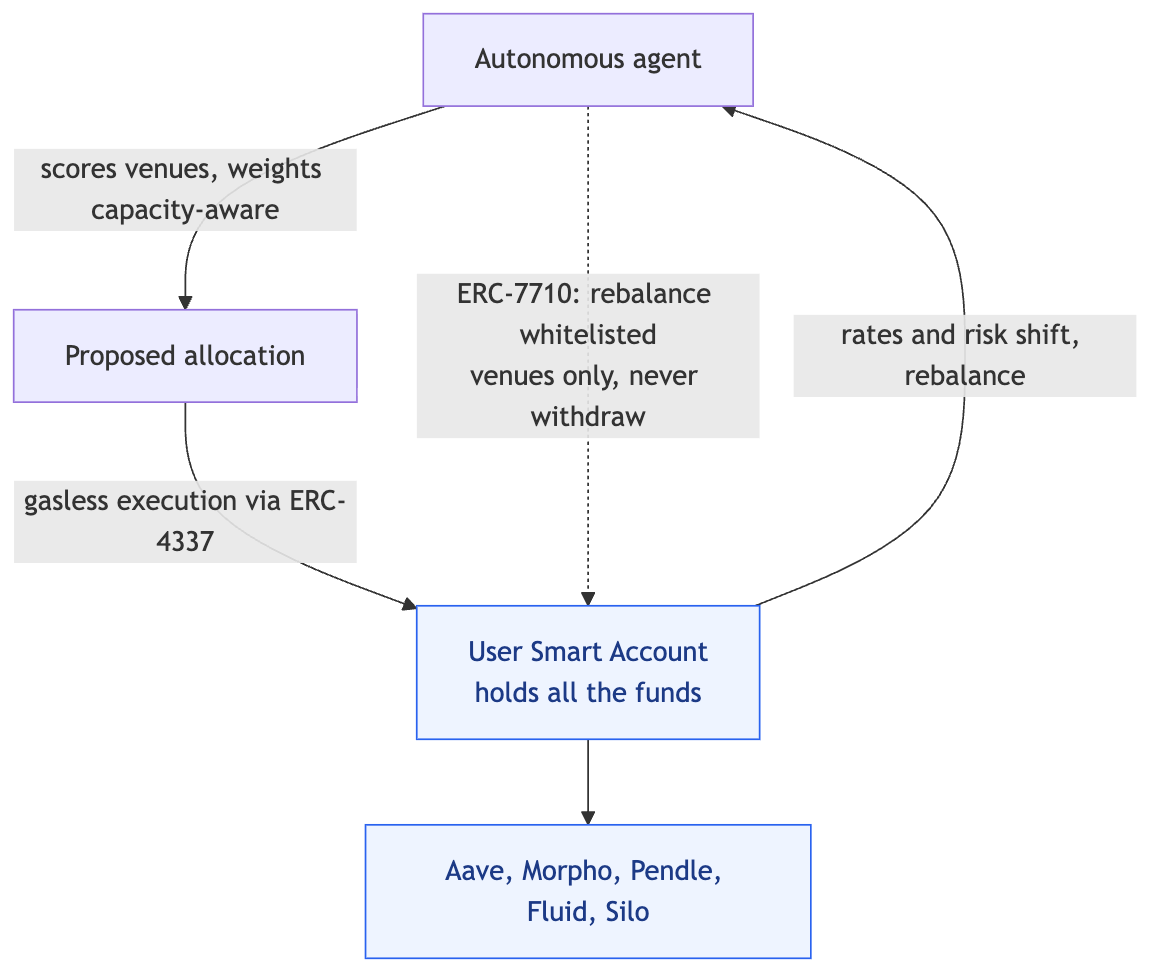
1 · Yield optimization (Arbitrum). An autonomous agent supplies capital across five venues (Aave, Morpho, Pendle, Fluid, Silo), scoring each market for risk and return and weighting positions capacity-aware, so it never over-concentrates into shallow liquidity. As rates move, it rebalances. Funds never leave the user's smart account; the agent holds a rebalance-only delegation, not custody.
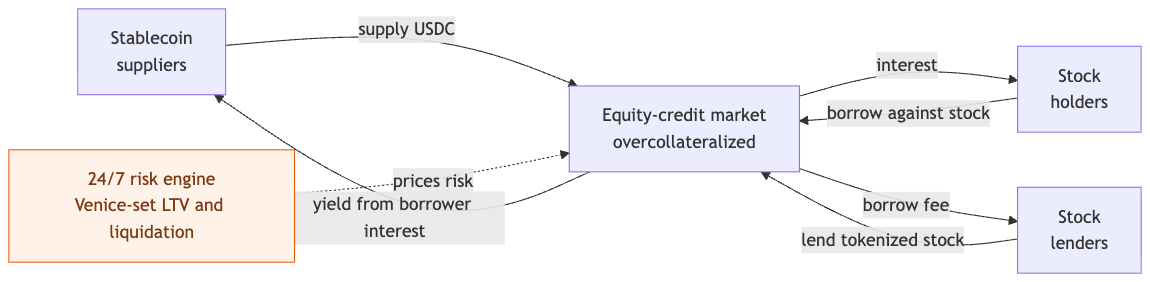
2 · Equity-credit market (Robinhood Chain + Arbitrum Sepolia). A self-contained, overcollateralized lending market for tokenized equities and stablecoins:
Supply stablecoins → earn yield paid by stock-holders borrowing against collateral.
Supply tokenized stocks → earn the borrow fee paid by traders shorting or levering them.
Borrow stablecoins against tokenized stocks → unlock liquidity without selling: no taxable event, keep the upside.
Lender yield = borrower interest. Nothing is subsidized or minted from thin air; the book is balanced and real. A 24/7 risk engine (the Venice brain, §6) manages LTV and liquidation thresholds across the market-closed gaps that break naïve equity lending.
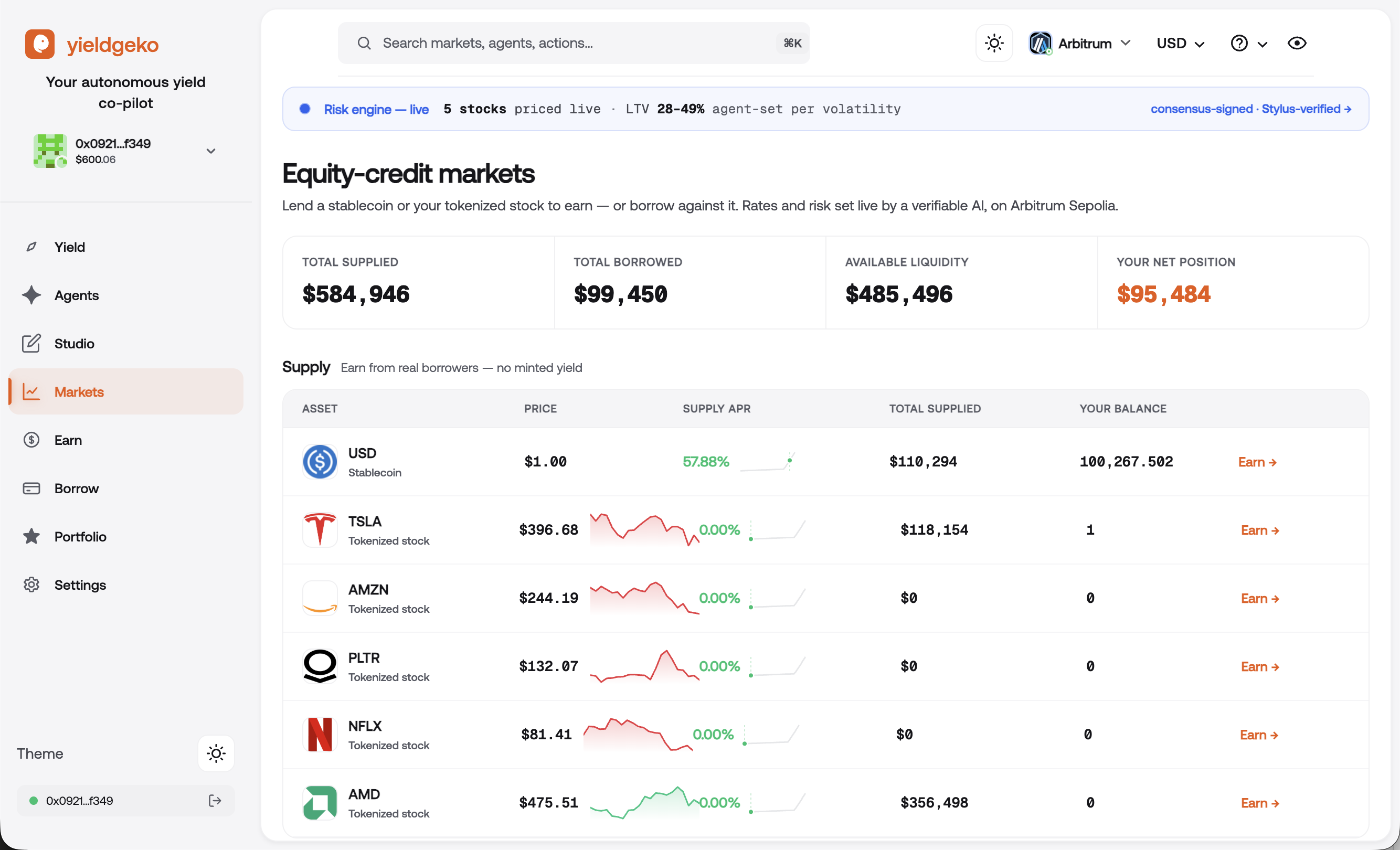
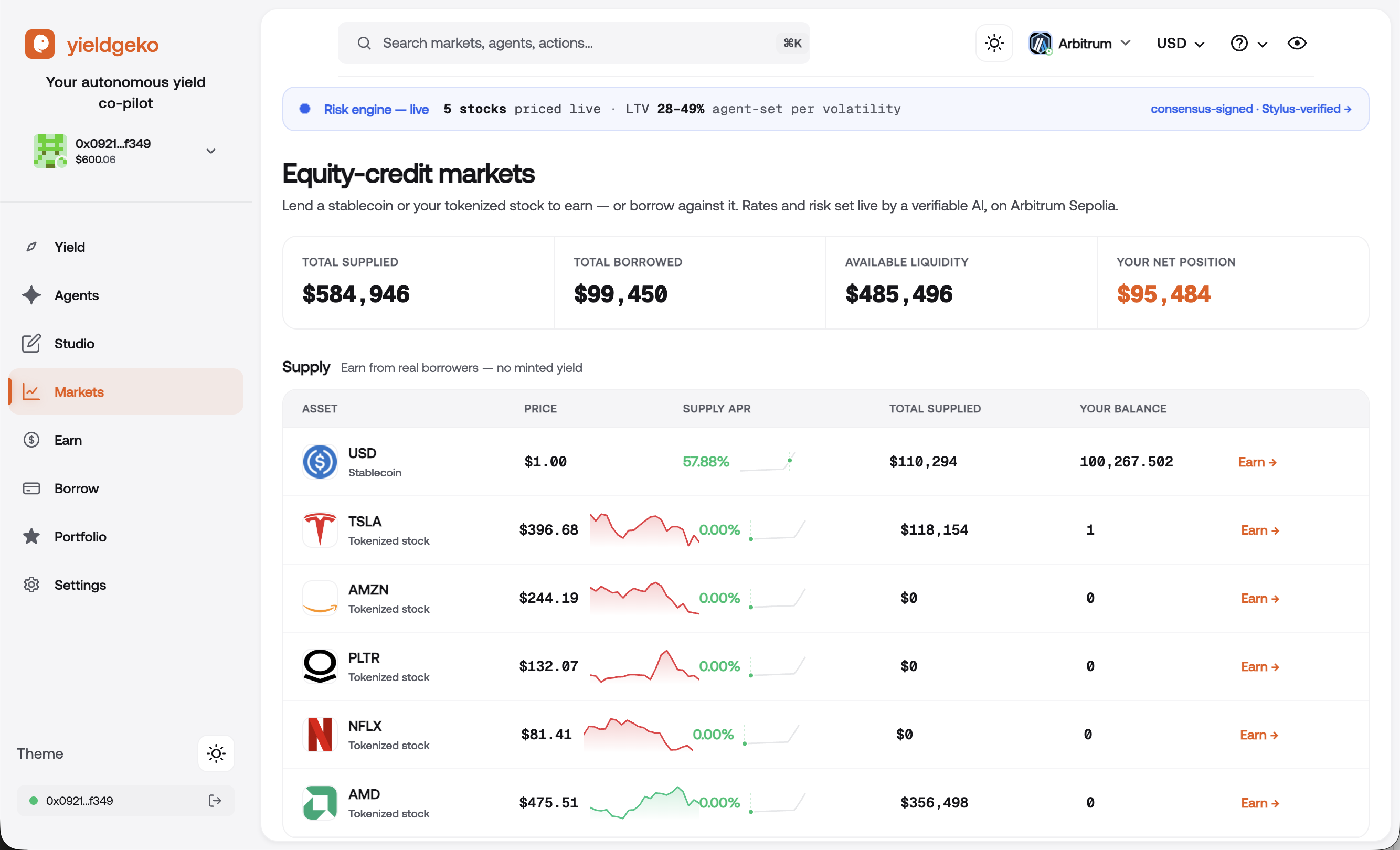
the equity-credit market, showing the markets table with per-asset price, agent-set LTV, supply/borrow APR, and the live price sparklines.
Agents are not hardcoded. Anyone authors a strategy in Studio (the venues it may use, its risk tier, its constraints) and publishes it to a public marketplace. Any other user clones it in one click, and that clone provisions the cloner's own dedicated smart account and signs the cloner's own scoped delegation. The strategy is shared; the capital and the custody are not. The author earns a marketplace fee on what their strategy manages, and the cloner keeps full custody and can exit at any time.
The agent itself runs without ever touching custody. When a user clones a strategy, YieldGeko provisions a dedicated smart account for that position (ERC-4337), unique to the (user, agent) pair. The user signs one ERC-7710 scoped delegation through the MetaMask Smart Accounts Kit, granting the agent authority to allocate and rebalance across a whitelisted set of venues, and nothing else. The agent can move funds between Aave, Morpho, Pendle, Fluid, and Silo; it can never move them to itself.
From there it works autonomously:
Scores each venue for risk and return from live on-chain data.
Weights the allocation capacity-aware, sizing into each market against its real liquidity, never chasing a headline APR into a pool that can't absorb the position.
Executes gaslessly: the user's smart account runs the batch under ERC-4337, sponsored, so the user signs once and never holds gas.
Rebalances as rates and risk shift, repeating the loop.
Every position is its own smart account, every action is consensus-signed and Stylus-verified (§7 and §8), and the agent's full history is written to an on-chain track record (ERC-8004), so a strategy's performance is auditable, not asserted.
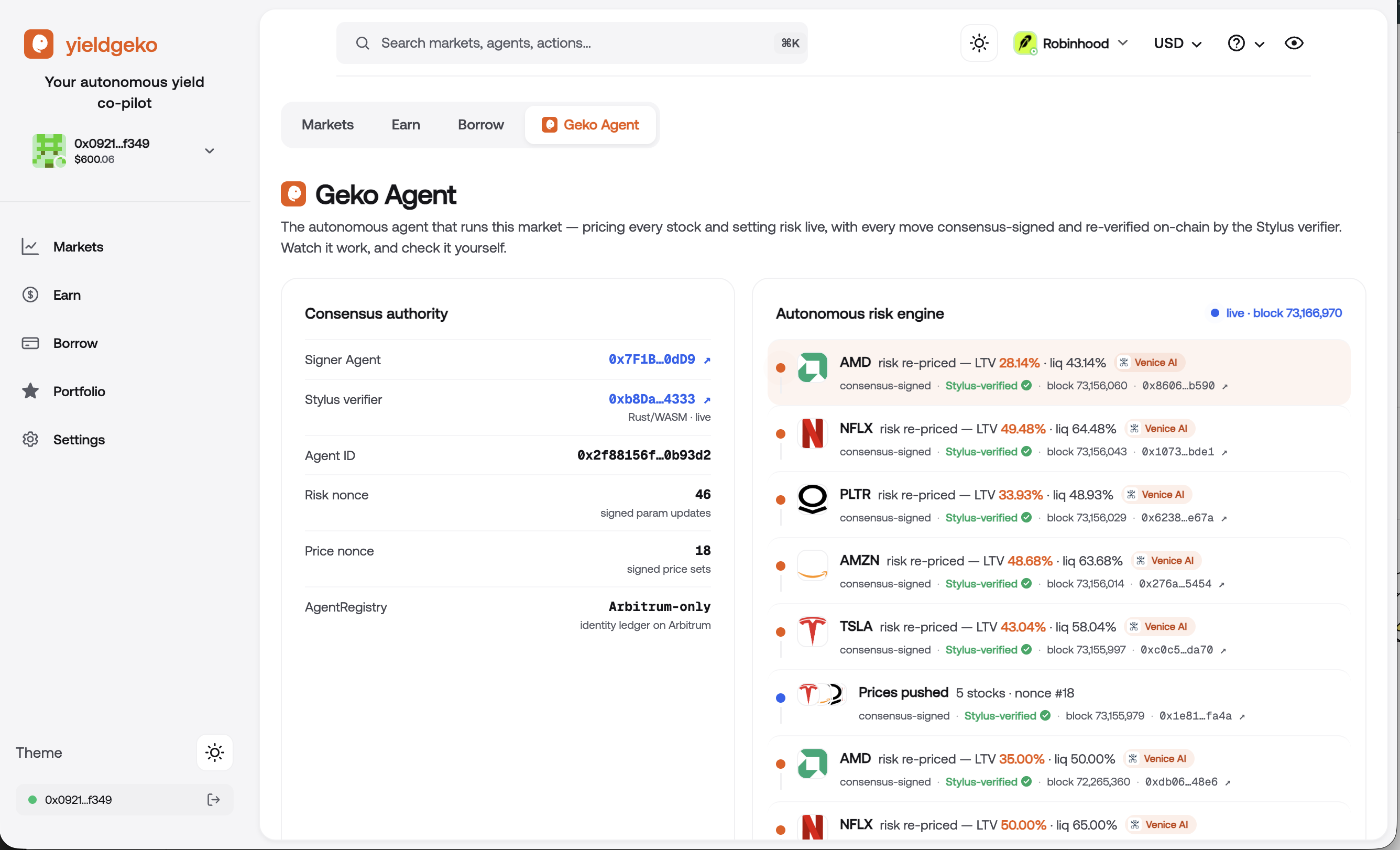
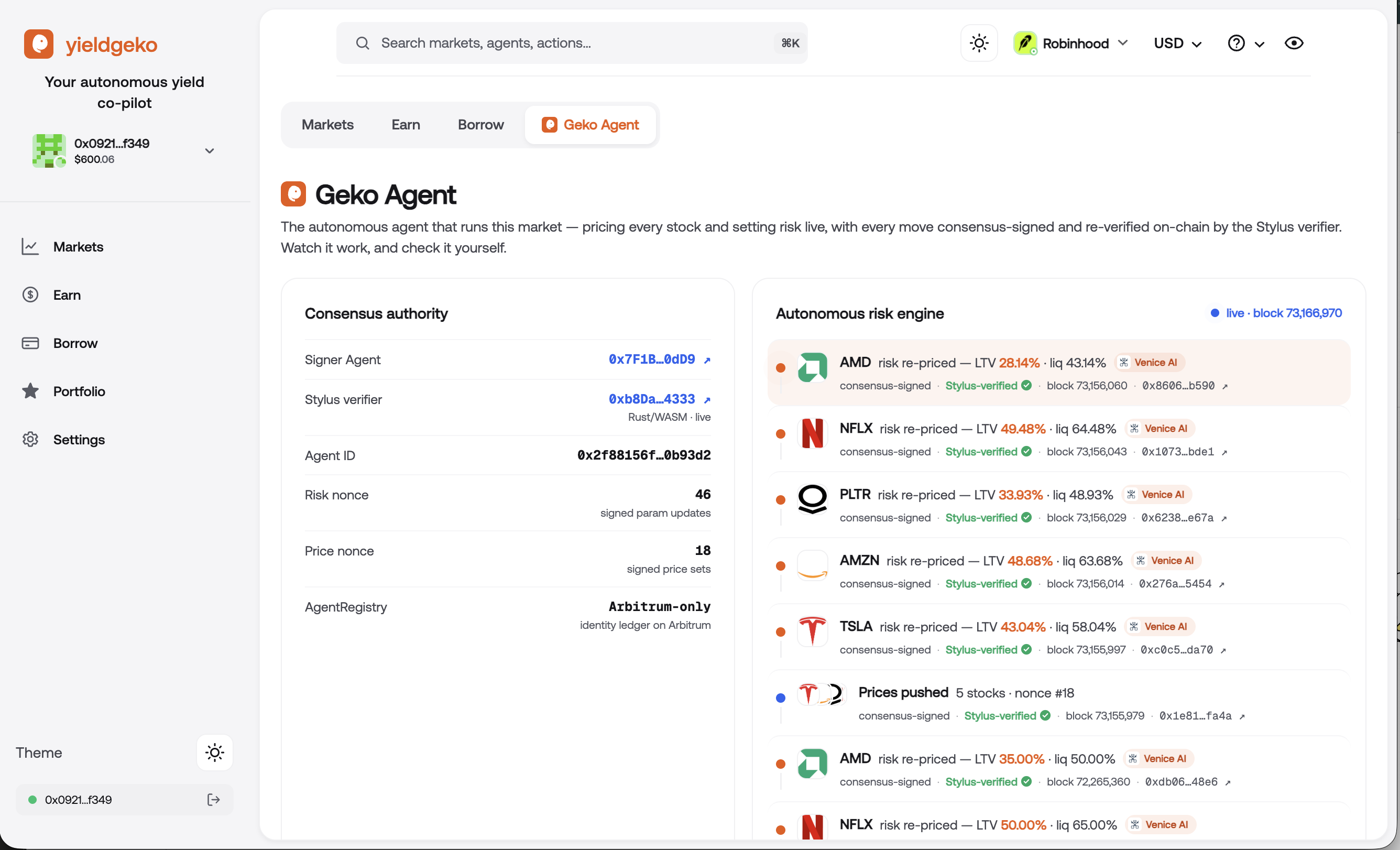
the live agent feed ("Geko Agent") showing per-cycle actions with venue/asset logos, the Venice risk chip, and the green Stylus-verified badge.
Equity collateral is only as safe as the LTV that backs it, and that LTV has to track the asset's risk in real time, including through the nights and weekends when the underlying market is closed and naïve equity lending breaks. YieldGeko runs that judgment through Venice.
Each cycle, Venice scores the risk of every listed asset from live signals (volatility, liquidity, momentum, the gap to the last oracle print). The score does not set the LTV directly. It is passed through a deterministic, hard-coded clamp: the on-chain LTV may only sit inside a fixed safety band (for example 20% to 55%), and Venice may move it by at most a bounded step (a few percentage points from the volatility baseline) per cycle. The AI advises within rails it can never break. A compromised or hallucinating model cannot widen a position past the band, because the band is enforced in the contract, not in the prompt.
Every risk decision is committed on-chain. Each cycle writes a judgmentHash (the hash of Venice's inputs and output) alongside the new LTV, so the reasoning behind each parameter is auditable after the fact rather than a black box.
The result is an equity-credit market whose risk parameters are AI-responsive but provably bounded: responsive enough to price real risk through market-closed gaps, hard-railed enough that the AI can never be the thing that breaks it.

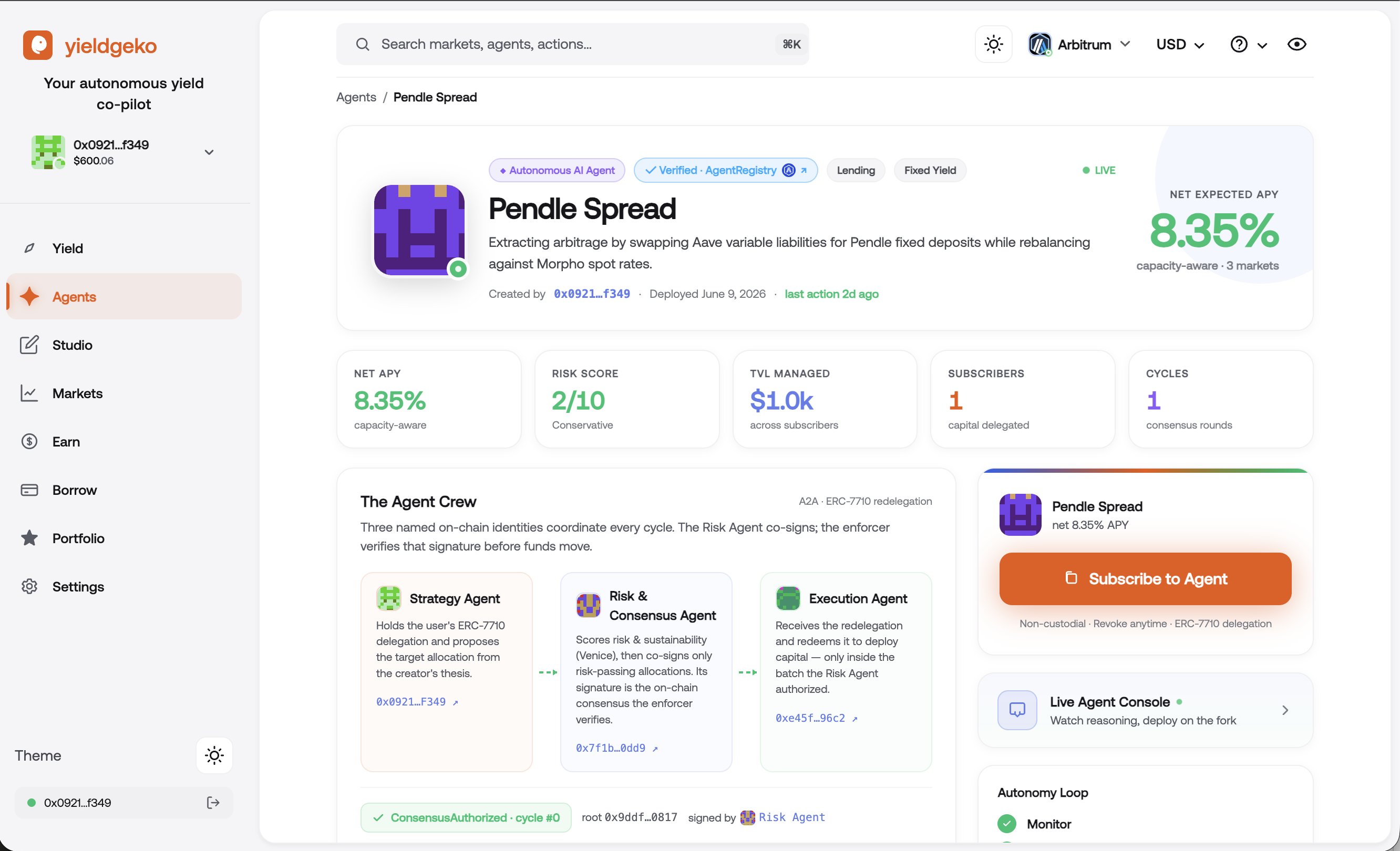
No single agent has authority. YieldGeko's autonomy is produced by a crew of agents that check one another, and the result is passed agent-to-agent on-chain before any funds move.
A cycle runs like this. One agent (the strategist) proposes an allocation. A crew of co-signing agents independently validates it and co-signs the result. The signed allocation is then redelegated agent-to-agent: the strategist holds the user's scoped ERC-7710 delegation and signs a child delegation to the executing agent, which redeems it through the MetaMask DelegationManager on-chain (redeemDelegations) to run the batch as the user's smart account. The executor is acting on authority that originated with the user, was bounded by the user's scope, and was co-signed by the crew, every hop provable on-chain.
This is what makes the autonomy robust rather than a single point of failure. A rogue strategist cannot execute without the crew's co-signature, and neither agent can act outside the scope the user delegated. The whole chain of authority, from user to strategist to executor, is enforced by the Stylus verifier.

the live consensus feed, showing co-signed actions and the agent-to-agent redemption on-chain.
One rule governs everything above, and it is enforced on-chain, not asserted off-chain:
The agent proposes an allocation, the crew co-signs it, an on-chain Stylus verifier re-checks the signatures and the scope, and only then can funds move. A tampered or replayed instruction reverts.
The verifier is implemented in Arbitrum Stylus (Rust/WASM), which makes on-chain verification of agent authority fast and cheap enough to run on every action. On each redemption it recovers the consensus signer, checks the co-signature against the agent's registered authority, and confirms the call is inside the user's delegated scope (the exact target contracts and function selectors the user signed). Anything else reverts.
This is the primitive every trust-me DeFAI product lacks: agent authority bounded and proven on-chain, not asserted off-chain. The same verifier is deployed and certified identical across three chains (Arbitrum One, Arbitrum Sepolia, Robinhood Chain) against a fixed test vector, so the guarantee holds wherever the protocol runs.

The market, in one balanced loop. A supplier deposits 50,000 USDC into the equity-credit market and earns around 5% APR, sourced entirely from borrower interest. A holder of 50 tokenized TSLA (about $20k) borrows 8,000 USDC at the agent-set LTV without selling, keeping the shares and the upside; the interest they pay funds the supplier. A third user supplies TSLA to the lending side and earns the borrow fee from traders who short or lever it. Three counterparties, one balanced book, every parameter Venice-priced and Stylus-verified. On Arbitrum, the same agent routes idle stablecoins across the five venues for the best risk-adjusted yield, rebalancing as rates move.
The user journey, end to end. In the product it is four steps:

The strongest claim YieldGeko makes is the one a user can check for themselves: the funds are never ours to lose.
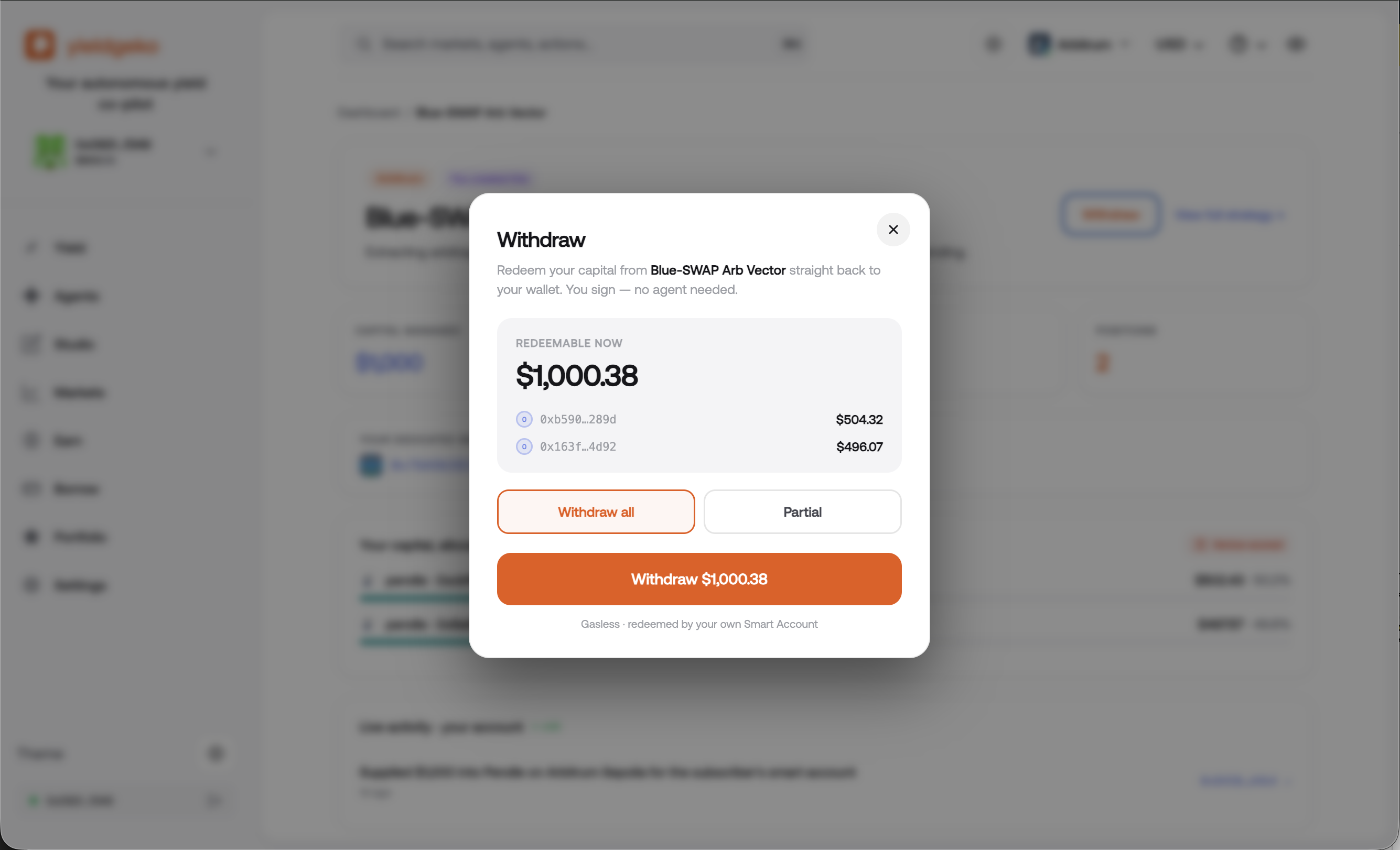
Every position lives in the user's own smart account. The agent holds only a scoped ERC-7710 delegation to allocate and rebalance; it has no authority to move funds to itself or anyone else. Because the user owns that account, they can exit unilaterally and at any time, without the agent, without the crew, and without YieldGeko being online at all. A single signed withdrawal redeems every position back to the user's wallet, deployed and idle balances alike, and it is gasless.
This is not a slide. The exit path is certified on-chain by a live supply-then-withdraw round-trip on Arbitrum Sepolia, asserting that capital deployed into a venue is redeemed back to the owner in full and the position goes to zero.

the withdraw flow, showing the live redeemable balance and one-click full or partial exit.
The protocol is real and independently auditable on public block explorers:
The Stylus consensus verifier is deployed and certified across three chains (Arbitrum One, Arbitrum Sepolia, Robinhood Chain), producing identical results against a fixed test vector.
The consensus enforcer and agent registry are live on Arbitrum One, with agents registered on-chain.
Non-custodial multi-venue execution runs on Arbitrum (Aave, Morpho, Pendle, Fluid, Silo) via scoped delegation.
Consensus-gated vaults and a native equity AMM run on Robinhood Chain, executing only signature-authorized actions; replays and forgeries revert.
The equity-credit lending market is live on Robinhood Chain and Arbitrum Sepolia: supply, borrow, and a 24/7 agent-set risk engine, each chain verified independently by its own Stylus verifier (no bridge, no cross-chain trust assumption).
The non-custodial withdrawal path is certified by a live supply-to-withdraw round-trip.
Every contract below is live on a real public chain and viewable on its block explorer. Shared identities across all chains: consensus signer 0x7F1B9e662e24425EF0140d1A25a54a4483180dD9, deployer / Agent A 0x092106703adE19BF7a638AD371f8f6c25831F349.
Arbitrum One (chainId 42161): the verifiable-autonomy core
Contract | Address |
|---|---|
StylusConsensusVerifier (Rust/WASM) | |
ConsensusScopedBatchEnforcer | |
AgentRegistry |
Arbitrum Sepolia (chainId 421614): autonomy, yield, and the equity-credit market
Contract | Address |
|---|---|
StylusConsensusVerifier | |
ConsensusScopedBatchEnforcer | |
AgentRegistry | |
CrossChainConsensusVault (yield leg) | |
LendingPool (equity-credit) | |
ConsensusPriceOracle | |
EquityAMM | |
InterestRateModel | |
Liquidator | |
ygTSLA (tokenized equity) |
Robinhood Chain (chainId 46630, Arbitrum Orbit L2): equities and the equity-credit market
Contract | Address |
|---|---|
StylusConsensusVerifier | |
EquityVault (consensus-gated) | |
CrossChainConsensusVault (equities leg) | |
LendingPool (equity-credit) | |
ConsensusPriceOracle | |
EquityAMM | |
Liquidator | |
ygUSD numeraire |
Native Robinhood Chain equity tokens (ERC-20)
Token | Address |
|---|---|
TSLA | |
AMZN | |
PLTR | |
NFLX | |
AMD | |
USDG (Global Dollar) |
Certified live transactions (selected)
Full autonomous loop on Arbitrum Sepolia (root delegation, agent-to-agent redelegation, DelegationManager redeem, Aave supply, all in one tx): 0xc15f7e8f6202426129297e59766e134a72325f61bb9f6e051378531dececc37f.
Cross-chain crew, one signature settling two chains atomically: Robinhood leg 0xb2d3e79f6ea7937d6325cc9c1cf67f93d9c9abadc45ae6931ebb56b3acd54a7e, Arbitrum Sepolia leg 0x90eb7ec9b9c0bae7baeb72b9dadc05127552fa4f35002ee89810cab7ebb605b4.
Equity-credit cycle (supply, borrow, repay, price crash, liquidate), Arbitrum Sepolia liquidation seizing exactly 23.142857 ygTSLA: 0x5277cb531d3bff581a818a4a1c04f0b7dac5a3f8dba044bf273e13933f94c204.
Why now.
Tokenized equities have product-market fit (over $1B market cap, hundreds of thousands of holders), and Robinhood Chain, an Arbitrum Orbit L2 purpose-built for tokenized RWAs, is bringing retail users on-chain at scale.
DeFAI is the dominant agent narrative, but it is bottlenecked on trust, exactly what verifiable, on-chain-enforced autonomy removes.
Arbitrum Stylus is live, making on-chain verification of agent logic economically viable for the first time.
Market.
DeFi yield optimization manages tens of billions in TVL; YieldGeko's Arbitrum agent competes on verifiability and capacity-aware allocation.
Tokenized-equity credit is a brand-new market, proven elsewhere (Kamino on Solana, Euler on Ethereum) and unoccupied on Arbitrum and Robinhood Chain.
The intersection, verifiable autonomous yield plus equity credit for tokenized assets, has no incumbent.
Competition.
Project | Scope | Gap |
|---|---|---|
Single-venue yield bots | one venue | miss the best risk-adjusted rate; off-chain trust |
Trust-me DeFAI vaults | custodial, opaque | no on-chain proof of agent authority |
Tokenized-equity lenders (Kamino, Euler) | borrow / lend | single-chain, not on Arbitrum or RH, no verifiable agent layer |
YieldGeko is the only protocol combining multi-venue yield optimization, a self-contained equity-credit market, and on-chain-enforced non-custodial agent autonomy, across Arbitrum and Robinhood Chain.
Where it runs.
Layer | Chain |
|---|---|
Yield optimization (Aave, Morpho, Pendle, Fluid, Silo) | Arbitrum |
Equity-credit market (tokenized equities) | Robinhood Chain and Arbitrum Sepolia |
Consensus verification (the Stylus verifier) | every chain: Arbitrum One, Arbitrum Sepolia, Robinhood Chain |
One protocol, one Stylus-verified agent, extensible to new assets and new chains. The cross
We built YieldGeko end to end during the hackathon: a non-custodial, verifiable yield-and-credit protocol for tokenized assets. We shipped an autonomous agent that allocates capital capacity-aware across five Arbitrum venues (Aave, Morpho, Pendle, Fluid, Silo), plus a self-contained equity-credit lending market for tokenized stocks on Robinhood Chain and Arbitrum Sepolia, where lender yield is paid entirely by borrower interest rather than subsidy. The autonomy is enforced, not asserted: a crew of agents co-signs every allocation, redelegates it agent-to-agent through the MetaMask Smart Accounts Kit (ERC-7710 + ERC-4337 gasless execution), and an Arbitrum Stylus (Rust/WASM) verifier re-checks every signature on-chain so a forged or replayed instruction reverts, while a Venice-AI risk brain prices each asset and sets its on-chain LTV inside a hard, deterministic safety band. We deployed and certified the full stack live across three chains with on-chain proof of the autonomous loop, the one-signature cross-chain crew, and a supply-borrow-liquidate cycle; added a strategy marketplace where anyone can publish a strategy and others clone it into their own non-custodial smart account; certified the unilateral withdrawal path; and put it all behind a live product at https://yieldgeko.xyz.
YieldGeko is currently bootstrapped and self-funded, and we were not actively raising during the hackathon, choosing instead to focus entirely on shipping a working, on-chain-verifiable product. With the full protocol now live and certified across three chains and a clear, unoccupied wedge (verifiable, non-custodial autonomous yield combined with equity credit for tokenized assets), we are open to conversations with aligned investors and ecosystem partners to take it from testnet to mainnet and expand the venue and asset coverage